
Environment Minister Appreciates Waste Management in Pekanbaru
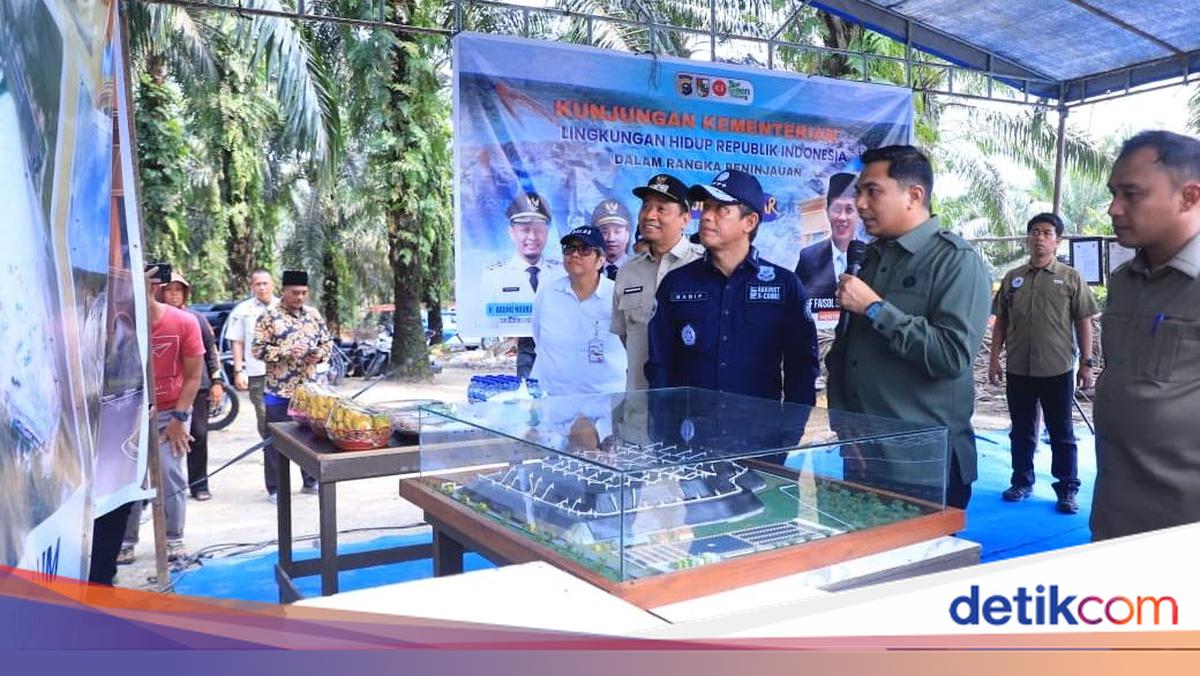
Environment Minister Hanif Faisol Nurofiq has assessed that changes in waste governance in Pekanbaru are beginning to show, despite the Muara Fajar landfill previously being known for high waste accumulation and risks.
According to Hanif, the practice of open dumping must be stopped immediately in accordance with Presidential Regulation Number 12 of 2025 on the National Medium-Term Development Plan. He appreciated the quick actions of the Pekanbaru City Government (Pemko) in carrying out initial arrangements at the site.
“I appreciate the quick steps taken by Pemko Pekanbaru in the initial arrangements. Changes are starting to be visible. We hope this process can be completed soon, including plans to open a new area for waste management,” he stated.
This was said during a working visit to Pekanbaru City on Saturday (25/4). One of Minister Hanif’s agendas was to visit the Muara Fajar II Final Disposal Site (TPA), Rumbai Barat Subdistrict.
In addition to the physical arrangement of the TPA, Pekanbaru is also beginning to move towards the use of modern technology. One of them is the development of methane capture or methane gas capture. This technology is considered to have great benefits, not only reducing harmful methane emissions—whose warming impact is dozens of times greater than carbon dioxide—but also potentially serving as an energy source.
Hanif emphasised that the central government fully supports these plans, with the condition that their implementation follows strict technical standards. “We are committed to facilitating the technical needs required by Pemko Pekanbaru,” he said.
On the other hand, the central government is also pushing for the acceleration of opening a new cell at the Muara Fajar TPA. This step is being taken while awaiting the preparation of environmental impact documents, which are currently in process, involving the Ministry of Public Works led by Dody Hanggodo.
Not only downstream, modernisation efforts in waste management are also being carried out upstream. Pemko Pekanbaru has built several waste stations as part of an integrated waste management system. Minister Hanif requested that the development of these facilities be accelerated to support national waste processing targets.
He also stressed the importance of the community’s role in sorting waste from the source. Referring to Law Number 18 of 2008, waste sorting is an individual and collective obligation. “Without sorting, resolving the waste problem will be difficult to achieve. This is the main foundation,” he asserted.
On that occasion, Hanif also revealed that the Waste Processing into Electricity project (PSEL) or Waste to Energy (WtE) for the Pekanbaru Raya area is currently being processed at the central level.
The documents have been submitted to the Minister of Investment and will be accelerated through cross-ministerial coordination.
As part of a major step, the Riau Provincial Government together with Pemko Pekanbaru and four regencies, namely Siak, Kampar, Pelalawan, and Bengkalis, have signed a Memorandum of Understanding (MoU) and Cooperation Agreement (PKS) for the PSEL in the Pekanbaru Raya agglomeration area on 7 April 2026 in Jakarta.
This facility is designed to process up to 2,000 tons of waste per day and is planned to be built in Kampar Regency. The project serves as a long-term solution to stop open dumping practices while converting waste into environmentally friendly alternative energy.
In the initial phase, this project will process 12 agglomeration locations first, before following up with Pekanbaru and its surroundings. However, he emphasised that the success of PSEL greatly depends on the quality of the waste processed, namely sorted waste.
“Quality waste is only in the form of sorted waste. I see that this potential has been built in Pekanbaru City,” he said.
He added that Pekanbaru has started separating organic and inorganic waste. Organic waste is directed for processing through methane capture, while high-economic-value inorganic waste is managed separately. The rest, which has low value, will be taken to the TPA.
Hanif added that the waste management innovations carried out by the Pekanbaru City Government under the leadership of Mayor Agung Nugroho are exemplary.
This includes waste management efforts realised through the establishment of Waste Stations. Several programmes are even integrated with the Green Policing programme initiated by the Riau Regional Police.
Through this programme, waste management not only focuses on environmental aspects but also law enforcement and control of negative impacts, such as odours and harmful gas emissions.
Meanwhile, Pekanbaru Mayor Agung Nugroho added that the Pekanbaru City Government has opened opportunities for cooperation with PLN for the utilisation of energy from waste.
If realised, this step will not only reduce environmental impacts but also potentially provide additional income for the region, particularly to support sustainable cleanliness and waste management programmes.
“Including support from the Green Policing programme initiated by the Riau Police Chief, it runs through cross-sectoral collaboration. Including synergy between TNI-Polri, the Prosecutor’s Office, the community, and the private sector as the key to success in driving changes in a more modern and integrated waste management system,” he added.