
Entrepreneurs Predict 2027 Minimum Wage Increase Will Not Exceed 3.5%, Here Is Why
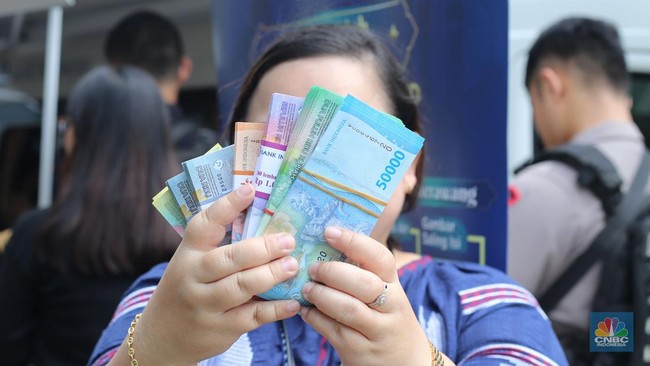
Business circles are responding to proposals from labour unions requesting a minimum wage increase of 7.5% to 9.5% for 2027. The business community maintains that the scale of wage increases should take worker productivity into account.
Bob Azam, Head of Labour Affairs at the Indonesian Employers Association (Apindo), stated that productivity is a crucial factor before the government determines minimum wage adjustments. “It must be assessed how many per cent productivity increases before setting the wage hike,” Bob told CNBC Indonesia on Friday (18/9/2026).
According to him, worker productivity in Indonesia is estimated to grow by only around 3% to 3.5%. Consequently, a minimum wage increase significantly higher than productivity growth is viewed as having the potential to exert pressure on inflation. “I believe our productivity rises by 3% to 3.5%. Therefore, it is impossible for the increase to be far from that figure, as it would impact inflation. It would be a pity for self-employed workers,” he said.
Bob also suggested that the focus of labour unions should not solely be directed at minimum wage increases, but rather towards improving worker purchasing power. “The focus of labour unions should be on purchasing power, not just the minimum wage increase,” he added.
When asked whether a 9.5% increase could be implemented, Bob emphasised that the figure needs to be reconsidered against productivity. “If productivity is 3.5% and wages rise by 9.5%, that means an additional 6% inflation. It is up to our country if we want that inflation,” he asserted.
Labour Proposes 7.5% to 9.5% Increase
Previously, the Confederation of Indonesian Trade Unions (KSPI) and the Labour Party proposed a minimum wage increase of 7.5% to 9.5% for 2027. This proposal applies to both Provincial Minimum Wages (UMP) and Regency/City Minimum Wages (UMK).
President of KSPI and the Labour Party, Said Iqbal, stated that the proposal was submitted early, as the 2027 UMP determination is scheduled for 1 November 2026, while UMK and sectoral minimum wages are due by 10 November 2026.
“KSPI and the Labour Party propose that the 2027 minimum wage, both UMP and UMK, falls within the range of 7.5% to 9.5%. We will fight for this figure within the Wage Council and through various constitutional channels,” said Said Iqbal.
Said explained that there are three main components used by KSPI and the Labour Party to calculate this proposal: the average annual national inflation rate, the average national economic growth rate, and a specific index. For the specific index, KSPI used a figure of 0.9, consistent with the range provided in Government Regulation Number 49 of 2026, which spans 0.5 to 0.9.
“In proposing the 2027 minimum wage and sectoral minimum wage, KSPI uses the average national inflation, average national economic growth, and a specific index of 0.9. The government regulation provides a range of 0.5 to 0.9, so using 0.9 is well-founded,” Said Iqbal asserted.
The data used covers the period from October 2025 to September 2026. However, as September 2026 data has not yet been released by the Central Bureau of Statistics (BPS), the preliminary calculation uses data up to August 2026.
Based on official BPS data gathered by KSPI for the period of October 2025 to August 2026, the average national inflation rate stood at 3.20%, while the average national economic growth reached 5.43%.
“Even when the September data is released, we expect the figures will not differ significantly. Therefore, for now, we are using an average national inflation of 3.20% and national economic growth of 5.43%,” he said.
By incorporating the 0.9 specific index into the calculation method, KSPI arrived at an average national increase of approximately 7.7%. This figure serves as the basis for the proposed lower limit of 7.5%.
Said noted that economic conditions vary by province and regency. Therefore, KSPI is not proposing a single figure for all regions, but rather a range of 7.5% to 9.5%. He cited the difference in economic conditions between West Java and North Maluku, as well as Bekasi Regency versus Gresik Regency.
Labour Highlights Purchasing Power
In addition to nominal wage increases, Said also highlighted the pressure of basic commodity prices on worker purchasing power. He argued that a wage increase would be meaningless if the price of daily necessities rises even faster. Consequently, labour groups will also urge the government to control the prices of essential goods.
“It is futile for nominal wages to rise if the amount of goods that can be purchased actually decreases. For example, previously 1 million Rupiah could buy five items. After the wage rises to 1.5 million Rupiah, it can only buy three items because prices have surged. Nominally, the wage has increased, but purchasing power and real wages have actually declined,” explained Said Iqbal.
He emphasised that workers require an increase in real wages, not just nominal figures. “Labour will certainly fight for the control of basic commodity prices. What workers need is an increase in real wages, not just a nominal increase that is subsequently eroded by inflation,” concluded Said Iqbal.