
Ensuring Halal Standards from Poultry Farm to Table
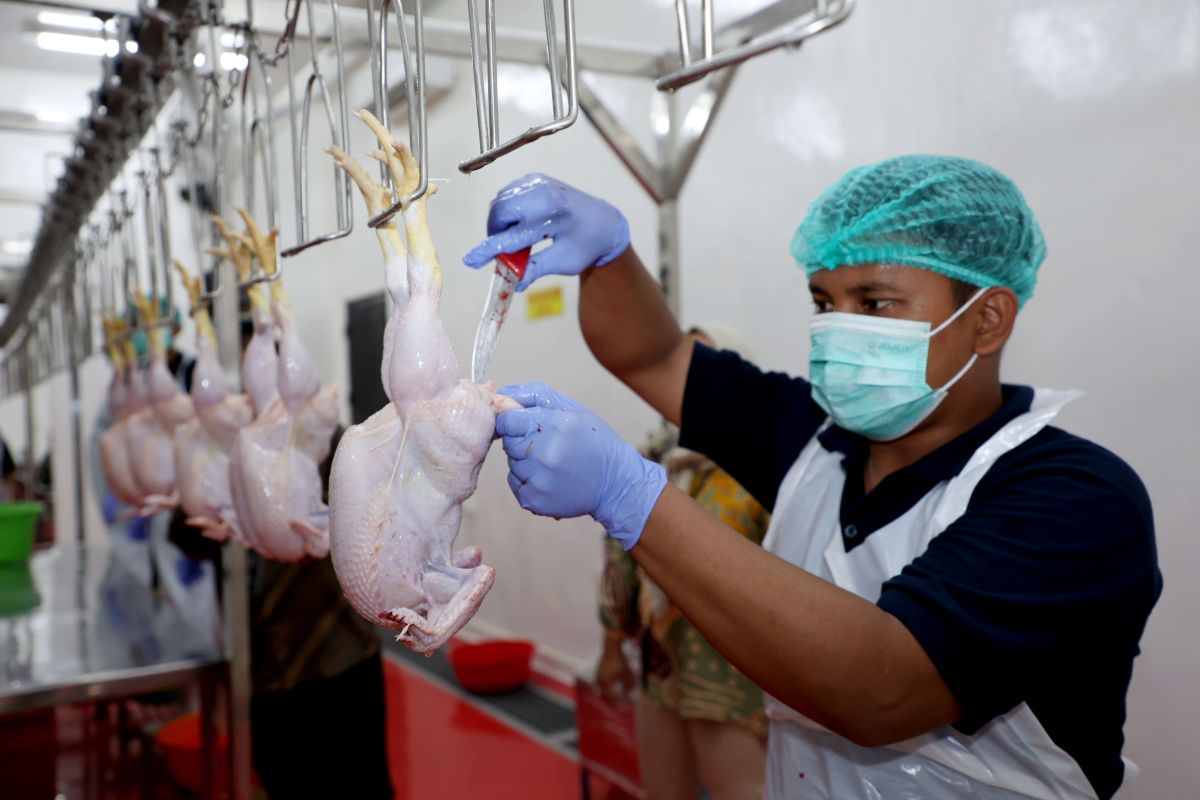
Surabaya (ANTARA) – The piece of chicken served at the dinner table has undergone a long journey that consumers rarely consider. Before it is prepared as a family meal, poultry must pass through slaughter, bleeding, defeathering, inspection and meat handling.
Every stage affects not only food quality, but also consumer health, animal welfare, environmental sustainability and confidence in its halal status.
In Surabaya, East Java, these issues have come to the fore as the city reorganises poultry slaughter facilities in traditional markets and takes action against slaughter operations in residential areas.
The suspension of poultry-slaughtering activity in Bratang Gede, Wonokromo district, on 23 October 2026, for example, shows that slaughter practices concern more than just businesses and their customers.
Noise, odours, cleanliness and compliance with licensing requirements also affect the quality of life of nearby residents.
Behind these issues lies a more fundamental task than simply relocating businesses: building awareness that poultry slaughter must comply with the principles of Aman, Sehat, Utuh dan Halal (ASUH), meaning safe, healthy, wholesome and halal.
Education must go hand in hand with adequate facilities, consistent oversight and protection for the sustainability of community businesses.
Critical points
The scale of daily demand presents a significant challenge. Fajar A Isnugroho, president director of state-owned PT Rumah Potong Hewan Surabaya, estimates that Surabaya needs slaughter capacity for about 20,000 birds a day. Lakarsantri Poultry Slaughterhouse (RPHU), meanwhile, has capacity for up to 5,000 birds a day – around a quarter of the estimated requirement.
That figure should be treated with care, since the capacity of one facility does not represent all poultry slaughter in the city. The government needs to update its data on poultry demand, slaughter volumes and the number of businesses that meet the requirements.
Even so, the gap points to the need to expand services so that ASUH principles can be applied more widely.
Another critical point is the slaughtering process. Under the ASUH principles, “safe” means food is protected from health hazards; “healthy” concerns the condition and hygiene of the meat; “wholesome” means the product has not been mixed with or substituted by other products; and “halal” relates to the type of animal and the method of slaughter. The four elements complement one another.
Guidance from the Indonesian Ulema Council (MUI) states that poultry must be alive when slaughtered and must die as a result of the slaughtering process. The blood should be allowed to drain for at least three minutes before the next stage. The birds must also be confirmed dead before being immersed in hot water for defeathering.
Immersing poultry in hot water before confirming that it has died is therefore a serious concern. If a bird dies for reasons other than slaughter in accordance with the requirements, the product does not meet halal criteria and may be considered carrion.
Any assessment should be based on inspection of the process, rather than an assumption that all traditional slaughtering is problematic.
Indonesian National Standard (SNI) 99002:2016 on halal poultry slaughter remains in force. The Halal Product Assurance Agency (BPJPH) has issued Decree No. 160 of 2026 on the halal product assurance system for the slaughter of ruminants and poultry. Halal assurance must be built into working practices, rather than treated as merely a seller’s claim.
Shared space
The reorganisation of poultry slaughter brings together food needs, economic interests and residents’ right to a comfortable environment.
In Bratang Gede, nighttime activity that generated noise and odours added to residents’ burden. A municipal inspection found that the business’s trading permit had expired and that its owner did not have a poultry-slaughtering permit.
Enforcement is necessary, but sealing a premises will not resolve the issue if slaughter demand remains and no affordable alternative is available. PT Rumah Potong Hewan Surabaya Perseroda’s offer to let the Bratang business use the Lakarsantri facility should be developed further, enabling the business to continue at a site that meets the requirements.
The reorganisation is based on Law No. 18 of 2009 on Animal Husbandry and Animal Health, as amended by Law No. 41 of 2014, and Surabaya Regional Regulation No. 5 of 2006. Slaughterhouse rules cover veterinary public health, hygiene, sanitation and animal welfare.
The Surabaya municipal government is preparing poultry slaughterhouses at Baba’an Baru Market and Wonokromo Market, each designed to handle up to 5,000 birds a day. As of 19 October 2026, both were still undergoing repairs and would begin operating only after facilities, technical requirements and traders’ readiness had been addressed.
The facilities could expand access to hygienic services, but designed capacity does not mean the service is already available. The municipality needs to confirm operating schedules, the volumes that can be handled and access for traders without additional costs that would erode their profits.
During the transition, information on schedules, fees and procedures for using the facilities should be communicated in advance so traders can adjust their businesses without losing income certainty.
The reorganisation must strike a balance. Consumers are entitled to safe and halal food, residents to a healthy environment, and traders and workers to business certainty and an opportunity to adapt.
Neglecting any one of these interests risks creating new problems. Regular dialogue among the municipal government, slaughterhouse operators, traders and residents is also needed to resolve operational difficulties before they escalate into conflict.