
Energy Subsidy Budget for 2027 Rises, Prabowo Allocates Rp28.7 Trillion for Fuel
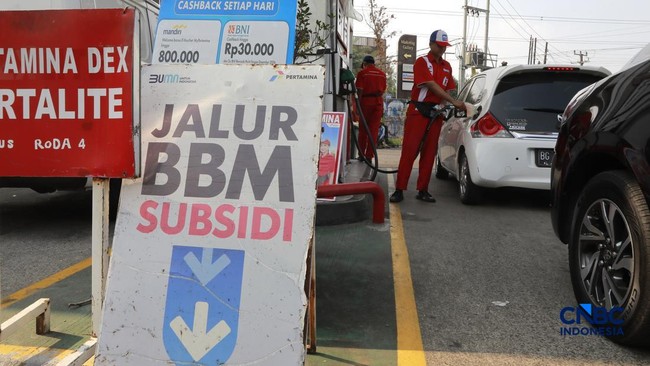
The government of President Prabowo Subianto is preparing a higher subsidy budget for certain types of fuel (BBM) in the 2027 State Budget Draft (RAPBN) compared with the estimated realisation in the 2026 State Budget (APBN).
In the Financial Note and RAPBN for the 2027 fiscal year, the subsidy budget for certain types of fuel, such as Pertalite and diesel, amounts to Rp28.7 trillion, an increase of approximately 8.71% compared with the 2026 outlook of Rp26.4 trillion.
“In addition, to improve the efficiency of subsidy spending, the distribution of subsidised fuel will be carried out with consumer registration,” as quoted from the Financial Note and RAPBN 2027 document, Sunday (15/8/2026).
The increase in the fuel subsidy budget is in line with the rise in total energy subsidies. This includes the subsidy budget for 3-kilogram LPG cylinders and electricity subsidies.
The draft energy subsidy budget for 2027 reaches Rp272.94 trillion, an increase of 20.1% compared with the 2026 outlook of Rp227.25 trillion.
The subsidy budget for 3 kg LPG also rises to Rp114.1 trillion from the 2026 outlook of Rp90.4 trillion, while the electricity subsidy increases to Rp130.1 trillion from the estimated 2026 realisation of Rp110.4 trillion.
The calculation of the subsidy budget for certain types of fuel and 3 kg LPG cylinders in the 2027 RAPBN uses the following assumptions and parameters:
the rupiah exchange rate against the US dollar and the Indonesian Crude Price (ICP);
a fixed diesel subsidy of Rp1,000 per litre;
a volume of 19,558.5 thousand kilolitres for subsidised diesel and 539.0 thousand kilolitres for kerosene; and
a volume of 8,945.0 million kg for 3 kg LPG cylinders.
Meanwhile, the increase in the electricity subsidy allocation is mainly influenced by the rise in the basic cost of electricity supply (BPP) and the increase in the volume of subsidised electricity. The increase in BPP is caused, among other things, by:
changes in the rupiah exchange rate against the US dollar;
changes in the Indonesian Crude Price (ICP) due to global geopolitical conflicts; and
increased production at gas-fired power plants.