
Energy Subsidies Still Commodity-Based, Here's the Danger for Indonesia
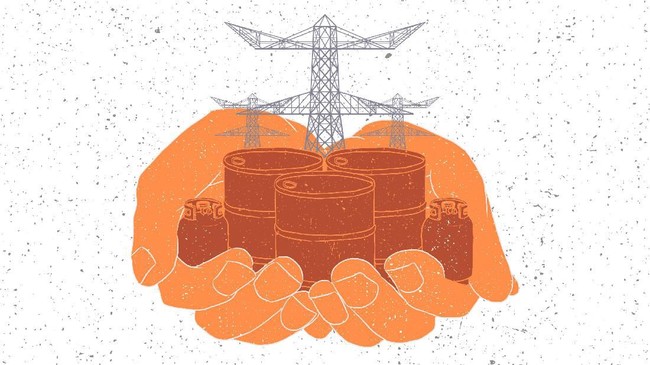
The energy subsidy and compensation scheme in Indonesia is still based on commodities, not on the communities receiving the benefits. This condition makes the government’s fiscal burden vulnerable to swelling when energy commodity prices rise.
Principal of Energy Shift Institute Ahmad Zuhdi Dwi Kusuma assesses that the current subsidy and compensation system is still attached to energy commodities, so price fluctuations can directly impact the state budget.
“The problem is, we see that the subsidy and compensation system in Indonesia is attached not to people, not to the community, but to commodities,” he said in the Energy Corner programme on CNBC Indonesia, quoted on Friday (28/8/2026).
Therefore, according to him, when there is an increase or fluctuation in energy commodity prices, the fiscal space that had previously been set through the State Revenue and Expenditure Budget (APBN) becomes more vulnerable to changes.
As a result, the subsidy budget that the government has prepared potentially no longer suffices to hold back price increases. The government must then rely on a compensation scheme to cover the difference.
“And when people who are not entitled to receive these subsidies get them, then the question arises as to where justice lies and so on,” he said.
As is known, the administration of President Prabowo Subianto has prepared a budget for subsidies for certain types of fuel oil (BBM) in the 2027 Draft State Budget (RAPBN) that is higher than the estimated realisation in the 2026 APBN.
In the Financial Note document along with the 2027 RAPBN, the value of the subsidy budget for certain types of fuel, such as Pertalite and diesel, is Rp28.7 trillion, up around 8.71% compared to the 2026 outlook of Rp26.4 trillion.
“In addition, to improve the efficiency of subsidy spending, the distribution of subsidised fuel is carried out with consumer registration,” as quoted from the Financial Note document along with the 2027 RAPBN, Sunday (15/8/2026).
The increase in the fuel subsidy budget goes hand in hand with the rise in total energy subsidies. This includes the subsidy budget for 3-kilogram LPG cylinders and electricity subsidies.
The draft energy subsidy budget for 2027 itself reaches Rp272.94 trillion, an increase of 20.1% compared to the 2026 outlook of Rp227.25 trillion.
The subsidy budget for 3 kg LPG also rises to Rp114.1 trillion from the 2026 outlook of Rp90.4 trillion, and electricity subsidies rise to Rp130.1 trillion, from the estimated 2026 realisation of Rp110.4 trillion.
The calculation of the budget for certain types of fuel subsidies and 3 kg LPG cylinders in the 2027 RAPBN uses assumptions and parameters, including:
the rupiah exchange rate against the US dollar and the Indonesian Crude Price (ICP);
a fixed diesel subsidy of Rp1,000 per litre;
a volume of certain types of diesel fuel of 19,558.5 thousand kilolitres and kerosene of 539.0 thousand kilolitres; and
a volume of 3 kg LPG cylinders of 8,945.0 million kg.
Meanwhile, the increase in the electricity subsidy allocation is mainly influenced by the increase in the basic cost of electricity supply (BPP) and the increase in the volume of subsidised electricity. The rise in BPP is caused, among other things, by:
changes in the rupiah exchange rate against the US dollar;
changes in crude oil prices (ICP) due to global geopolitical conflicts; and
increased production at gas-fired power plants.