
Energy Security Requires Strengthening of Upstream Oil and Gas Industry
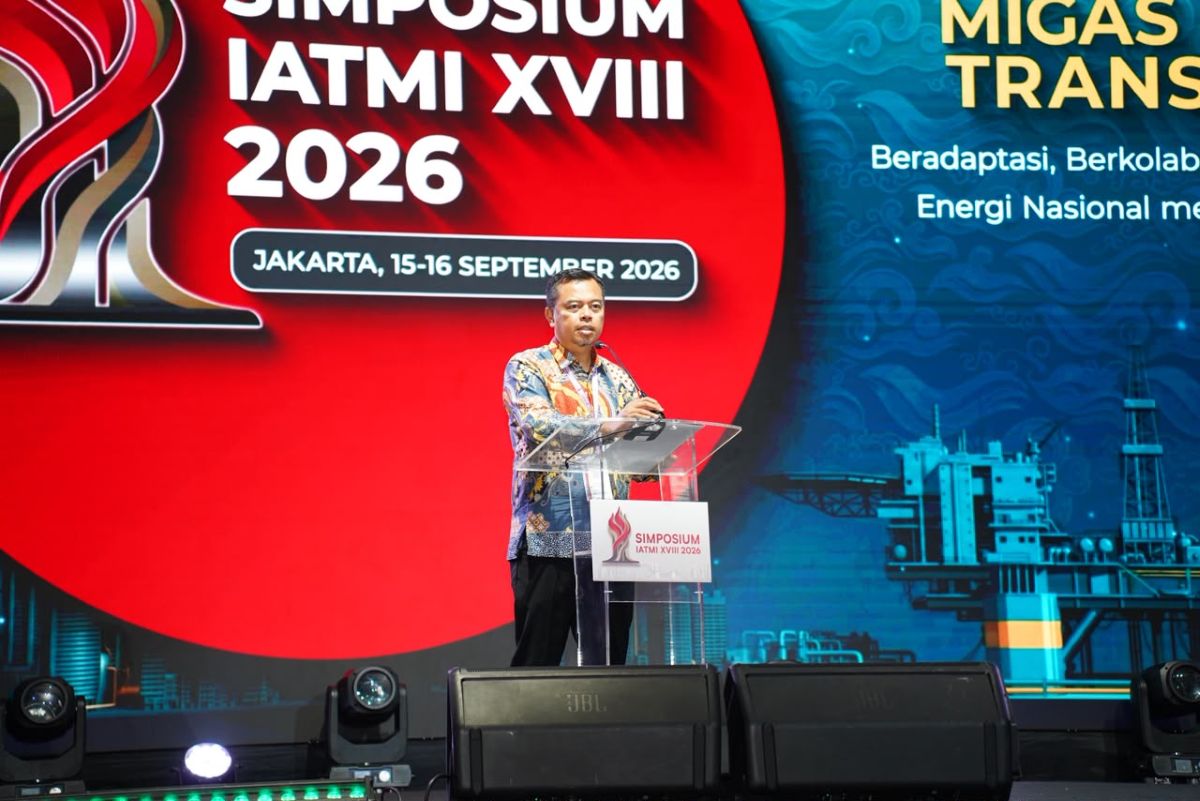
Efforts to strengthen national energy security and sovereignty require an upstream oil and gas industry capable of maintaining and increasing production. The challenge lies not only in discovering resources but also in ensuring that this potential can be converted into reserves, projects, investments, and finally, production.
Andre Wijanarko, Chairman of the Indonesian Petroleum Engineering Association (IATMI), stated that strengthening the upstream oil and gas ecosystem is a vital part of addressing national energy needs. According to him, closing the production gap requires policy certainty, investment competitiveness, and strong execution capabilities.
“We must not only talk about finding reserves. We must talk about how resources become reserves, reserves become projects, projects become investments, and investments become production,” Andre said during his address at the IATMI XVIII 2026 Symposium.
Andre noted that every stage faces challenges that need resolution, ranging from regulation, project economics, technology, and infrastructure to decision-making processes. Therefore, he believes the upstream oil and gas industry ecosystem must provide three main pillars: certainty, competitiveness, and execution.
“Certainty, so that investors have clarity and confidence in policy direction, regulation, and project economics. Competitiveness, so that Indonesian oil and gas projects can compete in attracting capital, technology, and the best talent. And equally important is execution,” he said.
Andre added that strengthening the upstream industry is also linked to the government’s agenda to build national energy security and self-sufficiency. This spirit, he noted, aligns with ‘Asta Cita’, particularly in strengthening national resilience and driving economic independence.
In the context of upstream oil and gas, this agenda needs to be translated through increased exploration, accelerated field development, the creation of a competitive investment climate, the utilisation of technology, and the strengthening of human resources.
“That spirit must be realised through our ability to optimise national resources, strengthen domestic production, and build an energy ecosystem capable of supporting national development needs,” he stated.
According to Andre, expanding exploration opportunities is a crucial step in creating new sources of production growth. Consequently, the addition and offering of new oil and gas Working Areas (WK) are relevant efforts to close the national production gap.
He assessed that new Working Areas do not merely mean an increase in acreage. Opening these opportunities can serve as an entry point for new investment, exploration activities, technology utilisation, job creation, the strengthening of supporting industries, and the addition of national oil and gas production sources.
“However, opening new opportunities is only the beginning. The next challenge is how that potential can be converted into reserves, developed into projects, and ultimately result in actual production,” said Andre.
Therefore, he emphasised the importance of collaboration between the government, industry, investors, academia, and professional associations to ensure that investment and exploration opportunities are translated into production activities.
In this regard, Andre stated that IATMI plays a role in bringing together the experience, competence, technological innovation, and ideas of professionals with industry needs and national interests.
“As a professional association, IATMI has the responsibility to bridge the experience, competence, technological innovation, and ideas of professionals with industry needs and national interests,” he said.
Andre expressed hope that the IATMI XVIII 2026 Symposium would not stop at the exchange of ideas but could drive concrete steps to strengthen the national oil and gas industry.
The symposium adopted the theme ‘Indonesian Oil and Gas in the Era of Energy Transformation: Adapting, Collaborating, and Leading’, with a sub-theme of ‘Building National Energy Security through Technology, Human Resources, and National Capability’. The theme brings together perspectives from the government, business entities, investors, and industry stakeholders to discuss various production and upstream investment challenges. Discussions covered not only production targets but also financial solutions, major discoveries, digital transformation, business judgment, legal certainty, and the sustainability of the energy industry.
The series of symposiums also included special sessions, technical sessions, a Student Paper Competition, and the IATMI Talent Development Program. More than 100 technical papers and 36 e-posters were presented during the forum.
Andre stated that the involvement of the younger generation is a vital part of strengthening the oil and gas industry. He noted that energy security is determined not only by current policies and investments but also by the readiness of the human resources who will lead the national energy industry in the future.
“We are also preparing those who will carry this forward in the future,” he said.
Currently, IATMI has 18,921 members, consisting of 11,659 professionals, 642 academics, and 6,620 students. This composition, according to Andre, demonstrates the importance of the association’s role in uniting industrial experience, academic knowledge, and the energy of the younger generation.
He hopes that the IATMI XVIII 2026 Symposium can bridge the gap between ideas and decisions, decisions and investment, and investment and production.
“Hopefully, from this forum, real steps will emerge to strengthen the oil and gas industry, close the production gap, and realise an Indonesian energy security and self-sufficiency that is resilient, competitive, independent, and sustainable,” concluded Andre.
Source: jawawa.id (https://jawawa.id/newsitem/energy-security-requires-strengthening-of-upstream-oil-and-gas-industry-1789559632)
Originally published by Media Indonesia (https://mediaindonesia.com/ekonomi/934097/ketahanan-energi-butuh-penguatan-industri-hulu-migas), translated from Indonesian