
Energy Ministry Launches Hydrogen-Diesel Bus and Jakarta-Patimban Green Corridor
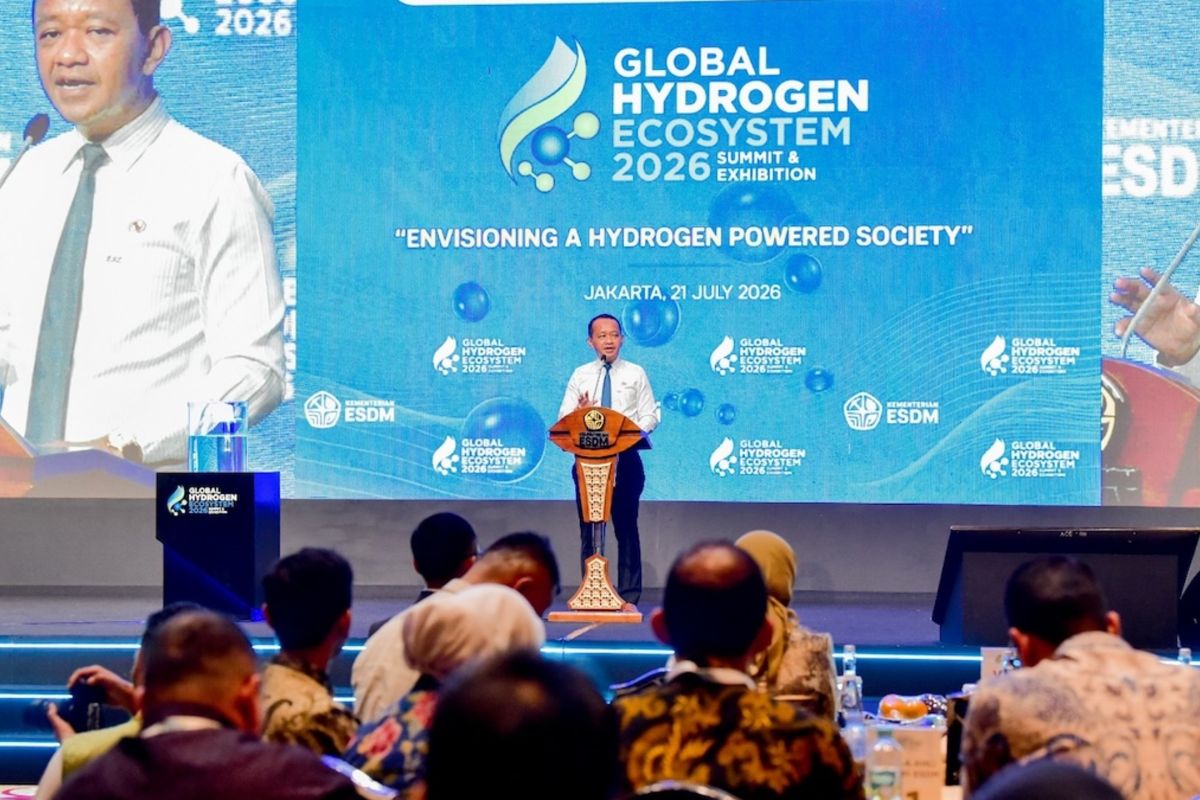
Jakarta (ANTARA) - The Ministry of Energy and Mineral Resources (MEMR) has launched a Hydrogen Diesel Dual Fuel (H2 DDF) bus as a pilot project, alongside the development of a Green Hydrogen Corridor spanning 194 kilometres between Jakarta, Karawang and Patimban, unveiled in Jakarta on Tuesday.
Energy and Mineral Resources Minister Bahlil Lahadalia said the two initiatives, introduced at the Global Hydrogen Ecosystem Summit (GHES) 2026, form part of efforts to develop the hydrogen ecosystem in order to strengthen the energy transition, energy independence and self-sufficiency, downstream processing, and national industrialisation.
“Hydrogen development is in line with the directives of President Prabowo Subianto’s Asta Cita. Hydrogen is a very important alternative energy source amid uncertain global geopolitical conditions, such as the conflict in the Middle East, which has created uncertainty,” Bahlil said in an official statement received in Jakarta on Tuesday.
GHES 2026 is being held from 21 to 23 July 2026 at the Jakarta International Convention Center (JICC), bringing together government, state enterprises, industry, academics, investors, research institutions and international partners to accelerate the development of a national hydrogen ecosystem.
According to Bahlil, geopolitical uncertainty requires every country to protect its national energy needs by leveraging its respective comparative advantages.
An integrated hydrogen ecosystem, from upstream to downstream, is also seen as capable of producing clean energy, creating added value domestically, boosting the competitiveness of national industry, attracting investment, and opening up new sustainable jobs and economic growth.
However, he acknowledged that the cost of hydrogen-based energy is still not competitive compared with other energy sources, including B50 fuel.
“The still-high cost of hydrogen-based energy is a challenge for all of us in terms of obtaining more efficient technology to make it more competitive,” Bahlil said.
He believes hydrogen prices will become more competitive than oil-based fuels as conflicts and geopolitical uncertainty continue, and as oil becomes increasingly difficult to obtain from new blocks.
Director General of New, Renewable Energy and Energy Conservation at the MEMR, Eniya Listiani Dewi, said hydrogen development is directed at supporting decarbonisation of the industrial, transport and power sectors while reducing dependence on fossil fuels.
“We currently have 93 hydrogen ecosystem development initiatives, with projects spread across Indonesia generating investment worth Rp32 trillion,” Eniya said.
The government is also developing hydrogen projects through the dedieselisation programme in Sumba, targeted to reach commercial operation date (COD) in 2028, and on Rote Island in cooperation with PT PLN (Persero).
The programme is projected to reduce the cost of electricity production from one US dollar, or around Rp17,909, to 25 US cents, or around Rp4,477, per kilowatt-hour.
The H2 DDF bus is a diesel-engined bus owned by state operator Perum DAMRI that has been modified to run on a combination of diesel fuel and hydrogen gas.
The pilot project was developed through cooperation between the MEMR, PT PLN (Persero) and Perum DAMRI.
Its implementation is supported by PT Sucofindo (Persero) as the independent testing, inspection and certification body, and PT Tritunggal Prakarsa Global as the executor of the bus pilot project.
President Director of PT Sucofindo (Persero), Sandry Pasambuna, said the company’s task is to ensure that the application of H2 DDF technology on the DAMRI bus meets safety, reliability and technical conformity requirements.
“As a Testing, Inspection, Certification and Consultation (TICC) company, Sucofindo acts as an independent party ensuring that the implementation of H2 DDF technology on the DAMRI bus meets safety, reliability and technical conformity requirements,” Sandry said.
According to Sandry, verification and assurance processes are needed so that hydrogen technology can be applied safely, measurably and in accordance with applicable standards.
The H2 DDF bus is equipped with 16 hydrogen storage cylinders, each with a capacity of 50 litres, a nominal pressure of 200 bar and a working pressure of 150 bar.
The hydrogen system has been installed on a Hino bus with a six-cylinder diesel engine with a capacity of 7,684 cubic centimetres.
Based on Sucofindo’s testing, the H2 DDF system reduces opacity emissions by 57.66 per cent, carbon monoxide by 45.45 per cent, carbon dioxide by 39.37 per cent, and nitrogen oxides by 21.16 per cent.
The pilot bus was developed to reduce the use of diesel fuel, replace part of the fossil fuel with hydrogen, and curb exhaust emissions without having to immediately replace the entire existing operational fleet.
Source: jawawa.id (https://jawawa.id/newsitem/energy-ministry-launches-hydrogen-diesel-bus-and-jakarta-patimban-green-corridor-1784638492)
Originally published by Antara (Indonesian) (https://www.antaranews.com/berita/5659127/kesdm-luncurkan-bus-hidrogen-diesel-dan-koridor-hijau-jakarta-patimban), translated from Indonesian