
Energy Ministry Drafts National Standard for Oil and Gas Drilling Equipment to Curb Imports
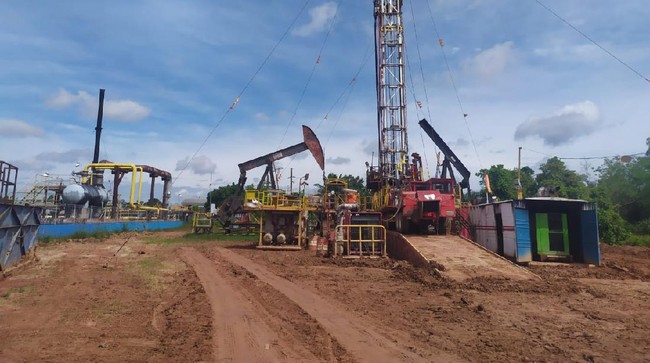
The Ministry of Energy and Mineral Resources (ESDM) is drafting a new Indonesian National Standard (SNI) for drilling and production equipment (rigs) in the upstream oil and gas sector. One of the aims is to reduce import dependence for oil and gas well drilling facilities.
Bambang Eka Satria, Coordinator for Oil and Gas Standardisation at the Directorate General of Oil and Gas at the ESDM Ministry, personally led the Consensus Meeting on the Draft Indonesian National Standard (RSNI 3) at PT Pindad’s Graha building in Bandung.
The drafting of the RSNI follows up on Decree of the Head of BSN Number 2/KEP/BSN/1/2026 on the National Programme for Standards Formulation in 2026.
Bambang stressed that mastery of domestic technical standards is considered important for Indonesia to build and maintain national rigs without international bureaucratic obstacles.
“At present, most rig requirements still rely heavily on imports. Therefore, we hope that in future Indonesia will be able to achieve self-reliance in building national rigs. Not only building them, but also being able to carry out maintenance independently, since one of the main keys to rig operations lies in their maintenance,” Bambang explained in an official statement quoted on Wednesday (29 July 2026).
The presence of the SNI is expected to reduce Non-Productive Time (NPT), which is often triggered by equipment reliability issues and the difficulty of obtaining imported spare parts.
Indeed, drilling operations in Indonesia have often been hampered by the obligation to obtain API licence certification from the United States, whose verification process takes a long time and delays drilling activities.
“Drilling rigs are a crucial component in oil exploration and production, yet until now we still do not have our own national standard. If all standards must continue to refer to foreign certification (ISO/API), while their use will later be carried out on a massive scale, that will certainly require many lengthy testing and verification processes from abroad,” said Ahmad Azhar, Vice President Technology Commercial and Implementation at PT Pertamina (Persero).
In addition, PT Pindad (Persero) is recorded as already having the capability to independently produce 7 of the 21 main components of drilling rigs. These components include the hoisting system, drawworks, rotary table, and mud processing equipment such as the shale shaker and desander.
Accordingly, PT Pindad is also ready to maximise its casting facilities and industrial engineering to support large-scale exploration needs in various working areas, including development projects in the Rokan Block.
“Synergy between the Government, industry, academia and all stakeholders is an important factor in producing an Indonesian National Standard that is applicable and able to answer industry needs, particularly in the field of oil and gas drilling and production equipment,” said Hera Rosmiati, Production Director of PT Pindad.
The draft RSNI 3 has now been agreed by the Technical Committee and will soon enter a public consultation period at the National Standardisation Agency (BSN) lasting 15 working days. Once officially enacted, the standard will serve as the reference for issuing Operational Worthiness Approval (PLO) based on domestic products to facilitate faster national oil and gas drilling needs.
“Our hope is that PT Pindad can contribute and collaborate in meeting the needs of the oil and gas drilling and production industry,” Hera concluded.
Source: jawawa.id (https://jawawa.id/newsitem/energy-ministry-drafts-national-standard-for-oil-and-gas-drilling-equipment-to-curb-imports-1785318837)
Originally published by CNBC Indonesia (https://www.cnbcindonesia.com/news/20260729151355-4-754816/pangkas-impor-esdm-rancang-standarisasi-produksi-alat-bor-rig-migas), translated from Indonesian