
Energy Ministry Backs PGN's Expansion of Household Natural Gas Access
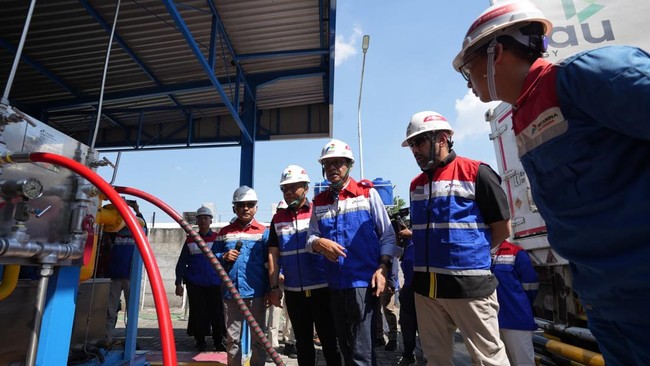
PT Perusahaan Gas Negara (Persero) Tbk (PGN), acting as Pertamina’s Gas Subholding, is fully committed to collaborating with the Ministry of Energy and Mineral Resources (ESDM) to expand natural gas access in the Yogyakarta region. Through the innovative use of Compressed Natural Gas (CNG) clustering, residents in Yogyakarta, particularly in the Sleman Regency, can now enjoy the tangible benefits of safe, reliable, and efficient natural gas for daily cooking.
The implementation of the CNG Clustering scheme in Sleman Regency served as a showcase project, which was personally inspected during a working visit by the Deputy Minister of Energy and Mineral Resources, Yuliendo Yulianto, last Friday.
Deputy Minister Yulianto appreciated PGN’s readiness in implementing the CNG-based gas network in Sleman. He noted that this innovation aligns with the government’s efforts to promote natural gas as a cleaner and more efficient transition energy sourced from domestic resources to strengthen national energy security.
Under the 2026-2029 National Medium-Term Development Plan (RPJMN), the government aims to develop approximately 350,000 household connections per year through various funding schemes.
“The use of CNG and gas networks provides efficiency for housewives, being practical and safe. For the Government, it can reduce the consumption of subsidised LPG and decrease the burden of LPG subsidies and imports,” said Yulianto.
Meanwhile, PGN President Director Arief K. Risdianto welcomed the Deputy Minister’s visit and expressed appreciation to the Ministry of Energy and Mineral Resources and relevant stakeholders for supporting the CNG Clustering implementation in Sleman. PGN emphasised that the Sleman gas network using the CNG clustering scheme has been successfully implemented, serving as concrete evidence that such innovation can be applied to other regions in Indonesia.
With this CNG Clustering scheme, natural gas can be distributed safely and reliably to household distribution networks without waiting for the presence of main transmission pipelines.
“The public does not need to worry about safety, as the high-pressure CNG at approximately 200 bar has been adjusted to the cluster system to flow safely into household kitchens. With strict supervision and reliable Pressure Regulating Equipment (PRS), the flow of natural gas to kitchens is ensured to be safe for daily use,” stated Arief.
Arief noted that the presence of this gas network significantly supports household cooking activities, making them much more practical, efficient, and secure. Furthermore, this network is a concrete step towards helping the government alleviate the state budget burden by reducing dependence on energy imports and subsidies.
To date, PGN has constructed over 4,500 household connections in Sleman, with a distribution pipeline network spanning more than 141 kilometres. The average natural gas supply to Sleman’s gas network customers has reached approximately 84,000 cubic metres (M3) per month, which is equivalent to the use of about 64 metric tons of LPG per month.
The use of the gas network in the Sleman area does not only target the household sector but will continue to be expanded massively to strengthen the local economy, ranging from Micro, Small, and Medium Enterprises (MSMEs), restaurants, and hotels to healthcare facilities such as hospitals.
In executing this ‘beyond pipeline’ service, PGN is optimising synergy with its subsidiary, PT Gagas Energi Indonesia (Gagas), which possesses a portfolio in non-pipeline gas distribution management. Currently, PGN, through Gagas, manages and operates 14 CNG stations/Mother Stations and 4 Mobile Refueling Units (MRU) that have reached various CNG consumers in the transport, commercial, and industrial sectors across various regions in Indonesia.
One commercial customer using CNG is the Payakumbuah Restaurant in Yogyakarta, with CNG usage reaching 2,000 - 2,300 M³. The benefit experienced by this restaurant’s operations is energy cost efficiency; compared to previous energy sources, using CNG can save approximately 30 - 33% in costs.
Arief continued that PGN has extensive experience in natural gas management, both through pipeline networks and non-pipeline modes such as CNG and LNG. As Pertamina’s Gas Subholding, PGN is ready to support the Government’s steps in formulating targeted CNG implementation and play an active role in the national energy diversification target.
“Through close synergy, PGN is committed to ensuring that the benefits of natural gas can be felt fairly and sustainably by all layers of society,” concluded Arief.
Source: jawawa.id (https://jawawa.id/newsitem/energy-ministry-backs-pgns-expansion-of-household-natural-gas-access-1782132739)
Originally published by CNBC Indonesia (https://www.cnbcindonesia.com/news/20260622184719-4-744788/kementerian-esdm-dukung-pgn-perluas-akses-gas-bumi-untuk-rumah-tangga), translated from Indonesian