
Energy and Food Security Must Be Viewed as Strategic Investments, Says MPR Deputy Speaker
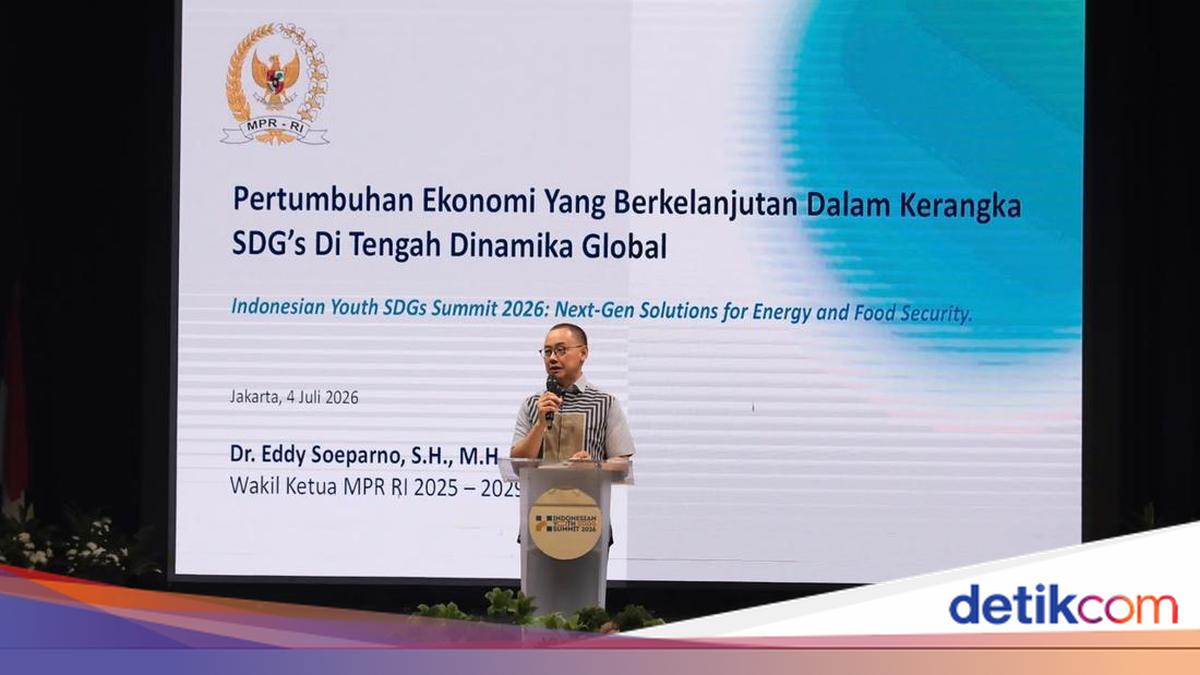
Deputy Speaker of the People’s Consultative Assembly (MPR) Eddy Soeparno stated that Indonesia’s targeted 8 per cent economic growth must be accompanied by strengthened energy security and sustainable development. He emphasised that the world is currently facing challenges from the climate crisis and rising geopolitical tensions, which directly impact energy security, global supply chains, and economic stability.
He assessed that this situation should be a momentum for Indonesia to strengthen its national development foundations through the implementation of the Sustainable Development Goals (SDGs), in line with the mandate of Article 33 of the 1945 Constitution. “Sustainability is not merely an option but a prerequisite for robust economic growth. Energy security, food security, and low-carbon development must be viewed as strategic investments to maintain Indonesia’s competitiveness in the future,” Eddy said in a statement on Sunday.
He made these remarks while delivering a keynote speech at the 2026 Indonesia Youth SDGs Summit, themed “Next-Gen Solutions for Energy and Food Security,” held at Bakrie University. The Doctor of Political Science from the University of Indonesia explained that recent climate-related disasters demonstrate the enormous economic costs incurred when development neglects sustainability aspects. Therefore, SDG implementation must be positioned as a national development instrument that balances economic growth, environmental protection, and public welfare.
In his presentation, Eddy also highlighted the impact of geopolitical conflicts in the Middle East on global energy supplies. He revealed that Indonesia’s dependence on oil and LPG imports remains a serious challenge to national resilience. “The paradox is that Indonesia is a country rich in energy resources, yet it is highly vulnerable to global supply disruptions. Energy security must be part of our national resilience strategy so that we are no longer dependent on international geopolitical dynamics,” he said.
To address these challenges, Eddy stressed that the energy transition must be carried out realistically and gradually. He rejected approaches solely focused on reducing fossil fuels without considering national development needs. “Indonesia requires a just energy transition. New and renewable energy must be accelerated, but at the same time, we still need gas as a bridging fuel, increased domestic energy exploration, bioenergy development, and the utilisation of Carbon Capture, Utilisation and Storage (CCUS) technology,” explained the National Mandate Party (PAN) deputy chairman.
He further outlined three priorities for strengthening national energy security. In the short term, the government needs to strengthen national refinery capacity, accelerate electrification, and implement energy substitution to reduce import dependency. In the medium term, Indonesia must optimise bioenergy development by leveraging national advantages such as biodiesel, bioethanol, biogas, and Sustainable Aviation Fuel (SAF). In the long term, the development of new energy sources like hydrogen and nuclear power plants must be prepared as part of the strategy towards net-zero emissions.
On the occasion, he also called on the younger generation to take an active role in realising this transformation. “Young people are the main actors who will determine the direction of Indonesia’s development. Innovation, research, green entrepreneurship, and youth leadership will be the determining factors for Indonesia’s success in achieving its sustainable development targets,” Eddy stated.
In his concluding remarks, Eddy asserted that Indonesia must not merely be a follower in the global energy transition agenda. “We must be a policy shaper, not just a policy taker. Indonesia possesses abundant natural resources, significant renewable energy potential, and a demographic dividend. With the right strategy, we can achieve strong economic growth while preserving environmental sustainability for future generations,” concluded the member of House Commission XII.
The event was also attended by prominent Indonesian environmentalist Prof. Emil Salim, who formerly served as State Minister for Development Supervision and Environment, along with Bakrie University Rector Prof. Sofia Alisjahbana, academics, students, and youth from various regions across Indonesia.