
Encouraging Feed Self-Sufficiency Among Livestock Farmers Through Bio-Ammoniation Technology
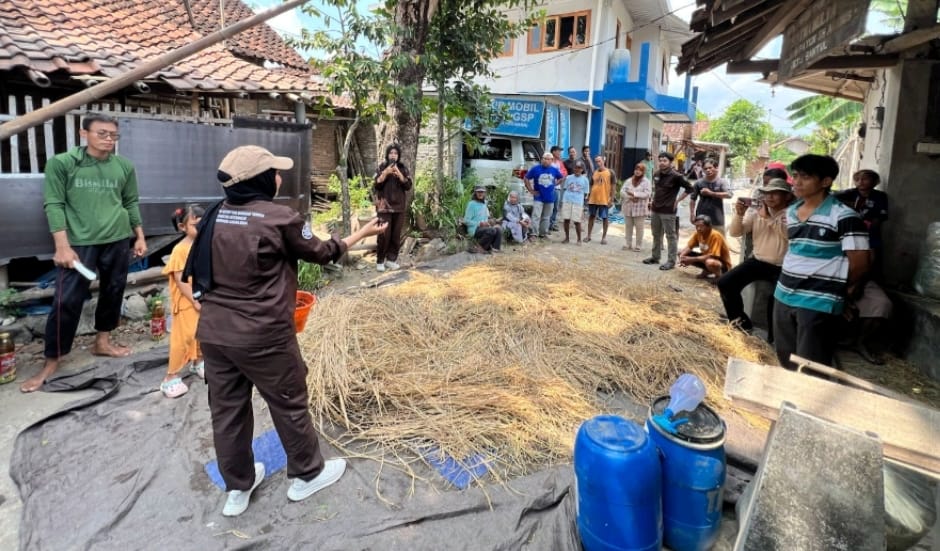
The self-sufficiency of livestock farmers through the use of appropriate technology in managing and providing animal feed needs to be encouraged and developed. To achieve this, Universitas Gadjah Mada (UGM), through its Community Service Programme for the 2026 funding year, is working with the Satwa Mulya Livestock Group in Sumberagung, Jetis, Bantul, to utilise such appropriate technology.
The activity, running from June to December 2026, is part of the Community-Based Empowerment scheme within the scope of Community Partnership Empowerment (PKM). The programme is funded by the Directorate of Research and Community Service, Directorate General of Research and Development, Ministry of Higher Education, Science, and Technology.
The programme focuses on increasing farmers’ capacity to utilise local resources as feed ingredients while applying simple processing technology suited to conditions at the farmer level.
The head of the community service team, Moh. Sofi’ul Anam, explained on Monday (24/8) that feed availability is one of the important factors in maintaining the sustainability of smallholder livestock businesses. Therefore, farmers’ ability to optimise materials available in their surrounding environment needs to be continuously strengthened.
Farmers need to be encouraged to optimise the resources available around them. “With proper processing, materials that were previously underutilised can become part of the feed source and help reduce dependence on external feed,” he explained.
In the programme, Sofi’ul was accompanied by Aji Praba Baskara and Fatkhanuddin Aziz as members of the community service team. One of the technologies introduced was bio-ammoniation. This technology is used to process feed ingredients based on agricultural waste so that their quality and utilisation as animal feed can be improved.
The application of the technology was carried out through material delivery, discussions, demonstrations, and direct practice with members of the livestock group. This approach was designed so that farmers not only gain theoretical knowledge but also have experience in applying feed processing technology.
“The application of technology in the community must pay attention to ease of use, availability of materials, and farmers’ ability to adopt it independently. Technology applied in the community must be appropriate to the conditions and needs of farmers. Therefore, mentoring and direct practice are important parts so that the technology introduced can truly be understood and applied by the group,” he stated.
According to Sofi’ul, in addition to feed processing, the mentoring also covers aspects of business management and livestock health. These steps are directed at strengthening the group’s ability to manage their livestock business better.
The head of the Satwa Mulya Livestock Group, Wedotomo, appreciated the mentoring provided by UGM. The activity broadened the group members’ insights, especially regarding alternative feed provision and management by utilising the potential available in the surrounding environment.
The programme is also directed at strengthening the livestock group as a platform for learning and sharing experiences among farmers. “Thus, the knowledge and skills acquired during the mentoring are expected to continue to be developed independently,” he said.
Through this community service programme, UGM seeks to strengthen the application of science and technology to answer community needs. The utilisation of agricultural waste as a feed source is expected not only to improve business efficiency but also to encourage more optimal use of local resources.
UGM hopes that the Satwa Mulya Livestock Group will be able to develop a more independent, efficient, and sustainable feed provision system and apply processing technology according to the group’s potential and needs.