
Encouraging a Stronger Investment Climate in Kalimantan
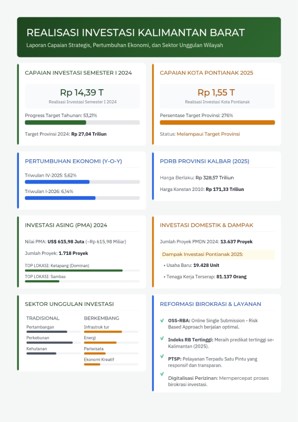
West Kalimantan is developing rapidly by making investors from all capital backgrounds feel welcome, as the province at the western tip of Borneo has undergone a total transformation, leaving behind rigid old ways for a modern service system that prioritises speed, transparency, and business certainty. In 2024, investment in West Kalimantan reached IDR 14.39 trillion, equivalent to 53.21 per cent of the annual target of IDR 27.04 trillion set by the Ministry of Investment/BKPM RI. “The investment door in West Kalimantan is now open wider. We are rolling out the red carpet for investors through a transparent licensing system,” reads a commitment on the official website of the West Kalimantan Investment Board (BPPT).
West Kalimantan does not rely solely on domestic investment. Throughout 2024, realised Foreign Direct Investment (FDI) reached US$615.98 million from 1,718 projects. Ketapang Regency became one of the areas attracting the most foreign investment, especially in the plantation and mining sectors. Equally compelling, the tourism and creative economy sectors are also beginning to show positive impacts. As West Kalimantan’s natural and cultural tourism potential becomes more recognised nationally and internationally, investors are starting to eye this sector as a promising business opportunity.
The old way of investing in Indonesia’s peripheral regions was synonymous with convoluted bureaucracy, licensing uncertainty, and unwritten “coffee money” practices. Investors often arrived with billions of rupiah but left frustrated because obtaining a Building Construction Permit (IMB) or an environmental permit could take months. West Kalimantan is now breaking that curse. The Provincial Government of West Kalimantan, through the Investment and One-Stop Integrated Services Agency (DPMPTSP), has implemented a Fast-Track system and full digitalisation integrated with the Risk-Based Approach (RBA) Online Single Submission (OSS) system.
International investors are eyeing West Kalimantan because of the local government’s commitment to Green Industrial Parks. The province is beginning to maximise its renewable energy potential, such as hydroelectric power plants (PLTA) and floating solar panels on existing reservoirs, to supply clean energy for downstream processing factories. Global investors bound by carbon footprint regulations (such as the European Union’s Carbon Border Adjustment Mechanism) are finding a new “haven” in West Kalimantan to build their manufacturing bases. Moreover, West Kalimantan possesses a comparative advantage that other regions lack: local wisdom and customary institutions. The old way of rogue investors using security approaches to clear land often resulted in horizontal conflicts that shut down factory operations.
In West Kalimantan, the government mandates and facilitates partnerships between corporations, indigenous communities, and local cooperatives. Customary leaders and community figures are involved from the social mapping stage. Investors are educated that the Social Licence to Operate is just as important as a ministerial permit. The result? Land conflicts in West Kalimantan’s industrial areas have reportedly declined drastically over the past three years. Investors are comfortable because they do not need to spend 30 per cent of their budget on security costs or handling social conflicts. They can focus on innovation and market expansion.
West Kalimantan today is proof that regions outside Java do not have to remain second-class in the investment arena. By abandoning old corrupt, slow, and exploitative ways, West Kalimantan offers a modern, green, and equitable ecosystem. The biggest lesson learned from the past is that investors buy certainty. Previously, many investment projects stalled midway due to land conflicts with indigenous communities or overlapping permits between central, provincial, and district/city governments. West Kalimantan no longer merely offers land for plantations or mining. Through downstreaming policies, the province forces and facilitates investors to build domestic processing plants. The bauxite smelters in Ketapang and Kayong Utara, as well as integrated palm oil processing plants, are proof that West Kalimantan offers added value. Investors benefit from regional incentives to build manufacturing industries, while the region gains a multiplier effect through local job absorption and increased locally-generated revenue (PAD).
Learning from old wounds, West Kalimantan now places conflict resolution and legal certainty at the forefront. The local government is more proactive in going to the field before permits are issued, mapping clear and clean areas, and engaging with indigenous community leaders. The second lesson is cutting “ghost costs”. The digitalisation of licensing through the Online Single Submission (OSS) system, integrated with Public Service Malls (MPP) in various districts/cities, is the answer to closing loopholes for illegal levies and reducing waiting times from months to days. What West Kalimantan is doing now sends a strong message for strengthening the investment climate across the entire island of Borneo. The era of inter-regional rivalry in Kalimantan, where districts tripped each other up to secure investor projects, is over. What is being built now is collaboration within the Borneo economic corridor. West Kalimantan is proving that to make investors comfortable and continue investing, local governments must dare to cut sectoral egos, transform into agile public servants, and place environmental and social sustainability as the main foundation. By leaving old ways behind, West Kalimantan is not just building factories or toll roads; it is building a sovereign, inclusive, and globally competitive economic future for Kalimantan. Investors no longer see West Kalimantan merely as a pile of bauxite ore or a stretch of palm oil. They see a strategic partner offering certainty.