
Empowering Through Art: Nurdini Prihastiti's Mission to Open Creative Spaces for People with Disabilities
People with disabilities often face a double limitation. Not only the limitations within themselves, but also the opportunities to demonstrate their potential. As a result, all the talents and abilities of people with disabilities go unchannelled and unrealised in the pursuit of achievement.
Data from the Ministry of Manpower records that the Labour Force Participation Rate (TPAK) of around 17 million people with disabilities of productive age reached only 20.14 percent in 2025. Yet people with disabilities also possess boundless creativity. Therefore, exploring their potential is important to help support their welfare.
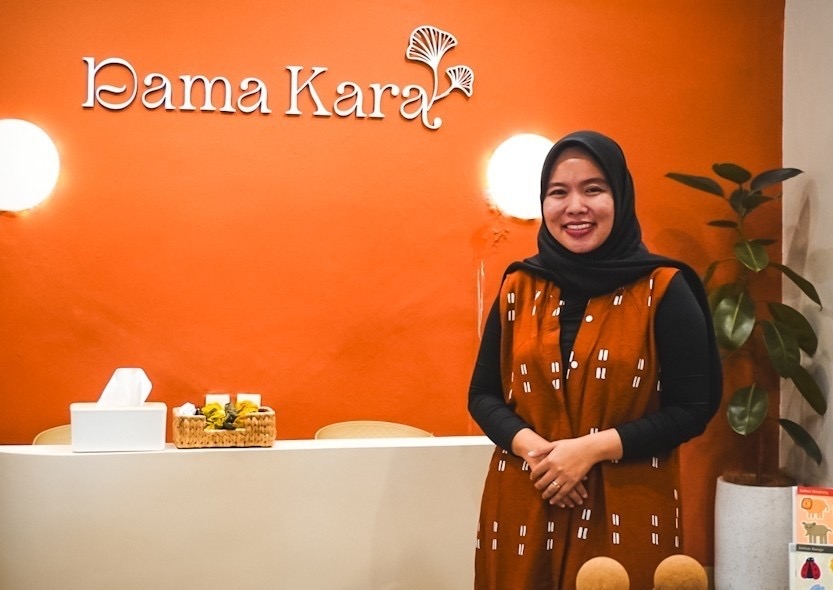
This is what Nurdini Prihastiti, affectionately known as Dini, has successfully demonstrated through Dama Kara, a brand that empowers people with disabilities to create in the field of fashion. They are mentored to pour their various imaginations into a range of designs and fashion items.
As a result, these works are not merely a space of expression for people with disabilities, but also products with economic value. The works produced have even been exhibited at international fashion shows.
“I am committed to making Dama Kara a platform for people with disabilities to create and to embrace them. We believe that creating truly knows no limitations,” said Dini, founder of Dama Kara and CEO of Dama Kara Foundation.
The idea of providing space for people with disabilities did not come suddenly. After graduating with a bachelor’s degree in Communication and Community Development from Institut Pertanian Bogor (IPB)/IPB University, Dini worked at a leading national company. There, the woman born in Lamongan, East Java, had a brilliant career.
However, at one point, Dini felt she had not provided much benefit to society. She resigned from the company and moved to Bandung. In this city of flowers, she pursued a master’s degree in Business Administration at Institut Teknologi Bandung (ITB) and opened a garment business with her husband.
“I felt that through business, the benefits I could provide would be greater. In the sense that I could create jobs for people around me or build a business that provides even more benefits,” she explained.
But that initial intention did not run smoothly. Only a few years into the business, Dini and her husband’s venture faced a trial. The ship carrying a client’s ordered products in Kalimantan caught fire in the middle of the ocean. The blaze consumed the entire ship and its contents, including the client’s ordered uniforms and souvenirs.
As a result, Dini had to reproduce those products. The losses reached hundreds of millions of rupiah. Even so, she did not want to blame anyone. This disaster instead became a moment of reflection for Dini.
“At that point, I realised that everything we have is entrusted to us by God. In the end, my husband and I agreed that we perhaps had not been charitable enough. If an order has the wrong size or poor quality, we can fix it. But if goods burn in the middle of the sea, that is something beyond our power as humans,” she said.
From the contemplation of Dini and her husband, the two agreed to start philanthropic activities alongside Dama Kara’s business activities. The foundation remained rooted in their clothing and garment business line. However, Dini continued to seek a philanthropy model that provided broader benefits.
Initially, since its establishment in early 2020, Dama Kara embraced women artisans and seamstresses around Dini’s business premises in Bandung and several cities in West Java. Given that many products are handmade, Dama Kara provided training to women who were then asked to help with garment production.
“The hope was that these women would earn additional income,” said Dini.
Involving women was deemed insufficient. Dini then expanded Dama Kara’s benefits by inviting a vulnerable group that had been overlooked: people with disabilities.
A child with special needs from England who later became popular on social media for her paintings inspired Dini. At the age of 3, the child named Iris was introduced to painting as part of therapy. Unexpectedly, by the age of 6, Iris produced expressive abstract paintings and demonstrated proficient use of colour.
From Iris’s story, Dini dug deeper into information about people with disabilities in Indonesia. According to her, the number of children with special needs in Indonesia could be higher than the Statistics Indonesia (BPS) figure of 22.97 million. This is because some communities still consider disability a disgrace that must be concealed.
Dini also explored the power of art as a therapeutic medium as well as the potential and strengths that can be drawn from people with disabilities like Iris Grace. An idea emerged: the artworks of people with disabilities could be combined with Dama Kara’s traditional fabric production.
Since then, Dini has been determined to involve people with disabilities in the creation of Dama Kara’s works. The involvement of people with disabilities in Dama Kara’s works underpinned the establishment of Dama Kara Foundation in 2024. Dini then also partnered with the social organisations Our Dream Indonesia and Art Therapy Center (ATC) Widyatama.
Dama Kara Foundation developed a number of programmes, such as drawing classes for people with disabilities. Through one-on-one mentoring by art facilitators—one person with a disability, one mentor—these classes not only train artistic skills and fine motor skills, but also sharpen imagination, concentration, and build the self-confidence of participants. The works of people with disabilities are then developed through collaborative workshops and exhibitions.
According to Dini, the people with disabilities who join Dama Kara Foundation do not have to be skilled at painting or designing. “We mentor them so that they can go from simply enjoying drawing to eventually being able to do it and discovering the distinctiveness of their works. We believe that nothing comes instantly. We just make sure that they truly enjoy it,” she said.
Dama Kara Foundation opens the widest possible space for people with disabilities who are interested in joining. This commitment emerged after several families of people with disabilities said that formal education for people with disabilities only goes up to senior high school or vocational school level.
“After that, there is no more space for them to contribute. So we try to embrace them with no maximum age limit,” she said.
Dini explained that each person with a disability requires special mentoring with a different style. For example, some children draw in dim light, while others work while listening to music. Dini and her team adapt to these habits.
Likewise with the works of people with disabilities. While continuing to be mentored and honed, Dama Kara does not demand a certain quality and adjusts to their abilities. In line with the commitment to benefit that Dini initiated, all Dama Kara programmes for people with disabilities are provided free of charge.
“They are not charged a single rupiah. From the selection process to their creative work, from art facilitators to drawing tools, everything is provided by Dama Kara. From every Dama Kara collection sold, we set aside a portion to support classes for our friends with special needs,” Dini revealed.
Dini’s concern for vulnerable groups is inseparable from her life journey. The youngest of three siblings once experienced economic limitations. Her father died when she was in the second year of junior high school. As a result, her mother, a primary school teacher, had to raise three children alone.
Like her current work, an entrepreneurial spirit had apparently grown in young Dini. In primary school, after returning from school, she was already brave enough to sell goods. “In the afternoon, I would sit at the madrasah or religious school where people bought snacks. I saw that as a selling opportunity. In the end, I asked my father for Rp5,000 in capital to buy snacks that I then sold,” Dini recalled.
That entrepreneurial spirit continued through senior high school and university. At IPB, Dini even rented a corner of the campus to open a stall selling bags and clothes. This business activity had to be managed around her lecture schedule and a host of other activities. At that time, Dini also joined the Student Executive Board (BEM) and became a radio broadcaster.
“Selling was perhaps more of a hobby. I like meeting and interacting with people. Besides, at that time I could eventually save money to pay for my boarding house. Apart from being a hobby, it turned out to reduce expenses,” she said with a laugh.
Dini’s formal education further reinforced her enthusiasm for social interaction. During her undergraduate studies in communication and community development at IPB, students were required to frequently engage with communities. Almost every semester, students stayed in residents’ homes for several days in various regions.
During her master’s in Business Administration at ITB, Dini’s studies and research were similar, even more specific in the field of traditional fabrics, which also paved the way for the establishment of Dama Kara. Her campus experience sharpened her social sensitivity.
“We explore problems in the community, then make analyses and propose suitable programmes. We try to observe daily life and find the main problems, which are often different from what they state,” she said.
It was also during her studies that Dini found the initial inspiration to enter the social sector. At that time, aware of her family’s economic condition, she hunted for scholarships from the first semester. “Almost every week I looked at the campus bulletin board that posted scholarship information,” she said.
Through that persistence, Dini eventually succeeded. A scholarship supported her tuition fees. However, this achievement did not stop her efforts to seek other scholarships she considered better. In the second semester, she saw an announcement for a scholarship that she felt offered added value.
Dini then took part in the selection for that scholarship and was accepted, subsequently withdrawing from the previous scholarship. From then on, Dini became a Tanoto Scholar. “The Tanoto Foundation scholarship was very helpful at that time. It not only provided tuition and pocket money, but also held leadership activities attended by many students from other universities,” she said.
Dini emphasised that the experience of meeting and exchanging experiences, as well as cultivating care for others through Tanoto Foundation activities, was truly memorable. That moment remains etched in her memory and helped spark Dini’s spirit to share and provide benefits for others, especially for marginalised groups.
“Many people have been helped by Tanoto Foundation. Not just me, but hundreds or even thousands of other friends. When we were gathered and listened to stories full of struggle, it crossed my mind: when can I start sharing if not now,” Dini said.
The works of people with disabilities are no longer underestimated. Their unique designs, combined with Dama Kara’s distinctive fashion techniques, are immortalised in clothing products such as kebaya, outerwear, and skirts.
These various garments have also found a place among fashion lovers, worn by a number of celebrities and influencers. Not only domestically, the fashion creations pioneered by Dini have also found markets abroad, including Singapore, Malaysia, Taiwan, and South Korea.
A number of Dama Kara’s haute couture works have also begun to step onto the world fashion stage. The Indonesian traditional textiles that serve as a space of expression for people with disabilities represented Indonesia at the Indonesia International Modest Fashion Festival (IN2MF) in France and Handarty Korea in South Korea some time ago.
Along with this, Dama Kara’s economic potential continues to grow. However, Dini believes that if a business only seeks financial profit, it will not last long. A business must be built and developed by providing real impact for its surroundings.
“A business will continue to exist as long as its impact can be felt directly by others. Dama Kara is currently growing and developing because our friends with disabilities are also helping us,” Dini asserted.
By empowering people with disabilities, Dama Kara can serve as a model for the younger generation in developing a business with impact. According to Dini, this impact does not have to be something big and can begin with sensitivity to one’s surroundings.
“So, try to look around and provide impact from the smallest things. No need to wait until later, no need to wait a few more years, but we can start now. Start small and do your best,” she concluded.