
Employment Protection Law Enacted, Introducing New Rules on Leave and Severance Pay
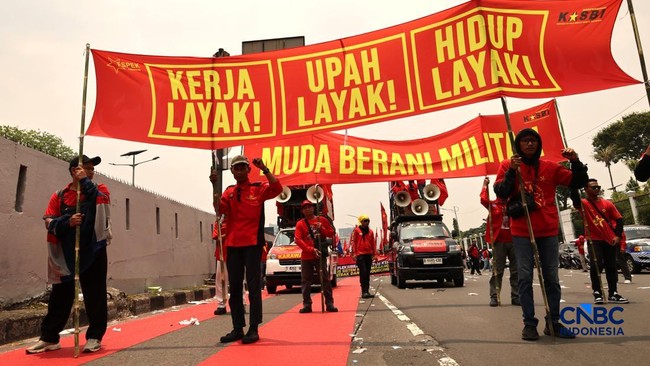
Jakarta, CNBC Indonesia — Law No. 27 of 2026 on Employment Protection was formally enacted and took effect on 28 October 2026.
The law repeals Law No. 13 of 2003 on Manpower. It also repeals parts of Law No. 6 of 2023, which enacted Government Regulation in Lieu of Law No. 2 of 2022 on Job Creation, specifically Chapter IV, Part One, Article 80(a), and Part Two, Article 81 of its annex.
Article 312 of Law No. 27 of 2026 stipulates that implementing regulations must be issued within one year of the law’s promulgation, by 28 October 2027.
The law consists of 313 articles divided into 23 chapters. Its considerations state that the country guarantees every citizen’s right to work and to a decent livelihood, in order to achieve national development goals and protect the Indonesian people, as mandated by the 1945 Constitution.
They also say that achieving national development goals requires improvements to employment rules, providing certainty and protection for the public while improving the quality of a skilled, resilient, adaptable, innovative and competent workforce able to meet local and global labour-market needs.
The law’s stated aim is to protect workers’ fundamental rights and ensure equal opportunities and non-discriminatory treatment, thereby supporting the welfare of workers and their families while taking account of business developments.
Law No. 27 of 2026 sets out 11 areas concerning the welfare, rights and obligations of workers and employers:
- Employment agreements
Fixed-term employment agreements (PKWT) may run for no more than two years and may be renewed twice, for up to one year each time. Workers must be notified of a renewal at least seven days before the agreement expires. The agreement must be written in Indonesian, registered within three working days and may not include a probationary period.
These agreements apply only to work that is completed once, seasonal work, new products or temporary work. If used for permanent work, a fixed-term agreement automatically becomes a permanent employment agreement (PKWTT). Workers are entitled to compensation when a fixed-term agreement ends.
For permanent agreements, probation may last no more than three months. Pay during probation must be at least 75 per cent of the applicable wage and no lower than the minimum wage, and social security coverage must remain in place.
Employers are prohibited from withholding diplomas or personal documents as security, except in relation to company-funded training covered by a written agreement.
- Outsourcing
Outsourcing is restricted to support services, including cleaning, catering, security and worker transport. Mining and oil and gas companies, as well as state-owned enterprises (SOEs), must use subsidiaries incorporated as limited liability companies.
If outsourced workers are used in a company’s core production process, the employment relationship automatically transfers to the company that commissioned the work. If an outsourcing provider changes, workers’ rights transfer and their length of service is calculated cumulatively.
Companies must comply with the new rules within one year. Existing agreements remain in force until they expire.
- Specific work relationships, including partnerships and digital platforms
People working under partnership arrangements are entitled to adequate income, occupational health and safety protection, and social security. Further rules on partnerships will be established in a separate law.
- Special protection
A minimum of 2 per cent of positions must be reserved for people with disabilities in government bodies, SOEs and regionally owned enterprises; the minimum for private companies is 1 per cent.
Employing children is generally prohibited. Exceptions apply to those aged 15 to under 18 performing light work for no more than three hours a day with parental consent; educational activities from the age of 14; and activities to develop talent and interests. The worst forms of child labour are entirely prohibited. Medium-sized and large companies must audit their supply chains to ensure they are free of child labour.
Women are entitled to menstrual leave of up to two days and three months of maternity leave, which may be extended by up to a further three months in special circumstances. Pay is full during the fourth month and 75 per cent during the fifth and sixth months. Workers are entitled to 1.5 months’ leave following a miscarriage, access to lactation facilities, and two days of leave for husbands accompanying their wives during childbirth, extendable to three days.
- Working hours, rest and leave
Standard working hours are seven hours a day over a six-day week or eight hours a day over a five-day week, in both cases totalling 40 hours a week.
Overtime requires the worker’s consent and a written or digital instruction. It is capped at four hours a day and 18 hours a week. Overtime pay is 1.5 times the hourly rate for the first hour and twice the rate for subsequent hours. The hourly rate is calculated by dividing basic pay plus fixed allowances by 173. Overtime on public holidays and rest days is paid at between twice and four times the rate, depending on the hours worked.
Workers are entitled to at least 12 working days of annual leave after 12 months of service, and 30 calendar days of extended rest leave after five consecutive years of service.
- Wages
Governors must set provincial minimum wages (UMP). Regency or city minimum wages (UMK) are optional and must be higher than the UMP; sectoral minimum wages are also provided for. The calculation uses economic growth, inflation and a coefficient of between 0.5 and 1, or the decent-living-needs benchmark, whichever is higher as agreed by the regional wage council.
In exceptional circumstances, the central government may use a different formula for a single period. The minimum wage applies to workers with less than one year of service; those with longer service are covered by a wage structure and scale.
Micro and small businesses are exempt from the minimum wage, but must pay at least 50 per cent of it. Wages must continue to be paid in certain circumstances, including illness—at 100 per cent for the first four months, followed by 75 per cent, 50 per cent and 25 per cent—as well as marriage, a family member’s death and religious observance.
Basic pay must account for at least 75 per cent of basic pay plus fixed allowances. Wage claims take priority if a company becomes insolvent, and workers may bring claims for unpaid wages without a time limit.
- Social security and severance reserves
Employers must enrol workers in the national health insurance (JKN), work-accident insurance (JKK), death insurance (JKM), old-age savings (JHT), pension insurance and job-loss insurance (JKP) programmes. The law explicitly establishes this as an obligation.
Employers must also provide a severance reserve fund managed by a government institution, except for micro and small businesses. Violations may be punished by sanctions up to and including revocation of a business licence.
- Industrial relations
Workers have the right to establish and join trade unions, and intimidation of union activities is prohibited. Companies with 10 or more workers must establish a Bipartite Cooperation Institution.
Collective labour agreements may last for up to two years and be extended by one year. A strike is a fundamental right, but must be notified in writing at least seven working days in advance and may take place after bipartite negotiations have failed.
- Termination of employment
All parties must seek to prevent redundancies, including by reducing overtime, working hours or shifts, or temporarily furloughing workers. If termination cannot be avoided, it must be negotiated through bipartite talks lasting no more than 30 working days.
If negotiations fail, termination is valid only after a decision by an industrial relations dispute-settlement body has become legally binding. A termination made without agreement or such a decision is void by law, and the worker must be reinstated. Bipartite negotiations are not required for resignation, the expiry of a fixed-term agreement, retirement or death.
Dismissal is prohibited in a number of circumstances, including illness lasting less than 12 months, marriage, pregnancy or childbirth, trade union activity, reporting an employer’s criminal conduct, discrimination, and illness or disability resulting from a workplace accident.
Following termination, severance pay ranges from one to nine months’ wages, depending on length of service. Long-service compensation ranges from two to 10 months’ wages and applies from three years of service. Compensation for entitlements includes unused leave, return travel costs and other items stipulated by the company.
- Criminal provisions
The law provides for legal sanctions for violations, including administrative penalties and criminal penalties for certain offences. Fines are set under categories II to VIII, with heavier fines for corporations.
- Transitional provisions
Industrial relations cases already registered will continue to be processed under the previous law. Provincial labour inspectors will be transferred to the civil service of the Ministry of Manpower within two years. Overseas apprenticeships will remain under the Ministry’s administration for one year.
Source: jawawa.id (https://jawawa.id/newsitem/employment-protection-law-enacted-introducing-new-rules-on-leave-and-severance-pay-1794052241)
Originally published by CNBC Indonesia (https://www.cnbcindonesia.com/entrepreneur/20261107145202-25-783186/uu-pelindungan-ketenagakerjaan-terbit-ada-aturan-baru-cuti-pesangon), translated from Indonesian