
Employment Law Needs to Better Accommodate Doctor-Hospital Working Relationships
The current employment and health legal system is considered inadequate in accommodating the working relationship between doctors and hospitals. This normative gap could give rise to uncertainty over doctors’ legal status, weak protection of labour rights, and unclear allocation of legal responsibility in the delivery of healthcare services.
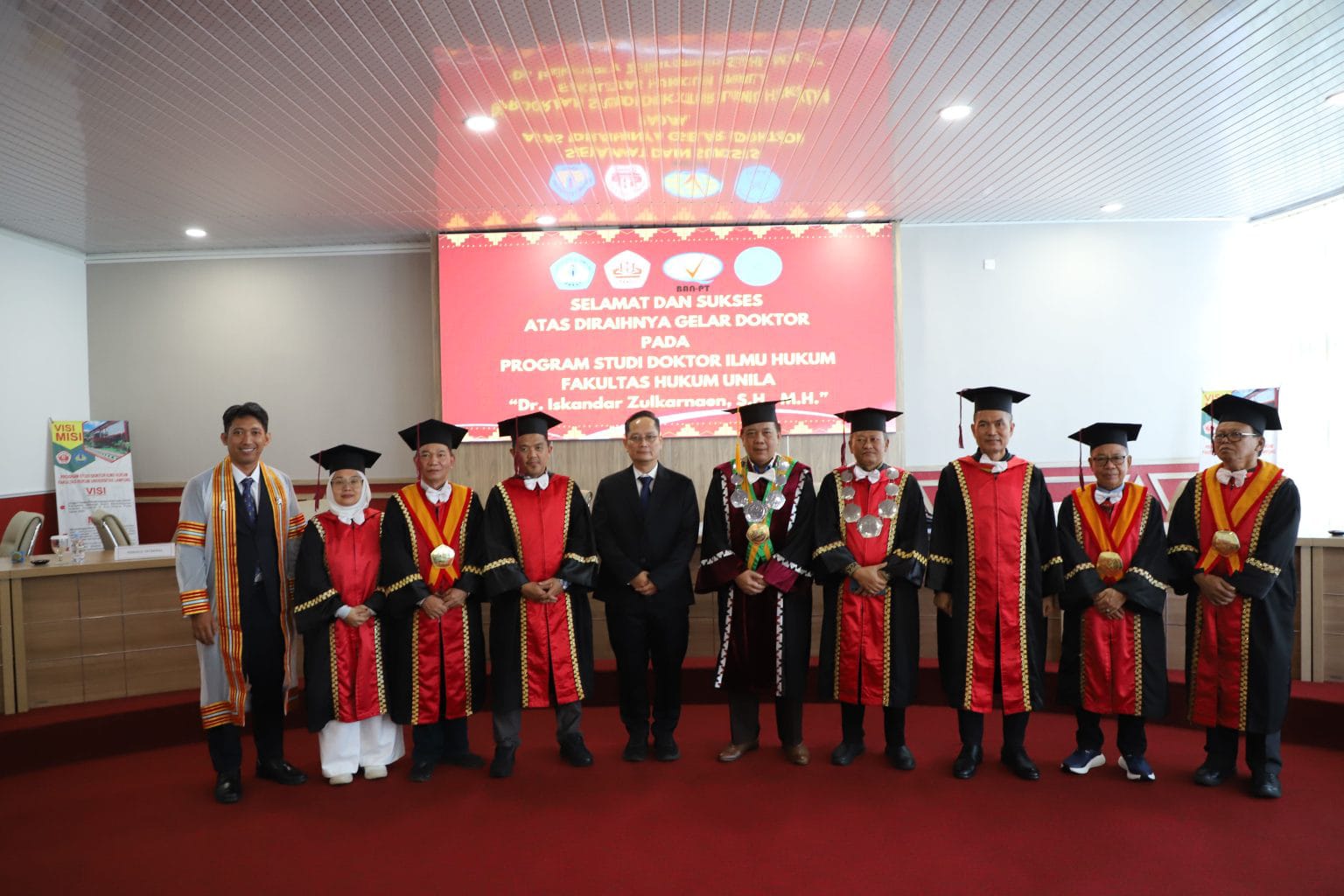
These findings form the core of a dissertation by Iskandar Zulkarnain, who successfully defended it at an Open Session of the Doctoral Programme of the Faculty of Law, University of Lampung, on Thursday (9 July).
Through his dissertation, entitled “The Legal Relationship Between Doctors and Hospitals from the Perspective of Professional Autonomy and Employment Status”, the research focuses on full-time specialist doctors who hold only one practising licence (SIP) at a single private hospital, with no other licence elsewhere, and who are not civil servants.
Iskandar concludes that current regulations have been unable to address the distinct characteristics of the medical profession, which differ from ordinary employment relationships.
“On one hand, doctors work within a hospital’s organisational system. They use hospital facilities and are subject to service standards, work schedules, governance and quality targets. Yet on the other hand, doctors retain professional autonomy in making medical decisions that legally and ethically cannot be intervened in by hospital management,” Iskandar explained in his dissertation, as stated in a press release in Jakarta on Saturday (11 July).
A DUAL CHARACTER
According to Iskandar, this dual character cannot be fully accommodated by the existing employment regime, which only recognises fixed-term contracts (PKWT), permanent contracts (PKWTT), or partnership arrangements based on cooperation agreements.
“As a result, various problems arise, from the unclear status of doctors as workers or partners, the protection of normative labour rights, legal responsibility in medical disputes, through to legal protection for hospitals as healthcare institutions,” he added.
Based on normative, empirical and comparative research, Iskandar proposes a Hybrid Sui Generis Employment Relationship Model, a new legal model that recognises doctors as having an employment relationship with the hospital without eliminating their professional independence.
Under this model, doctors would still receive protection as workers for the normative rights inherent in an employment relationship, such as legal certainty, employment social security, occupational safety and health protection, and industrial dispute settlement mechanisms.
At the same time, the state would continue to recognise doctors’ professional autonomy and provide space for professional practice and healthcare cooperation in accordance with prevailing laws and regulations.
“This model is considered a meeting point between the interests of hospitals as healthcare providers, doctors as professional personnel, and society as recipients of care,” Iskandar affirmed.
A REFERENCE FOR NATIONAL LAW
Responding to the dissertation, the National Coordinator of GeberBUMN, Ahmad Ismail, said the research holds significant value as a reference for national law.
In his view, the dissertation not only identifies a legal vacuum but also offers a new regulatory model that is more adaptive to the character of the medical profession.
“The Hybrid Sui Generis model deserves to be considered as a reference in drafting and refining regulations in the health and employment sectors,” said Ahmad, known as Ais.
He noted that debate over doctors’ status has always been framed around two opposing poles: employee or partner. In reality, he said, healthcare practice shows that the relationship has a special character requiring specific regulation.
“The Hybrid Sui Generis approach also has the potential to be applied to other professions with similar characteristics, namely those working within an organisation while still exercising independent professional authority based on ethical and competency standards,” Ais added.
Iskandar’s dissertation was examined by nine legal academics and experts from both within and outside the University of Lampung. The examining panel declared that Iskandar Zulkarnain had passed with a highly satisfactory grade and was entitled to the degree of Doctor of Legal Science.
Amid the growing complexity of hospital governance and mounting demands for the protection of medical personnel, these academic findings are hoped to serve as a foundation for the government, the House of Representatives (DPR), professional organisations, hospital associations and other stakeholders in building an employment system that provides legal certainty, protects medical personnel and ultimately improves the quality of national healthcare services.