
Employers Urge Labor Bill to Support Job Creation
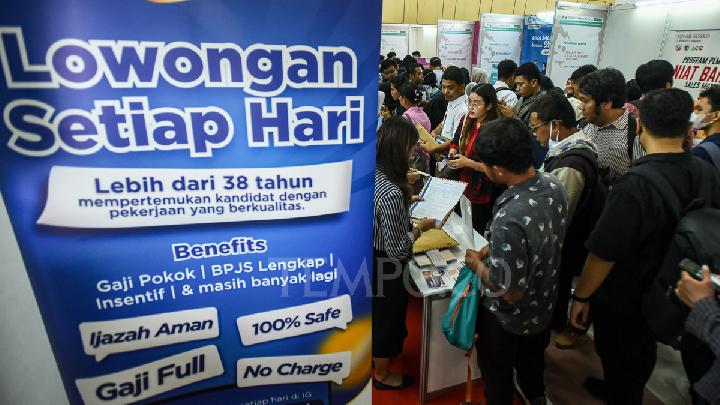
TEMPO.CO, Jakarta - The Indonesian Employers Association (Apindo) has urged lawmakers to ensure discussions on the Labor Protection Bill not solely strengthen protections for workers, but also address challenges in job creation, productivity enhancement, investment, and business sustainability.
“Workers need certainty of rights and a decent income, while job seekers need opportunities. To meet both, companies must be able to survive, invest, and recruit. Therefore, every new regulation needs to strengthen protection while maintaining the business world’s ability to create jobs,” said Apindo Jakarta Chair Solihin in a statement in Tangerang on Friday, October 2, 2026, as quoted from Antara.
He stated that updating labor regulations offers momentum to build a system that is more adaptive to changes in the working world.
According to him, new regulations must provide certainty of rights for workers while allowing companies the space to adapt, invest, and create jobs.
Solihin pointed out that today’s labor challenges have changed significantly. Geopolitical shifts, supply chain developments, technological advances, green economy transitions, climate change, and competition for investment demand greater adaptability from both employers and workers.
Meanwhile, Indonesia continues to grapple with millions of new job seekers entering the market each year, persistent youth unemployment, an expansive informal sector, skills gaps, and complex layoff dynamics.
For this reason, he assesses that any additional obligations, restrictions on employment relationships, or expansion of sanctions need to be thoroughly evaluated for their impact on business continuity and job creation.
Regulations, he added, should also reflect sector-specific dynamics, business scale, production models, labor requirements, productivity, and financial capacity.
“Regulations intended to strengthen protection should not end up narrowing job creation opportunities. Labor reform must be able to meet the needs of workers while also reflecting the realities of the business world,” Solihin emphasized.
Data from the Ministry of Investment and Downstream Industry/BKPM show that investment realization reached Rp1,010.6 trillion in the first half of 2026, absorbing 1.44 million workers. For the business sector, this milestone underscores the necessity of maintaining investment momentum to drive job creation.
“Job creation requires tangible investment. We need to attract new investments while also providing room for existing businesses to expand. When investment and expansion are underway, recruitment opportunities will also increase,” Solihin stated.
He noted that pressure on job creation can have broader implications for purchasing power, consumption, MSMEs, and family welfare. Therefore, the success of labor reform should not only be measured by strengthened norms, but also by an increase in formal jobs, enhanced productivity, and improved worker welfare.
Solihin stated that the business world encourages the application of the flexicurity principle, a balance between worker protection, flexibility in the workforce, and business certainty.
“Protection must be real: wages must be paid, social security must be available, post-layoff rights must be honored, and workers must have the opportunity to return to work. At the same time, companies need flexibility to respond to market changes and certainty to invest,” he explained.
Reform, Solihin continued, needs to shift from merely regulating employment to actively creating it. This includes adaptive regulations, a wage system that supports productivity, pathways for informal workers to transition to the formal sector, and enhanced training and certification that meet industry needs. Apindo also advocates that labor reform move alongside investment and industrial policies to support the creation of 2 million new formal jobs each year and increase the proportion of certified competent workers to 30 percent by 2030.
Apindo expressed appreciation for the legislative process and inputs from workers, business owners, the government, and other stakeholders. However, before ratification, the business world urges a cumulative impact study on various employment provisions, including their effects on different sectors, business scales, workers, and job seekers.
Apindo also encourages substantive tripartite dialogue, as well as clarity regarding funding, implementing regulations, oversight mechanisms, and transition periods. This ensures that the protections mandated by law can be implemented without hindering job creation.
“The success of the law should be reflected in fulfilled workers’ rights, increased formal jobs, sustainable businesses, and improved welfare. Therefore, we urge that any remaining issues be refined before ratification. Indonesia needs a labor system that can protect workers while also creating more jobs,” Solihin said.
Read: Indonesia Launches Program to Prepare Gen Z for Life Beyond Work
Click here to get the latest news updates from Tempo on Google News