
Employers Anticipate Wave of Layoffs, Seek Government Assistance
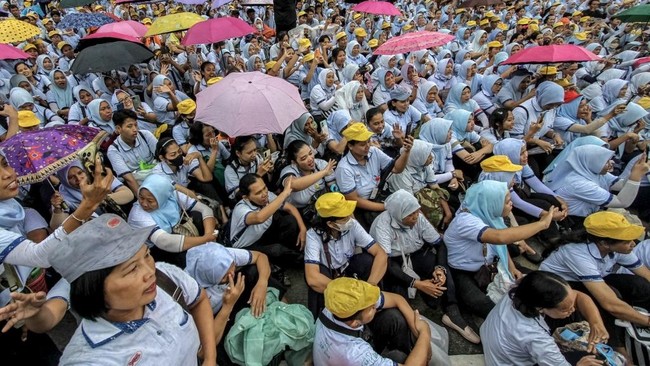
The Indonesian Employers’ Association (Apindo) is preparing 12 mitigation steps to help companies avoid terminating employment (PHK) amid ongoing economic pressures. The measures are being designed as an early warning system to map a company’s condition before it is forced to resort to layoffs. Apindo’s Head of Employment Affairs, Bob Azam, stated that the association is currently coordinating with the government, including the Ministry of Manpower, to prepare the guidelines. “Regarding the PHK issue, we have also spoken with the Minister of Manpower (Yassierli). Apindo is now preparing steps to avoid layoffs. We are jointly preparing approximately 12 steps we have initiated, for how companies can avoid terminating employment,” Bob said when met at the Apindo National Executive Board office in Jakarta on Tuesday (23/6/2026). According to Bob, these steps will serve as a reference for companies to identify the level of difficulty they face before deciding to reduce their workforce. “We are currently drafting the steps, which naturally include cost-cutting, efficiency measures, and so forth, before taking drastic measures such as workforce reductions,” he stated. Apindo will later classify a company’s condition into several stages. If a company is still at an early level, the chance of rescue is considered still open. However, if it has reached the highest level, layoffs become almost unavoidable. “These are the steps we will later share with companies so they can implement them, and we can map the situation. For instance, if a company has reached step 12, it means it is on the brink. But steps 1, 2, and 3 are still at the beginning; if it is still at the start, there is still time to help,” Bob explained. He even cited practices applied in Japan. According to him, a company that is already struggling to pay the minimum wage should receive assistance earlier to prevent it from ending in mass layoffs. “For example, if it cannot afford to pay the minimum wage, in Japan that is a sign the company must be helped. In Indonesia, it gets taken to court. We need to change that mindset,” he clarified. “So, if a company cannot even pay the minimum wage, it indicates something is wrong within the company. That is one example,” he continued. Nevertheless, Bob acknowledged that in the current economic situation, layoffs remain a risk that is difficult to avoid entirely. He said the business world must be realistic in facing rapid economic and technological changes. “But in an economic situation like this, we must also be realistic that terminating employment is a necessity. The important thing is how those affected by layoffs can find new jobs again,” Bob stated. According to him, the biggest challenge lies in the workforce’s readiness to face the emergence of new types of jobs due to technological developments. “Sometimes we lack anticipation for these newly formed jobs; other countries that are more prepared end up being the ones who can enjoy this change. That is something that needs further study,” he said. Echoing Bob, Apindo’s Vice Chairman of Employment Affairs, Darwoto, said the drafting of the 12 steps is also intended as a guide for the business community and the government in anticipating broader potential layoffs. “Yes, regarding the current layoff issue, we are sort of conducting mitigation, or further review. Because we are currently drafting how to anticipate layoffs. So, Apindo is offering 12 steps,” Darwoto said. He explained that the stages will depict a company’s condition in tiers, from the initial phase to a critical condition where layoffs can no longer be avoided. Darwoto mentioned that labour-intensive industries such as textiles and footwear still face considerable challenges. Besides stagnant export markets, the national industry also faces intense competition from Bangladesh, Sri Lanka, and China, which are increasingly aggressive in developing manufacturing technology. “Because we know that the export market itself now tends to be stagnant. Meanwhile, our competitors, countries like Bangladesh, are also quite aggressive there, so this is also a challenge,” he said. Apindo is therefore proposing a number of incentives to maintain industrial competitiveness while suppressing the risk of layoffs, ranging from import duties and logistics costs to taxation. “So, incentives for import duties, then logistics, taxation—whether the government might possibly make a breakthrough by lowering VAT to 10 percent again, for example. But on the other hand, the government’s fiscal position is also heavy,” he concluded.