
Employee Spending at Rp5.03 T: A Glimpse of the Ministry of Transportation's 2027 Indicative Budget
The Ministry of Transportation (Kemenhub) has recorded an indicative budget ceiling of Rp28.34 trillion for 2027. This figure is allocated across several types of spending, including non-operational goods expenditure at 73.65% or Rp20.88 trillion, employee expenditure at 17.75% or Rp5.03 trillion, and operational goods expenditure at 8.6% or Rp12.43 trillion.
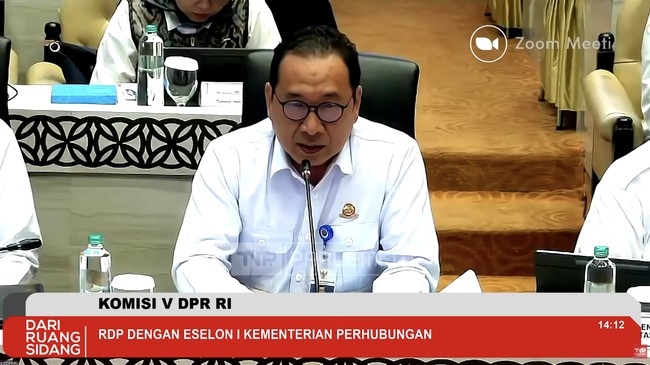
Secretary General of Kemenhub, Arif Toha Tjahjagama, stated that based on the source of funds, pure rupiah accounts for the largest portion, at 53.1% or Rp15.05 trillion of the total indicative ceiling. This is followed by foreign loans at 16.85% or Rp4.77 trillion, non-tax state revenue at 13.68% or Rp3.87 trillion, public service agency funds at 8.57% or Rp2.42 trillion, Sharia-compliant securities (SBSN) at 7.8% or Rp2.21 trillion, and foreign grants at 0.003% or Rp980 million.
As a follow-up, the indicative ceiling has been distributed to all echelon I units, including the Secretariat General at Rp553.88 billion, the Inspectorate General at Rp88.05 billion, the Directorate General of Land Transportation at Rp4.31 trillion, the Directorate General of Sea Transportation at Rp10.81 trillion, the Directorate General of Air Transportation at Rp5.29 trillion, the Directorate General of Railways at Rp4.65 trillion, the Directorate General of Transportation Integration and Multimoda at Rp122.04 billion, the Transportation Policy Agency at Rp115.83 billion, and the Transportation Human Resources Development Agency at Rp2.39 trillion.
Arif explained that the 2027 indicative budget ceiling will be allocated to several priority programmes. The first is employee spending with an allocation of Rp5.03 trillion. The second is a safety support programme worth Rp4.64 trillion, covering the procurement of connectivity facilities and infrastructure, rehabilitation of transport infrastructure, and safety equipment such as road fixtures and navigation aids. The third is a pioneer programme covering land, sea, air, and rail transport services worth Rp3.28 trillion. The fourth is a programme for the implementation of duties and functions worth Rp2.57 trillion.
He detailed further programmes, including transport integration and multimoda at Rp64 billion, education and training at Rp1.63 trillion, transport policy formulation at Rp3.6 billion, connectivity infrastructure at Rp7.55 trillion, transport services at Rp2.42 trillion, and technical support for transport at Rp1.1 trillion.
The indicative ceiling has been adjusted to meet the basic needs of each activity, especially mandatory ones such as employee spending and safety support. However, based on the ministry’s total requirement for 2027 of Rp55.16 trillion, there remains a backlog of Rp26.82 trillion. Consequently, Kemenhub has proposed an additional budget of Rp20.25 trillion to strengthen several priority sectors, including safety support at Rp7.99 trillion, pioneer services at Rp957 billion, service support at Rp9.31 trillion, and additional employee spending of Rp2 trillion.
Arif also highlighted the issue of the employee spending budget shortfall. In 2027, Kemenhub’s employee spending needs are estimated to reach Rp7.03 trillion, while the allocation in the indicative ceiling is only Rp5.03 trillion, leaving a shortfall of Rp2 trillion which has been proposed to be met through additional government budget. If this proposal cannot be fulfilled by the time the budget allocation is finalised, Kemenhub has prepared two scenarios. First, it will reallocate a portion of the Infrastructure Maintenance and Operation (IMO) budget amounting to Rp2.82 trillion to employee spending, considering that IMO payments are made in the fourth quarter of 2027. Second, it will shift the funding source from foreign loans to pure rupiah worth Rp1.23 trillion to cover part of the employee spending needs.
This situation is not the first experienced by Kemenhub. In the 2026 fiscal year, the ministry also faced an employee spending shortfall of Rp1.82 trillion. A portion of that shortfall was covered through internal budget optimisation, while the remainder is still being proposed through additional spending budget. Therefore, Kemenhub hopes the proposed additional budget for 2027 can be accommodated so that safety, connectivity, and transport service programmes can continue to run optimally.
Source: jawawa.id (https://jawawa.id/newsitem/employee-spending-at-rp5-03-t-a-glimpse-of-the-ministry-of-transportations-2027-indicative-budget-1782996791)
Originally published by CNBC Indonesia (https://www.cnbcindonesia.com/news/20260702173002-4-747628/belanja-pegawai-rp503-t-begini-gambaran-pagu-indikatif-kemenhub-2027), translated from Indonesian