
Emerging from July's 'Hell', Can the IHSG Fly Free in August?
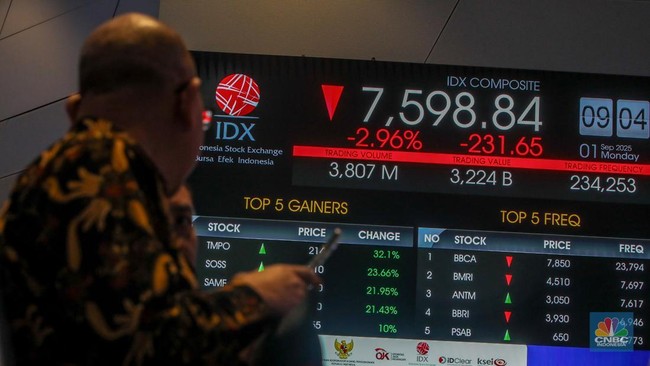
The Composite Stock Price Index (IHSG) has started August 2026 with strong momentum, continuing a positive trend after finally breaking its losing streak in July. The index recorded its first monthly gain in July, surging 10.51% and emerging from what was described as a ‘hellish’ period, marking its worst start to a year in history since at least 1990. Despite this, the IHSG remains down 27.90% year-to-date and 31.75% from its record close in January.
On Monday, the first trading session of August saw the IHSG close slightly lower by 0.03% at 6,234.13, with a trading volume of 22.24 billion shares. While the short-term momentum is improving, the index is still trading approximately 17% below its 200-day moving average, indicating that the broader trend has not yet turned fully bullish.
Historically, August has been a favourable month for the Indonesian stock market. Over the past decade, the IHSG has posted gains in nine out of ten Augusts, with an average return of 2.10%. The best performance was in 2024 with a 5.72% gain, while the sole decline was a 0.97% drop in 2019. If the index repeats its average August return, it could mathematically end the month around 6,367, or near 6,389 if it matches the average gain from the positive years. However, seasonal patterns alone are not a reliable basis for investment, especially given the challenging conditions in 2026, including a weak rupiah, high interest rates, and foreign investor caution.
Technically, the 6,450 level is seen as the critical gateway for a sustained rally. The IHSG briefly touched 6,454.31 on 23 July but failed to hold, closing at 6,315.31 on massive volume of 57.06 billion shares. The resulting candle had a long upper shadow, indicating strong selling pressure at that level. A valid breakout would require a close above 6,450, ideally in the 6,475-6,500 range, with a solid green body and a short upper shadow, supported by volume exceeding 32 billion shares. Current trading volume of 22.24 billion shares suggests the strength to breach this resistance is not yet fully formed.
Global factors remain a headwind. The Federal Reserve held its benchmark rate at 3.50%-3.75% on 29 July, but the decision was hawkish as three FOMC members voted for a 25-basis-point hike. The 10-year US Treasury yield is hovering around 4.70%, which could keep global funds in dollar assets and limit flows to emerging markets like Indonesia. Brent crude oil prices near US$87 per barrel present a mixed impact, potentially supporting commodity stocks but also raising inflation and energy import cost risks.
Domestically, the rupiah is trading near Rp18,000 per US dollar, and its weakness may reduce foreign investor returns when converted, limiting buying interest. Bank Indonesia has held the BI-Rate at 5.75% to maintain stability, though this keeps the cost of capital high. On the fundamental side, the economy provides some cushion, with first-quarter 2026 GDP growth at 5.61% year-on-year and July inflation at 2.88%. Credit growth is projected at 8%-12% for the year. However, uncertainty surrounding the upcoming MSCI review of market transparency and ownership structures in November 2026 may keep foreign investors selective. The base case scenario sees the IHSG moving sideways to bullish, with a fair value target of 6,450 by the end of August, supported by improving RSI momentum but constrained by low volume and persistent rupiah pressure.