
Embracing North Korea, Is Trump Risking the Fracture of the South Korea Alliance?
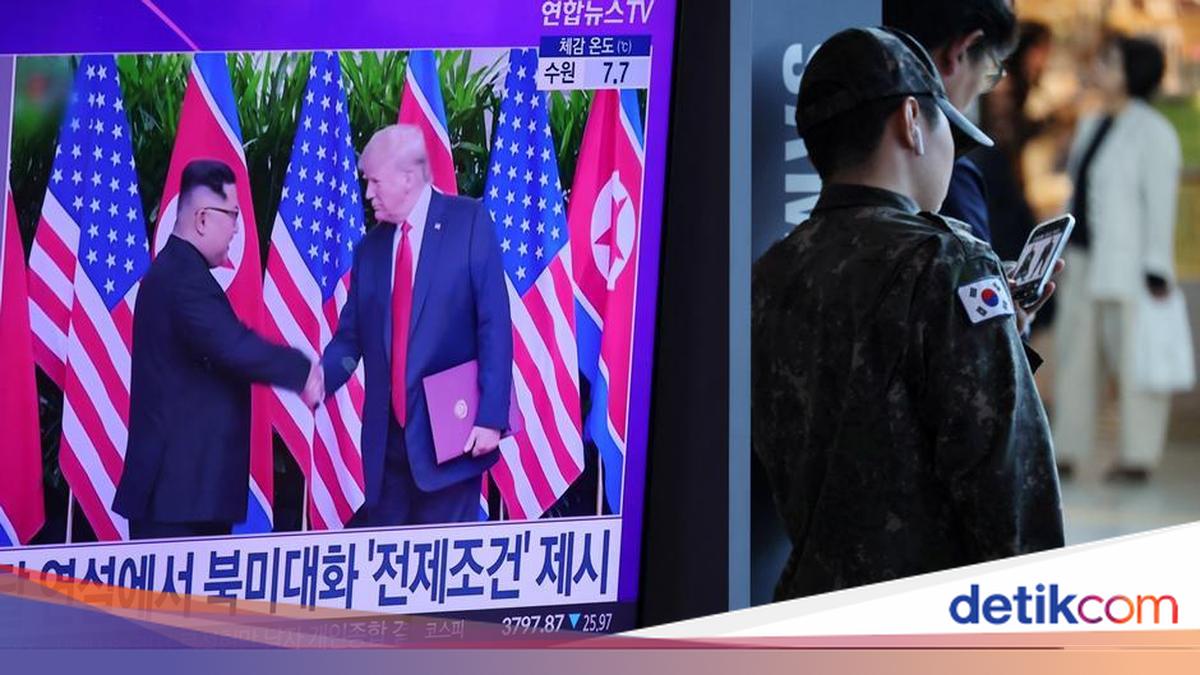
US President Donald Trump announced on Sunday (16/8) that he had ordered the Pentagon to limit the scale of American involvement in joint military exercises with South Korean forces taking place this week. The decision has sparked concern among South Koreans and experts worried about the deteriorating security situation in Northeast Asia.
In a social media post, Trump said he had ordered the United States to “significantly reduce” its involvement, arguing that the exercises were “expensive”. Trump added that American participation in the drills would send a “completely inappropriate and hostile signal” to North Korea, which he said had been “non-threatening and respectful” of his presidency.
Trump appeared to ignore the recent series of missile tests conducted by North Korea. Pyongyang on Friday (14/8) even threatened to implement a “new level” of nuclear deterrence in response to the planned US-South Korea exercises. North Korean state media described the drills as a “dress rehearsal for a war of invasion”.
The US president also indicated that his decision was partly influenced by the South Korean government’s refusal to help with the “denuclearisation” of Iran.
On Monday (17/8), Trump reaffirmed his decision to limit the scope and scale of the Ulchi Freedom Shield exercise, which began the same day and was scheduled to run until 27 August. Speaking to reporters at the White House, Trump said North Korean leader Kim Jong Un had responded to his offer to resume negotiations.
The reduction in the scale of the annual exercise comes as Kim’s position grows stronger thanks to an increasingly close alliance with Russia. At the same time, in recent years Pyongyang has removed a number of fundamental safeguards in inter-Korean relations by officially abandoning the decades-long goal of reunification. North Korea has also amended its constitution to designate South Korea as its principal enemy.
“The cost savings from reducing these exercises are marginal, while the diplomatic benefits for relations with North Korea remain doubtful,” said Leif-Eric Easley, professor of international studies at Ewha Womans University in Seoul.
Easley added that Kim has shown “no interest” in Washington and Seoul’s offers to discuss the possible elimination of North Korea’s nuclear weapons.
“Trump’s latest social media post about Kim Jong Un indicates a willingness to re-engage, but North Korea is busy profiting from Russia’s war against Ukraine while modernising its own military,” Easley told DW.
He added that reducing combined defence exercises “could undermine alliance coordination, slow South Korea’s process of taking greater responsibility for its own defence, and weaken deterrence against possible conflict in Asia.”
Concerns in South Korea were reflected in newspaper headlines on Tuesday (18/8). Chosun Ilbo highlighted the importance of joint exercises to protect the country from an aggressive and unpredictable neighbour, and warned that Trump was gambling with the foundations of the alliance.
David Silbey, professor of military history and defence policy at Cornell University in the United States, said in a statement that the decision came as the US military was overstretched. The US Navy had even diverted forces from the Pacific to the Middle East amid the war with Iran.
“Reducing commitment to exercises with South Korea likely reflects a reduction that was inevitable anyway,” he wrote. He added that the offer of negotiations to Kim also reflected “America’s continuing disregard for its allies”, and that Taiwan, Japan and the Philippines were all watching developments closely.
Beijing, of course, was also watching developments carefully, albeit from the position of an adversary rather than an ally, he said.
According to a report by the US news agency Associated Press, Trump made the decision to reduce the exercises without consulting South Korea. It remains unclear which parts of the exercise will be scaled back.
On Monday, the office of South Korean President Lee Jae Myung said Seoul would continue to “coordinate closely” with the United States in “maintaining a robust combined defence posture as well as joint exercises and training”.
At a regular Cabinet meeting on Tuesday, President Lee praised the US-South Korea alliance and called for South Korea to strengthen its own military power.
“As we strengthen our own capabilities, our value and significance as an ally will grow,” he said.
In Washington, politicians from both parties opposed Trump’s order, arguing that the decision weakens the alliance with South Korea and benefits America’s adversaries.
Senator Jack Reed, the most senior Democrat on the Senate Armed Services Committee, called the move a “foolish and reckless decision made by President Trump and his chaotic administration”.
“Kim Jong Un has scored a propaganda victory and South Korea, one of our strongest allies, is being punished for no reason other than Trump’s personal ego,” he said in a statement.
Republican Senator Thom Tillis stressed the length of South Korea’s military alliance with the United States. He argued that reducing the scale of the exercises also benefits Russia, because it allows North Korea to send more mercenaries to fight in Ukraine.
Kim Sang-woo, a former politician from South Korea’s left-leaning New Politics Congress who is now a board member of the Kim Dae-jung Peace Foundation, said the majority of South Koreans…
Source: jawawa.id (https://jawawa.id/newsitem/embracing-north-korea-is-trump-risking-the-fracture-of-the-south-korea-alliance-1787136971)
Originally published by detikcom (https://news.detik.com/dw/d-8625913/rangkul-korut-trump-pertaruhkan-retaknya-aliansi-korsel), translated from Indonesian