
Embracing El Niño: Pidie Farmers in Aceh Reap Shallot Harvest
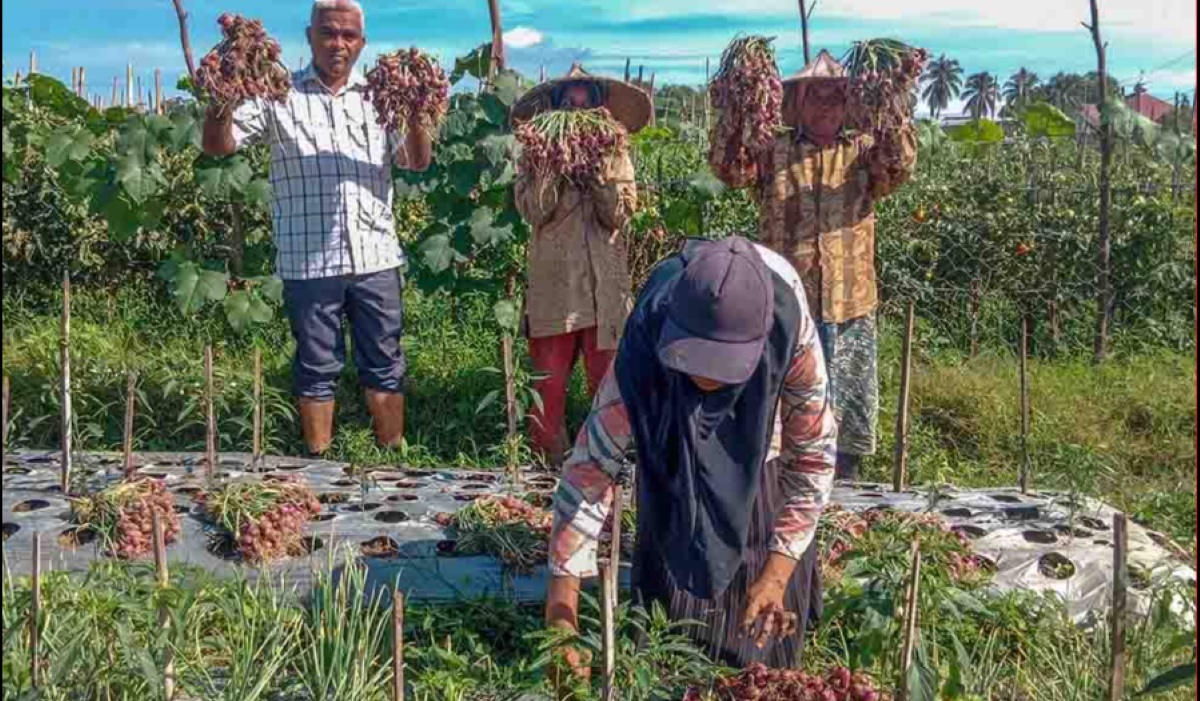
The El Nino weather phenomenon does not always bring harm to the agricultural sector. In Pidie Regency, Aceh Province, farmers have proven that with the right strategy, extreme heat can instead become an opportunity for profit.
Rather than forcing themselves to plant rice amid a water crisis, farmers in several districts have chosen to work with nature. They have shifted their crop from rice to shallots, which are more resistant to dry conditions.
Based on field observations, large-scale shallot harvesting has been bustling in the districts of Simpang Tiga, Peukan Baro and Pidie. The move was taken as a clever solution for the gadu (second) planting season, which is usually hampered by irrigation water supplies.
“Because of the irrigation water crisis, farmers here prefer to plant shallots during the dry season. Moreover, this is a coastal area, so shallot production is quite promising,” said Mustamar Arifin, Head of the Programme and Finance Sub-Division of Simpang Tiga District, Pidie, on Monday (27/7).
The shallot harvest locations are spread across several customary areas, known as Kemukiman, including Mukim Tunggoe, Mukim Iboh, Mukim Bungie and Mukim Pekan. These areas lie in downstream regions that frequently struggle to obtain irrigation water during the dry season.
Muslim, a local farmer, revealed that enthusiasm among residents for switching crops is very high. Of the 52 gampong (villages) in Simpang Tiga District, around 40 are now productive shallot farmland.
“Some of the shallot land is owned by the farmers themselves, while the rest is rented,” Muslim added.
This success shows that adaptation to climate change, such as the El Nino phenomenon, is key to sustaining farmers’ economies. By changing course from rice to shallots, farmers in Pidie have remained productive despite the threat of drought.
In the Kemukiman Lampoih Saka area of Peukan Baro District, for example, farmers have each installed water pump engines along the local secondary irrigation channels.