
Embodied Intelligence Adoption Expands Across Chinese Society
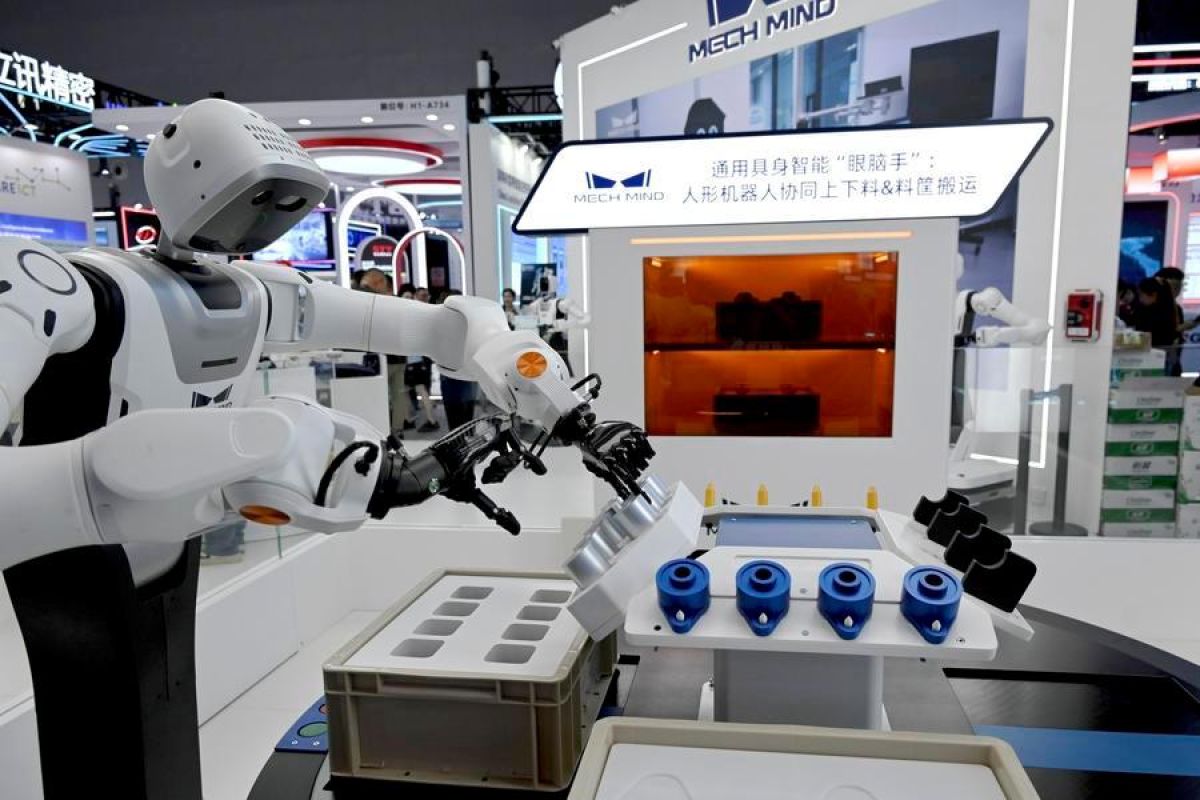
A demonstration at the World AI Conference (WAIC) 2026 in Shanghai showcased how robotic intelligence is transforming mechanical automation. In a replica factory line presented by Shanghai TARS Robotics Co., Ltd., robots functioned not merely as tools but as autonomous ‘colleagues’ capable of detecting their surroundings and adapting to changes independently. This reflects a broader shift as embodied intelligence moves from research laboratories into widespread industrial application.
Official data supports this trend. According to China’s State Taxation Administration, revenue in the embodied intelligence sector grew 22.4 percent year-on-year from January to May 2026, following a 13.9 percent increase for the full year 2025. Industrial purchases of embodied intelligence robots more than tripled during the same period. Shanghai has set a target to deploy 100,000 humanoid robots in factories by the end of the 15th Five-Year Plan (2026-2030), with the adoption rate of AI agents among large-scale industrial enterprises expected to exceed 80 percent.
Nationally, embodied intelligence is now a strategic pillar for future industries. The proposed 15th Five-Year Plan in 2025 included it in the country’s medium- to long-term industrial roadmap for the first time, and the 2026 outline designated it as a new growth driver. Government work reports for two consecutive years have mandated concrete steps for its development. A State Council document targets the adoption rate of next-generation intelligent terminals and AI agents to surpass 70 percent by 2027 and 90 percent by 2030, making the AI-driven economy a major contributor to national growth.
As industrial application accelerates, companies are also exploring consumer uses. At WAIC 2026, Shanghai-based manufacturer Fourier introduced an immersive living space called ‘A Day with the Robot Butler’. The exhibit featured a living room setup where a humanoid robot autonomously navigated the space, retrieved a bottle of water, and handed it to a visitor without remote control or button commands. The robot, Fourier’s GR-3, is powered by a semantic task execution centre that integrates a large language model, 3D spatial mapping, navigation planning, and control execution into a single workflow. It can memorise room layouts, identify object locations, understand functional areas, and act on natural language commands. When a user says, ‘I’m thirsty,’ the GR-3 interprets the intent, locates the dining area and beverages using its spatial semantic map, and autonomously plans the most efficient route to fetch and deliver a drink, bridging AI cognition and physical action without explicit step-by-step instructions.
Beyond the home, embodied intelligence is reaching consumers in public spaces. In a shopping centre on West Nanjing Road in Shanghai’s Jing’an District, a boxing ring set up outside a Unitree Robotics experience store drew crowds watching two humanoid robots spar. The store, which opened on 31 May, is the first of its kind in Asia. Located on the second floor of Jiuguang Department Store, the compact 100-square-metre space showcases Unitree’s latest consumer products, including the G1 and R1 humanoid robots and the Go2 robotic dog. Visitors, including families with children and international tourists, watch robotic dogs climb slopes, jump, and spin, while humanoid robots mimic gestures and perform fluid movements. Alex Butler, general manager of local media company Shanghai Spotlight, described the dancing robots as ‘really cool’ and ‘a very impressive milestone for the future of humanoid robots.’ Despite the spectacle, industry experts caution that the real economic value lies elsewhere.