
Eleven Years On, Republika Highlights Recurring Forest and Land Fires
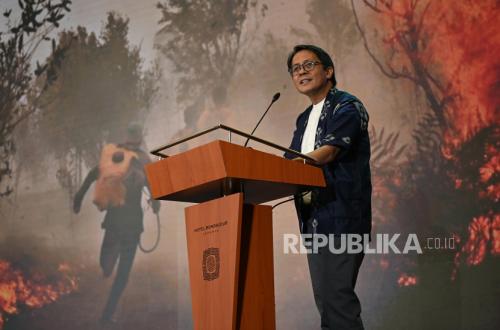
JAKARTA — Republika has highlighted the recurring forest and land fires, even though the issue has been in the public eye for more than a decade. Republika editor-in-chief Andi Muhyiddin questioned what progress had been made in tackling the fires, given that their effects continue to threaten human and wildlife lives.
Andi recalled an image of a schoolchild cycling through smoke from forest fires in Riau, which appeared on the cover of Republika 11 years ago. The same problem has now resurfaced in reports on forest and land fires and their environmental impact.
“Eleven years ago, Republika put on our front page a picture of land burning in Riau. A child in school uniform was cycling through the haze. The child was struggling to breathe,” Andi said when opening the ESG NOW Leadership Forum & Awards 2026 at Hotel Borobudur in Jakarta on Monday (19 October 2026).
He also referred to the death of a male orangutan named Sempurna in Ketapang, West Kalimantan, on 30 August. The orangutan was found in a very weak condition and received oxygen and care, but died later that same day.
An examination found lung damage believed to be strongly linked to exposure to smoke. For Andi, the incident was a reminder that environmental damage affects not only people but also wildlife, which loses the quality of its habitat.
“If 11 years have passed and we are still seeing similar suffering, perhaps there is something we need to ask ourselves. What has actually changed?” he said.
Andi said that improving the environment required practical action and the involvement of various parties. He cited Rosita, a woman who used her own money to rehabilitate degraded land in Megamendung, Bogor, West Java. The area has grown into a forest of around 30 hectares, from an initial 2,000 square metres.
According to Andi, Rosita’s story shows that environmental change can begin with individual initiative, without waiting for a major project or advanced technology. He also cautioned businesses against treating Environmental, Social and Governance (ESG) principles as mere reporting, targets or statements in annual reports.
“ESG must answer a simple question: what changes when we are involved? Does the environment improve? Do communities become stronger? Are workers better protected? Are companies more transparent and accountable?” Andi said.
Through the ESG NOW Leadership Forum & Awards 2026, themed “Inspiring Impact”, Republika brought stakeholders together to discuss policy direction and promote sustainability practices that deliver measurable results. The forum brought together representatives of government, businesses, investors, academia and civil society organisations to strengthen transparency and cross-sector collaboration.
Republika presented the ESG NOW Awards 2026 in the Government Track and Corporate Track categories. The local government category covered innovations in waste management, renewable energy, forest governance and sustainable tourism, while the corporate category recognised companies that integrate ESG principles into their core business strategies.
Andi said he hoped good practices developed by local governments, companies and communities could be studied and adopted more widely. Such collaboration, he said, should drive tangible change in environmental protection so that future generations do not continue to face the threat of forest and land fires and their effects on people’s lives.