
Elderly Residents in Bantul Develop Tech- and Solar-Powered Goat Farming
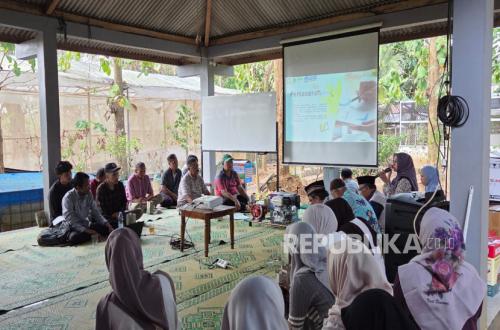
Elderly residents in Argodadi Village, Sedayu District, Bantul Regency, are proving that age is no barrier to productivity and contributing to village development. Through a Community Service Programme under the Village Empowerment scheme funded by the Directorate of Research and Community Service of the Ministry of Higher Education, Science, and Technology, the elderly are being encouraged to build a circular village economy through goat farming, livestock waste utilisation, and the application of technology and renewable energy.
The activity, held on Sunday in Bakal Hamlet, Argodadi Village, was attended by the Village Head Prayitno, PCM Sedayu Chair Heru Waseso, PRM Argodadi Chair Ngadikan, Kapanewon Sedayu representative Riyadi, Chair of the Productive Elderly Group (Lanterna) Eko Budi Suprihatin, Chair of the Livestock Group Eko Pramono, members of Lanterna and the livestock group, as well as 20 Recognition Community Service Programme students from Universitas Ahmad Dahlan (UAD).
The programme was chaired by Dr Moh. Toifur from UAD, with team members Dr Bambang Sudarsono (UAD), Nur Fitri Mutmainah from Universitas ’Aisyiyah Yogyakarta, and Irfan Yunianto (UAD). The implementation was also supported by Okimustava, M.Pd.Si., as the Field Supervisor for UAD’s Community Service Programme, along with the Recognition Community Service Programme students.
Argodadi Village Head Prayitno welcomed the programme as it aligns with the village’s development vision to improve community welfare. He noted that empowering the elderly through productive economic activities provides a double impact, increasing income while enhancing the quality of life for older residents. “This programme is very much in line with Argodadi Village’s aspirations to improve the welfare of its citizens. Besides providing economic benefits, this activity also supports the well-being of the elderly so they remain active, healthy, and have a better outlook on life,” Prayitno said.
Appreciation was also conveyed by PCM Sedayu Chair Heru Waseso, who noted that programmes focusing on the elderly are still relatively rare in community service activities. “There are still few community service activities that specifically make the elderly the main subject of empowerment. In fact, they have vast experience, skills, and social capital. This programme is an excellent example of how the elderly can continue to work and contribute to society,” he stated.
Meanwhile, PRM Argodadi Chair Ngadikan expressed his organisation’s readiness to support the programme’s sustainability. One form of support to be provided is training on making burnt rice husk as a planting medium to support the utilisation of organic fertiliser produced from processed livestock waste.
On this occasion, the community service team also handed over various technological devices to partner groups to strengthen the transformation of community livestock farming into a more modern, educational, and sustainable system. The Lanterna Group received educational tools for halal, hygienic, healthy, and happy goat farming as a means of developing community-based edutourism livestock farming. Meanwhile, the Livestock Group obtained production equipment for technology-based livestock waste processing to produce economically valuable organic fertiliser.
Both partner groups also received Internet of Things (IoT)-based air quality monitoring devices that allow real-time monitoring of pen environmental conditions. This technology is expected to help create a healthier and more comfortable livestock environment for both the animals and the surrounding community.
As part of renewable energy education, the community service team also provided solar panel-powered lighting systems for the livestock farming area. The presence of this technology not only supports nighttime farming operations but also serves as a learning tool for the community on the use of environmentally friendly and sustainable alternative energy.
Team leader Dr Moh. Toifur explained that the programme is designed to build a village circular economy ecosystem that integrates livestock farming, agriculture, digital technology, and renewable energy. Previously underutilised livestock waste is now processed into organic fertiliser, while IoT technology and solar panels are used as educational tools and to improve farming management efficiency. “We want to build a comprehensive empowerment model. Goats produce economic value, their waste is processed into organic fertiliser, environmental quality is monitored using IoT technology, and energy needs are supported by solar panels. Thus, the community not only gains economic benefits but also learning experiences about technology and environmental sustainability,” he explained.
Through collaboration between universities, village government, community organisations, livestock groups, elderly groups, and students, this programme is expected to become a model for elderly empowerment based on a circular economy that can be replicated in other regions. The programme also demonstrates that the elderly are not a passive group, but rather a social asset capable of driving productive, competitive, and sustainable village development.