
El Niño Threatens Aceh Farmers, Customary Rules and Local Wisdom Tightened
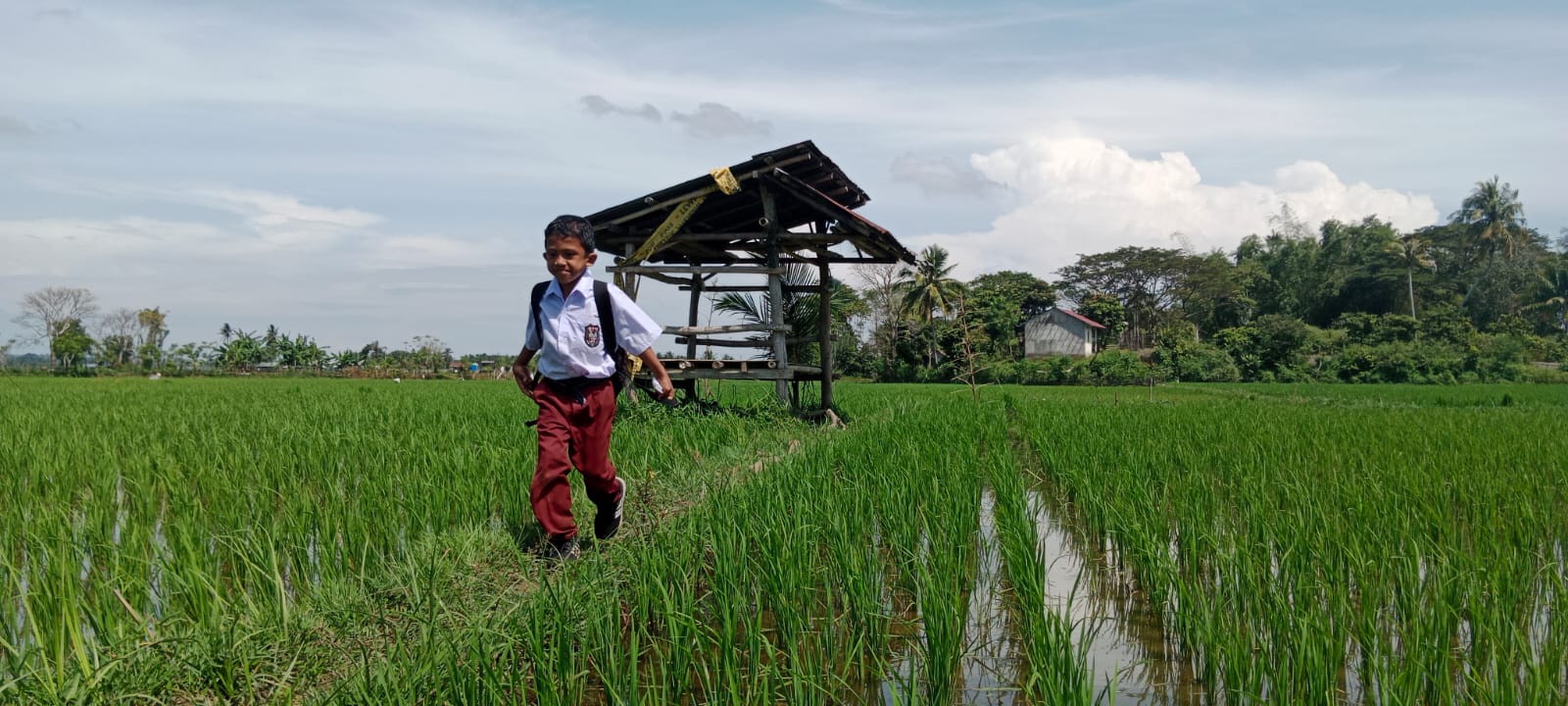
The natural phenomenon of El Nino is increasingly haunting rice farmers in Aceh Province. Thousands of hectares of second-season (gadu) rice crops are now gripped by a water crisis.
In Pidie Regency, for example, hundreds of hectares of rice plants aged between two weeks and two months have begun to experience water shortages. Water sources such as the Tiro River, Krueng Baro River and Krueng Reubee River have seen significant depletion.
River water levels, previously at half the river’s depth, now stand at only around 20%. Because of the low levels, river water is becoming difficult to channel into tertiary networks to be distributed across the paddy fields.
Observations by Media Indonesia found that among the areas beginning to face water shortages are paddy fields in parts of Pidie District, Indrajaya District, Peukan Baro, Padangtiji and Delima District. Some of the growing paddy fields have started to dry out, with cracks appearing in the soil, while other plots retain only moisture.
“Some parts have already dried up and the soil has started to crack with holes. If it does not rain soon, we fear the growth process and rice flowering will be disrupted,” said Abdullah, a farmer in Pidie District, on Wednesday (15/7).
In the Jurong village area of Indrajaya District, farmers have begun using pump machines to draw water from drainage channels. They fear that if they do not pump the water quickly, the continuously dwindling flow will disappear entirely.
Farmers in the Bambi mukim in Peukan Baro District are doing much the same, using water pumps at several points along channels that still carry flow.
Meanwhile, in several other locations in Lampoih Saka hamlet, Peukan Baro District, the distribution of irrigation water has been tightened. During the day, water is channelled to upstream paddy fields, while from nightfall until early morning it goes only to farmers in the downstream area.
“We in the downstream section of the irrigation channel are only allowed our share of water from night until morning. Those upstream use the daytime to obtain water,” said Tarmizi, a farmer in Peukan Baro District.
Media Indonesia’s investigation found that these customary rules and local wisdom are set by the kejruen blang (traditional farming leaders). This has been practised for generations.
Anyone who violates these rules is subject to fines or social sanctions. This is done to ensure mutual respect for farmers’ rights and to preserve harmony among them.
Elsewhere, as many as 66 families, or 158 people, in Bunder Hamlet, Sumber Pinang Village, Pakusari District, Jember Regency, lack access to clean water due to the dry season affecting the area.
To reduce the risk of drought, the Livestock, Fisheries and Food Security Office (Dinas TPHPKP), coordinating with technical agencies, has carried out normalisation and dredging of a number of irrigation areas.
In addition to distributing clean water aid, the Regional Disaster Management Agency (BPBD) continues to coordinate with village and district governments as well as relevant regional apparatus to monitor conditions on the ground.
As many as 20,393 families, or 57,413 people, spread across 60 villages, 40 districts in 14 areas of Central Java, have begun to be affected by drought.
The emergency alert status has been declared until 30 September 2026, as the prolonged dry season is expected to be even drier.