
El Niño Persists: When Will the Peak of the Dry Season Occur in Indonesia? BMKG Provides Update
The Indonesian Meteorological, Climatological, and Geophysical Agency (BMKG) has released its latest analysis regarding atmospheric dynamics in Indonesia for the third ten-day period of May 2026. The report examines the current development of the El Niño phenomenon and the progression of the dry season in Indonesia.
BMKG revealed that monitoring results for the third ten-day period of May 2026 showed a decadal Indian Ocean Dipole (IOD) index of -0.92 (-0.56). However, BMKG emphasised that although the monthly index has exceeded normal limits, it cannot yet be categorised as a negative IOD phenomenon as it has only persisted for one month.
Meanwhile, the ENSO decadal index (monthly ENSO) of +1.04 (+1.00) indicates El Niño conditions. Previously, BMKG warned that there is less than a 20% chance of the El Niño phenomenon developing into a strong category.
According to BMKG, El Niño-Southern Oscillation (ENSO) refers to an anomaly where sea surface temperatures in the Pacific Ocean, off the coasts of western Ecuador and Peru, are higher than normal. During the El Niño phase, the trade winds that usually blow from east to west weaken or even reverse direction. This weakening is linked to the expansion of warm sea surface temperatures in the eastern and central Pacific. As warm water shifts eastward, evaporation, clouds, and rainfall also shift away from Indonesia, meaning Indonesia faces an increased risk of drought.
In current climate science terms, BMKG clarified that El Niño represents an anomaly where sea surface temperatures in the eastern and central equatorial Pacific are warmer than normal, while the sea surface temperatures in the western Pacific and Indonesian waters, which are usually warm (the warm pool), become cooler than normal. During El Niño, cloud formation areas shift from Indonesia towards the central Pacific Ocean, resulting in reduced rainfall in Indonesia.
Consequently, El Niño, particularly when occurring during the dry season, requires close attention due to its potential to reduce rainfall. BMKG warned that the impact could trigger disasters such as droughts and land or forest fires. Prolonged droughts could have further far-reaching impacts on agriculture, the economy, and social stability.
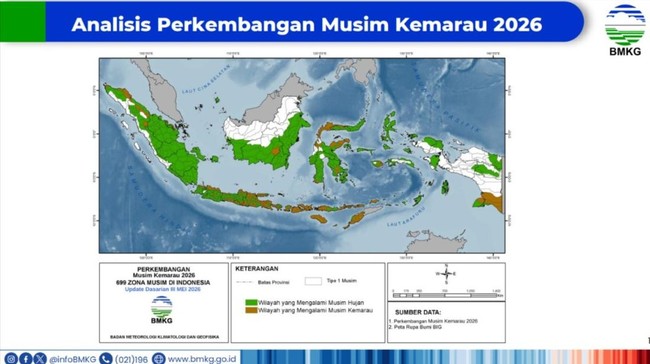
Regarding the early warning for the dry season, BMKG’s latest report indicates that no regions have yet entered the ‘Alert’ or ‘Danger’ categories for meteorological drought. However, certain areas in West Nusa Tenggara (NTB) have entered the ‘Watch’ category for meteorological drought, effective for the first ten-day period of June 2026.
BMKG further revealed that based on Seasonal Zones (ZOM), 28.6% of Indonesia (200 ZOM) is currently experiencing the dry season. This includes parts of Aceh, North Sumatra, Riau, Riau Islands, northern Banten, parts of Jakarta, northern West Java, Central Java, East Java, Bali, most of NTB, most of NTT, parts of Gorontalo, Central Sulawesi, West Sulawesi, South Sulawesi, Southeast Sulawesi, Maluku, and parts of South Papua.
Zones predicted to enter the dry season during the first to third ten-day periods of June 2026 include most of Sumatra, parts of Banten, southern Jakarta, parts of West Java, central Java, small parts of East Java, West Kalimantan, Central Kalimantan, South Kalimantan, East Kalimantan, most of North Sulawesi, West Sulawesi, parts of South Sulawesi, parts of Southeast Sulawesi, parts of Maluku, parts of West Papua, eastern Papua, Papua Highlands, parts of Central Papua, and parts of South Papua.
As for when the peak of the 2026 dry season will occur, BMKG predicts it will vary. Some regions, specifically several zones in Sumatra, have already experienced the peak. However, other areas are predicted to reach the peak of the dry season in January 2027. Generally, according to BMKG’s maps, most parts of Indonesia are expected to experience the peak of the dry season during July and August this year.
Source: jawawa.id (https://jawawa.id/newsitem/el-nino-persists-when-will-the-peak-of-the-dry-season-occur-in-indonesia-bmkg-provides-update-1780846341)
Originally published by CNBC Indonesia (https://www.cnbcindonesia.com/news/20260603152406-4-739820/el-nino-masih-terjadi-kapan-puncak-musim-kemarau-di-ri-ini-kata-bmkg), translated from Indonesian