
El Niño Intensifies to Strong Category, BMKG Chief Issues Warning
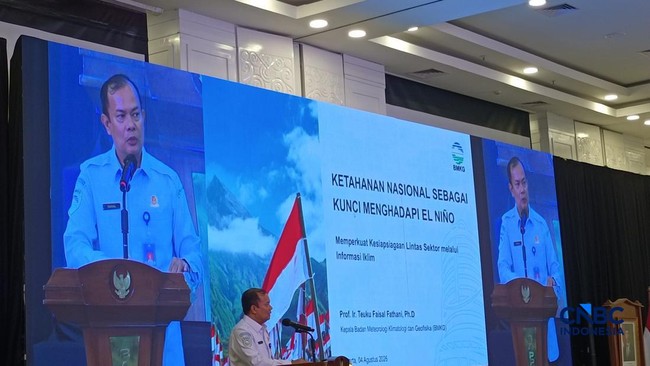
The Meteorology, Climatology and Geophysics Agency (BMKG) has stated that the El Niño phenomenon in Indonesia has now entered a strong category and has the potential to intensify to very strong. This condition is expected to make the dry season from August to September drier and longer, thereby increasing the risk of drought and forest and land fires, especially in the southern region of Indonesia.
BMKG Head Teuku Faisal Fathani said that BMKG had actually anticipated this condition since March 2026, when the agency predicted Indonesia would experience a dry season coinciding with a moderate category El Niño. As conditions developed, the World Meteorological Organisation (WMO) on 2 June 2026 determined that El Niño was active, while BMKG monitoring results now show its intensity has increased to strong.
‘Based on BMKG monitoring results, the current El Niño condition is in the strong category. This is indicated by the sea surface temperature anomaly in the 3.4 region, and we are not only using the ten-day data from July, but we are using the May-June-July period to show that the El Niño intensity at plus 1.59 is in a strong position with the potential to become very strong,’ Faisal said during his presentation at the National Dialogue event of the Ministry of National Development Planning/Bappenas in Jakarta on Tuesday.
He explained that El Niño is a global climate phenomenon characterised by warming sea surface temperatures in the central to eastern equatorial Pacific Ocean. When it occurs simultaneously with the dry season, the phenomenon causes reduced rainfall, making the dry season drier and last longer. ‘I need to emphasise that El Niño and the dry season are two different, separate phenomena. We will still experience rainy and dry seasons, but what we need to be wary of is if the dry season coincides with El Niño,’ he said.
According to BMKG, the most critical period is expected to occur from August to September when rainfall in most regions is in the low to very low category. The influence of El Niño is expected to diminish after Indonesia enters the rainy season in mid-October. ‘In August and September, rainfall is low to very low. Then in October, mid-October, we start entering the rainy season, so El Niño becomes insignificant in Indonesia,’ he stated.
The most affected areas are regions south of the equator, namely East Nusa Tenggara, West Nusa Tenggara, Bali, Java Island especially coastal areas, southern Sumatra, and South Papua. ‘The areas very significantly affected by El Niño are Indonesian regions below the equator or the southern part of Indonesia. These are the areas that will experience a dry season that is drier and longer in period compared to the climatological average over the last 30 years,’ he explained.
BMKG reminded that the impact of El Niño is not only felt in the agricultural sector, but also in clean water supply, reservoir and irrigation management, energy, health, marine affairs, and the community’s economy. Therefore, cross-ministerial and institutional coordination has been carried out over the past few months. To anticipate drought, BMKG together with the Ministry of Public Works is also conducting weather modification operations to fill reservoirs experiencing drought, including to maintain raw water supply, irrigation, and hydroelectric power plants.
On the other hand, BMKG is also increasing vigilance against the potential for forest and land fires which are expected to increase during the peak of the dry season. ‘Then the forestry sector, the potential for forest and land fires increases, thereby reducing air quality. In the energy sector, water discharge in hydroelectric plants can decrease, affecting electricity supply. We are also doing this by filling reservoirs. Meanwhile, the health sector faces health disruptions and diseases, so we need to prepare anticipatory measures,’ Faisal said.
He added that the government is now prioritising preventive measures to reduce the risk of forest and land fires, differing from the approach applied during the strong El Niño in 2015. ‘Previously we just waited for it to burn and then we extinguished it, but now we try before it burns. The Ministry of Environment has data on water level fluctuations in peatlands. If it is less than 1 metre, then BMKG cooperates with the National Disaster Management Authority to conduct weather modification operations to raise the water level, saturate the soil so it is more difficult to burn,’ he said.
Faisal also stressed that the government’s preparedness to face El Niño did not just begin after the limited meeting chaired by President Prabowo Subianto last week, but has been ongoing since BMKG issued its prediction in March 2026. ‘So here, to clarify, our preparations did not start since the meeting last week chaired by President Prabowo Subianto; that is a continuation of coordination that has been carried out for months,’ he concluded.
Source: jawawa.id (https://jawawa.id/newsitem/el-nino-intensifies-to-strong-category-bmkg-chief-issues-warning-1785822703)
Originally published by CNBC Indonesia (https://www.cnbcindonesia.com/news/20260804112421-4-756355/el-nino-otw-sangat-kuat-kepala-bmkg-kasih-peringatan-begini), translated from Indonesian