
El Niño Hits Indonesia’s Farmland: Here Is the Evidence
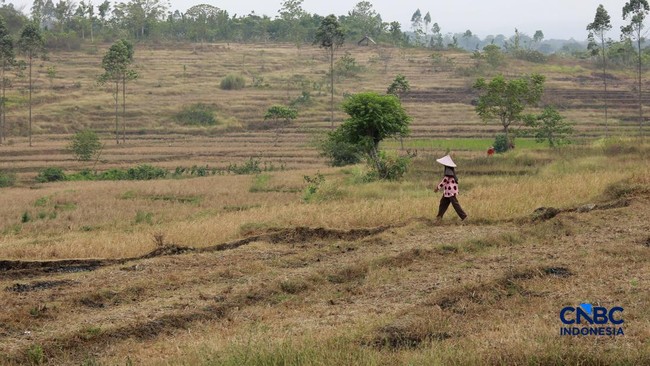
Jakarta, CNBC Indonesia – The effects of the El Niño phenomenon are beginning to show in the condition of Indonesia’s rice crops. Statistics Indonesia (BPS) recorded a decline in the proportion of land currently planted with rice, or standing crop, in September 2026 compared with the same period in previous years.
According to the results of the September 2026 Area Sample Frame (KSA) survey, standing crop accounted for just 20% of the observed area. This was below the 23.10% recorded in September 2023, when Indonesia was also experiencing El Niño.
The September 2026 figure was also the lowest for September compared with 2021, 2022, 2024 and 2025. In those years, the proportion of land planted with rice ranged from 24.67% to 26.46%.
Ateng Hartono, BPS Deputy for Distribution and Services Statistics, said the lower share of rice cultivation in September 2026 coincided with an increase in the proportion of fallow land and land planted with crops other than rice.
“In September 2026, the proportion of land under standing rice crops fell, while the share of fallow or idle land and the share planted with crops other than rice rose, compared with August and with the same period last year,” Ateng said at a BPS press conference on Monday (2 November 2026).
BPS recorded that, of the total agricultural area surveyed in September 2026, most—34.81%—was planted with crops other than rice. A further 25.74% was fallow or left idle.
Meanwhile, land planted with rice, or standing crop, accounted for only 20%. Land already harvested made up 11.74%, while 6.94% was being prepared for planting. Ateng said a similar pattern could be seen by comparing rice cultivation in September 2023 and September 2026, both periods affected by El Niño.
“In September 2023 and September 2026, when El Niño occurred, the proportion of land under standing rice crops was relatively low, at 23.10% and 20% respectively,” he said.
He said the decline in standing crop indicated a smaller area of rice cultivation in the early vegetative, late vegetative and generative stages. This could be followed by a reduction in potential rice harvest area over the next three months, as each growth stage has a different time to harvest.
“Rice in the generative stage is generally harvested one month later. Rice in the late vegetative stage will be harvested two months later, while that in the early vegetative stage will be harvested in three months,” he explained.
Rice harvest potential at risk of falling
The decline in the proportion of land planted with rice is a condition that requires close attention, as it could affect harvest area in the following period. The KSA survey recorded a rice harvest area of 0.91 million hectares in September 2026, down 19.40% from 1.13 million hectares in September 2025.
Cumulatively, rice harvest area from January to September 2026 reached 9.24 million hectares, a 2.23% decline from the same period last year. Potential harvest area from October to December 2026 is estimated at just 1.54 million hectares, down 17.75%—or about 330,000 hectares—compared with the same period in 2025.
Overall, rice harvest area in 2026 is forecast to reach 10.78 million hectares, a 4.80% decrease from the previous year.
BPS also estimates that rice production in 2026 will reach 57.45 million tonnes of milled dry grain (GKG), down 4.57%, or around 2.75 million tonnes, compared with 2025.
Ateng cautioned that potential harvest-area figures could still change in response to conditions in the fields.
“Our note is that the potential figures may change depending on rice-crop conditions from October to December 2026—for example, if there are pest or plant-disturbance organism attacks, floods or drought, changes to farmers’ harvesting schedules, or other circumstances,” he said.
Source: jawawa.id (https://jawawa.id/newsitem/el-nino-hits-indonesias-farmland-here-is-the-evidence-1793609462)
Originally published by CNBC Indonesia (https://www.cnbcindonesia.com/news/20261102133119-4-781532/bencana-el-nino-hantam-lahan-pertanian-ri-ini-bukti-buktinya), translated from Indonesian