
Ekovokasi Proposed as Solution to Urbanisation Inequality in Major Cities
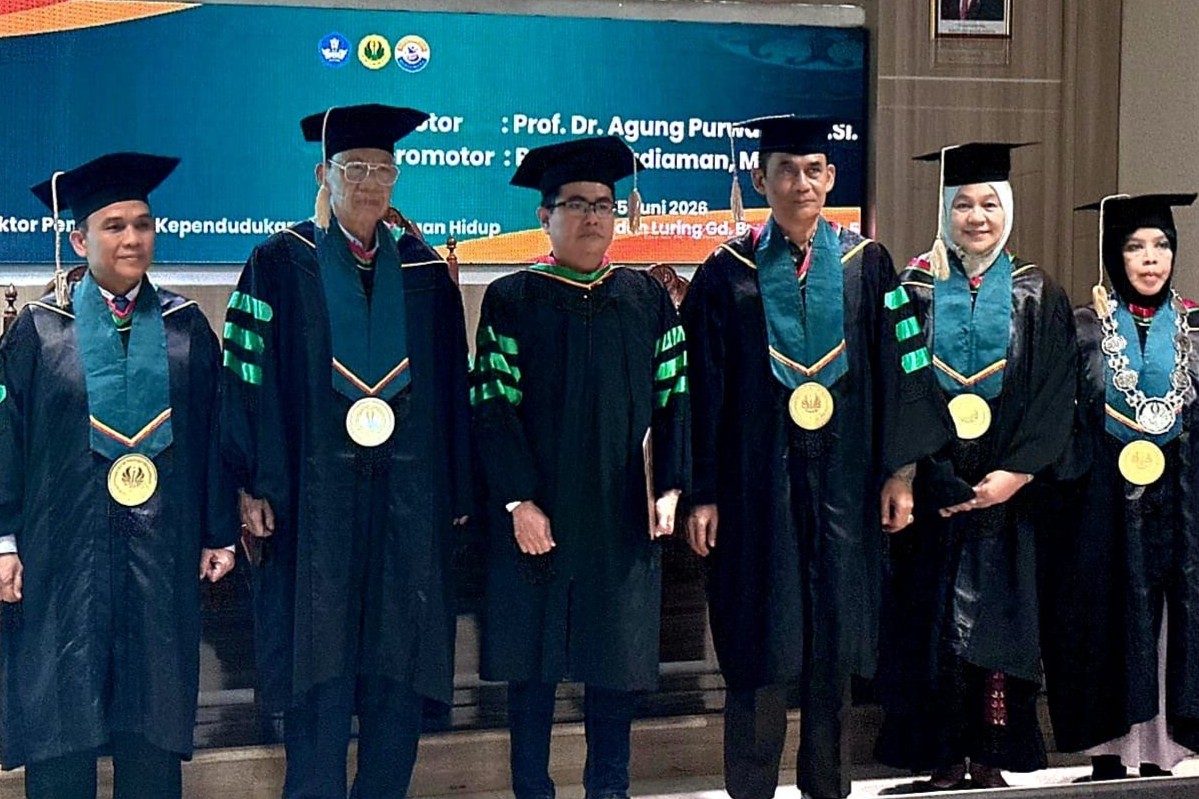
The inequality arising from the urbanisation process in major cities requires an approach that focuses not only on physical development but also on restoring the rights of vulnerable groups. Responding to this challenge, the concept of Ekovokasi (Ekosistem Advokasi-Vokasi) is offered as a transformative model to strengthen social protection, economic empowerment, and the restoration of dignity for migrant women marginalised in urban life. The idea emerged from the doctoral research of Syaifudin in the Population and Environmental Education (PKLH) Study Programme at the Postgraduate School of Jakarta State University (UNJ). The research successfully led him to earn a doctorate with distinction and a perfect Grade Point Average (GPA) of 4.00 during the promotion hearing held at the UNJ Postgraduate School Auditorium on Monday (15/6). Through a dissertation titled ‘From Urbanisation to Ekovokasi: Reconstruction of the Right to the City for Migrant Women in the Trap of Urban Prostitution’, the research examined the impact of urbanisation, which does not always present equal opportunities for all citizens, particularly migrant women in urban areas. Using a critical paradigm qualitative approach combining in-depth interviews, field observation, and policy document studies, the research found that urbanisation, development inequality, and weak social protection have pushed some migrant women into risky informal sectors, including urban prostitution. The research findings indicate that a city development orientation focusing more on economic growth and the capitalisation of space has given rise to social and spatial segregation. This condition results in limited access for vulnerable groups to decent work, social protection, and opportunities to improve their quality of life. This phenomenon is referred to as the ‘urbanisation of inequality’, a process of urbanisation that actually strengthens and reproduces social inequality in urban areas. The research also identified the phenomenon of ‘disconnected citizenship’, a situation where migrant women are administratively recognised as city residents but have not yet obtained equal access to rights substantively. As a result, they remain in a vulnerable position and find it difficult to escape the cycle of poverty and social marginalisation. As an answer to these problems, the Ekovokasi concept was developed by integrating various aspects, from social advocacy, social rehabilitation, social security, and social protection to economic empowerment and the strengthening of vocational skills. This approach is expected to become a more comprehensive recovery instrument for vulnerable groups in urban areas. According to Syaifudin, sustainable city development must place people at the centre of development. An inclusive city, he said, not only provides physical space for its residents but also guarantees access to decent work, social protection, and opportunities for a dignified life. He hopes the Ekovokasi concept can become an alternative approach in fighting for the rights of migrant women who have often been marginalised in the urbanisation process. From an academic perspective, this research offers novelty through the reconstruction of the theoretical framework of Population and Environmental Education (PKLH) by incorporating the Ekovokasi concept as both an analytical instrument and a solution. The findings also expand the study of the right to the city, citizenship, gender, and the environment in the context of contemporary urbanisation. Through this concept, urban development is expected to be oriented not only towards economic growth but also capable of delivering social justice and stronger protection for community groups that have long been on the periphery of development.