
Eko Surya Lesmana Introduces SPLIT Concept: Loss of Critical Voices Signals Fragile Power
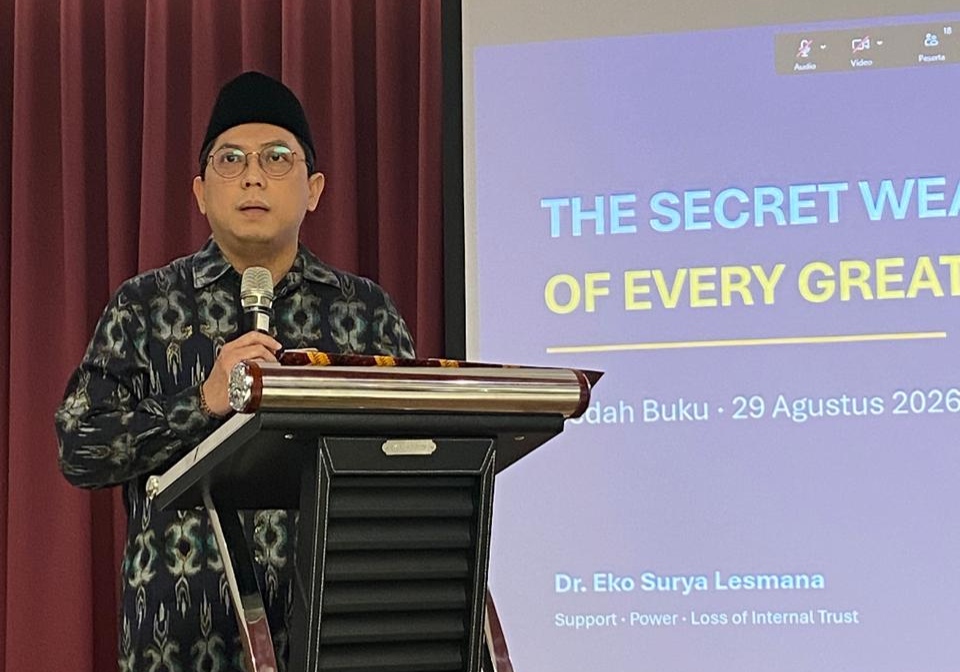
A great power does not always collapse because of attacks from external enemies. Collapse often begins much earlier, when those within it choose to remain silent and stop providing support voluntarily.
This provocative idea is the main topic of discussion in a book review of The Secret Weakness of Every Great Power by Dr. Eko Surya Lesmana at the Nyi Ageng Serang Jakarta Library on 29 August 2026.
Eko Surya Lesmana emphasised that silence within an organisation or state is often misinterpreted as a form of agreement. A leader may feel their position is growing stronger because they no longer hear objections, when in fact this condition could be a signal that trust has vanished.
“Silence is often the earliest sign. A quiet room does not necessarily contain heads that agree. It could be that the room contains hearts that have stopped thinking about the problems we are facing,” said Eko in his statement on Wednesday (26/8/2026).
His professional experience in risk management led Eko to an idea he calls SPLIT. This term describes a phenomenon in which power appears intact and solid from the outside, while support and trust from within slowly drift away.
According to Eko, the collapse of the Soviet Union in 1991 is a clear example of the SPLIT phenomenon. When its flag was lowered, the Soviet Union technically still possessed nuclear weapons and a complete state apparatus. However, the system collapsed because the people’s trust in the foundations of its power had disappeared long before.
The book also dissects the difference between power that merely appears strong and leadership that has real support. Eko refers to historical figures in this regard.
Eko delivered a crucial message for leaders: being loved alone is not enough. Leaders must be able to provide mechanisms so that support can transform into concrete action. Victories achieved must be safeguarded with structures that can endure and trust that remains consistent.
“A good leader is not necessarily the most loved. A good leader is one who can still be trusted even when the people disagree with them,” he asserted.
Written in English to reach an international audience, The Secret Weakness of Every Great Power brings a risk management perspective from Indonesia to the global stage. Eko hopes this work will spark more honest conversations about leadership, where critical voices are no longer seen as a threat, but rather as proof that people still care.
“Trust is a universal currency. Its value is the same in the family room as it is in the state room. That is why trust must be continually invested through honesty and the courage to listen,” Eko concluded.