
Eight Ways to Strengthen the Competitiveness of Indonesian Sharia Banks
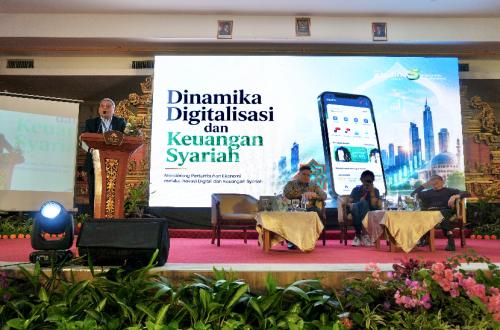
The discourse on the decline in sharia financial inclusion from 13.41 per cent in 2025 to 13.24 per cent in 2026 has come under scrutiny, amid conventional financial services that continue to grow. Observers suspect that sharia finance is not aggressive in capturing the market.
There is a paradox that is rarely spoken openly in Indonesia’s sharia finance industry. Data from the Financial Services Authority (OJK) as of May 2026 recorded national sharia banking assets reaching Rp1,047 trillion, growing 11.07 per cent year-on-year — faster than the growth of national banking in general. Financing grew 10.32 per cent to Rp729 trillion, third-party funds grew 11.66 per cent to Rp810 trillion, and asset quality was actually healthier than the industry average, with a gross non-performing financing ratio of only 2.31 per cent.
But behind those double-digit growth figures, the market share of sharia banking against the total national banking industry is actually stagnant, even slightly declining — holding in the range of 7.2–7.5 per cent throughout 2026, having even fallen from 7.69 per cent at the end of 2025. The cause is simple mathematically but heavy structurally: the asset base of sharia banks is still too small compared to the asset base of conventional banking, which reaches tens of thousands of trillions of rupiah, so that a small nominal increase in conventional banks still far outpaces a high percentage increase in sharia banks.
On the social side, the gap is increasingly felt. The OJK’s 2025 sharia financial literacy and inclusion survey showed that literacy was relatively good at 43.42 per cent, but the inclusion index — namely people who actually use sharia products — was only 13.41 per cent. This means that people ‘know’ about sharia banks, but not many have ‘chosen’ them. On the global stage, Indonesia’s position in the Global Islamic Economy Indicator (GIEI) according to DinarStandard even fell to fourth place in the 2025/2026 report, below Malaysia, the United Arab Emirates, and Saudi Arabia — even though Indonesia remains far ahead in the modest fashion and halal food sectors. Ironically, as the country with the largest Muslim population in the world, Indonesia’s position in the global sharia financial ecosystem is actually losing to countries with much smaller Muslim populations.
Why the Old Recipe?
For years, the industry policy recipe for this problem has almost always been the same: encourage product innovation, expand branch office networks, improve public literacy, and so on. All three are correct, but have proven insufficient to structurally lift market share — because all three operate within the same playing field as conventional banks, only with a different label. When affirmative support from the state — fiscal incentives, regulatory favouritism, a firm political roadmap — comes half-heartedly, sharia banks cannot continue to play on a field whose rules are made for the logic of conventional banks. What is needed is not a patchwork strategy, but the courage to change the playing field itself with the following steps:
First, wholesale banking and supply chain financing. OJK data shows a positive trend: the financing-to-deposit ratio (FDR) of sharia banking continues to rise to 87.65 per cent in March 2026, indicating an increasingly strong contribution to the real sector. Large banks such as BSI, BCA Syariah, and Bank Mega Syariah have also begun to seriously work on the wholesale banking segment and syndicated financing based on corporate and state-owned enterprise ecosystems. This direction needs to be sharpened: sharia banks should not compete for the same consumer market as conventional banks, but rather build supply chain financing based on profit-sharing contracts (mudharabah) for production clusters — agriculture, fisheries, creative industries, and MSME supply chains. This is not a charitable strategy, but a product differentiation that is structurally difficult for conventional banks to imitate without fundamentally changing their business model.
Second, activation of the ZISWAF ecosystem. This is an asset owned exclusively by the sharia ecosystem and is still very far from being utilised. The Indonesian Waqf Board records the national potential of zakat, infaq, alms, and waqf (ZISWAF) at nearly Rp400 trillion per year, with the potential of cash waqf alone reaching Rp180 trillion per year — not including waqf land assets whose value is estimated to exceed Rp2,000 trillion. However, realisation is still very low: accumulated cash waqf that has been successfully collected is only around Rp2–3.5 trillion, less than 2 per cent of its annual potential. A gap of this magnitude is an opportunity, not merely a statistical note. Sharia banks can become the integration node of ZISWAF with productive financing — for example through the Cash Waqf Linked Sukuk (CWLS) scheme that has already been initiated, then expanded into a platform where cash waqf funds finance productive MSMEs, with part of the returns used for the sustainability of empowerment programmes. This is a source of cheap and loyal funding that conventional banks do not have, while strengthening the social function of sharia banks so that they are not merely banks that happen to be sharia, but economic empowerment institutions for the ummah that happen to be in the form of banks.
Source: jawawa.id (https://jawawa.id/newsitem/eight-ways-to-strengthen-the-competitiveness-of-indonesian-sharia-banks-1787154786)
Originally published by Republika (https://analisis.republika.co.id/berita/tk0366451/delapan-jalan-memperkuat-daya-saing-bank-syariah-indonesia), translated from Indonesian