
Eight Monitor Lizards Hidden in Suitcase, South Korean Foreign National Arrested at Airport
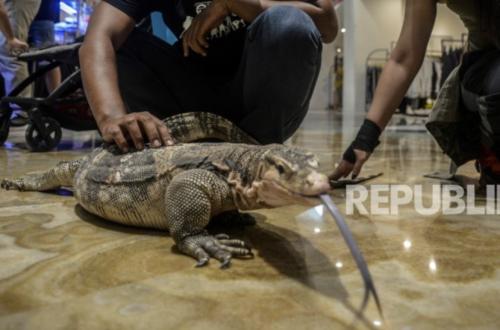
The Ministry of Forestry (Kemenhut) has foiled an attempt to smuggle eight live monitor lizards to Seoul via Soekarno-Hatta Airport in Tangerang, Banten. A South Korean foreign national with the initials JJ (25) was named a suspect after the eight animals were found in his luggage.
Director General of Forestry Law Enforcement at the Ministry of Forestry, Dwi Januanto Nugroho, said the discovery shows that international flight routes are still being exploited for the illegal trade of Indonesian wildlife.
“Repeated discoveries at airports show that the illegal trade of Indonesian wildlife has already utilised cross-border routes. Our response is not sufficient if it is only at the departure gate,” he said in a statement on Monday (17/8/2026).
The case came to light when JJ was about to fly to Seoul via Soekarno-Hatta Airport on Tuesday (28/7/2026). Officers found eight live monitor lizards inside the suspect’s luggage.
The eight animals consisted of six emerald tree monitors (Varanus prasinus) and two Aru Island monitors (Varanus beccarii). All the animals were secured to receive handling and care.
Meanwhile, JJ was handed over to the Forestry Law Enforcement Office for the Java, Bali, and Nusa Tenggara Region (Balai Gakkum Kehutanan Jabalnusra) to undergo legal proceedings.
Based on the examination results and evidence obtained, investigators named JJ as a suspect. He is charged under several articles of Law Number 32 of 2024 concerning Amendments to Law Number 5 of 1990 on Conservation of Biological Natural Resources and Their Ecosystems, as well as other criminal provisions.
The suspect faces a maximum prison sentence of 10 years and a maximum fine of Rp2 billion.
Dwi said investigators are still developing the case to trace the origin of the eight monitor lizards and the possible involvement of other parties. Further investigation is also being conducted to uncover the parties supplying the animals in Indonesia and the networks that are the destination for shipments abroad.
“Indonesia must not become a source of supply for the world’s illegal wildlife market,” said Januanto.
According to Dwi, this is not the first such case handled by the Ministry of Forestry at an international airport. In previous cases at Soekarno-Hatta Airport, the ministry handled the smuggling of 202 reptiles by a Russian foreign national, 134 reptiles by an Egyptian foreign national, 13 live birds by a Chinese foreign national, and 103 reptiles involving Dutch and Lithuanian foreign nationals.
This series of cases shows that international flights remain one of the routes vulnerable to use in the illegal wildlife trade. Therefore, supervision needs to be carried out from the time the animals are obtained until the process of shipment to the destination country.
Dwi said supervision also needs to be strengthened through information exchange with authorities in destination countries. If links to international networks are found, coordination can be carried out through law enforcement cooperation mechanisms, including Interpol.
According to Dwi, eradicating the illegal wildlife trade is part of the government’s policy to protect Indonesia’s biodiversity. The Ministry of Forestry is also tightening supervision to prevent Indonesian wildlife from entering international trade networks.
Head of the Jabalnusra Forestry Law Enforcement Office, Aswin Bangun, said the case was uncovered as a result of coordination among several agencies at Soekarno-Hatta Airport.
“We appreciate the Quarantine Office, Customs, AVSEC, and the Jakarta BKSDA who worked together until this shipment was successfully foiled. Synergy at the exit point will continue to be strengthened, including information exchange and early detection of smuggling methods. From this case, investigators are also continuing to investigate the origin of the animals and the parties involved to develop the investigation,” said Aswin.