
Egyptian President Shot Dead After Announcing Peace with Israel
Peace agreements between several Arab countries and Israel often trigger sharp debates and divisions within those nations. This is particularly the case in countries whose populations are known for vocally opposing Zionism.
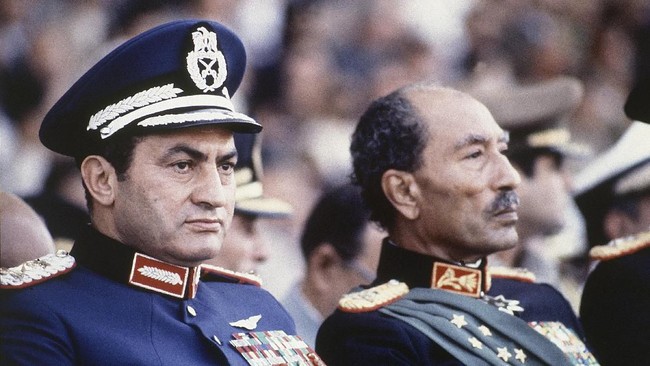
One of the most tragic incidents occurred in Egypt, when President Anwar Sadat (1970-1981) was killed by his own soldiers shortly after signing a peace treaty with Israel.
The incident took place on 6 October 1981, as Sadat attended a large-scale military parade in Cairo. The parade was held to commemorate the success of Egyptian forces in crossing the Suez Canal and breaching Israeli defences during the 1973 Yom Kippur War.
Like other national leaders, Sadat sat in the main grandstand with extremely tight security. No one anticipated anything untoward, as military parades typically use weapons without live ammunition. This is standard procedure in many countries.
However, unbeknownst to all, the Egyptian military ranks had been infiltrated by a group intent on ending the president’s life. As the procession of military vehicles passed in front of the grandstand, a truck came to a halt. One of the officers on board dismounted and saluted Sadat.
Quoting the New York Times, Sadat then returned the salute by standing up. But that salute was merely a ruse. In an instant, three grenades were thrown towards the grandstand, followed by automatic rifle fire from the troops on the truck. Chaos erupted. Sadat collapsed on the spot, along with several officials and spectators.
President Sadat was rushed to hospital and underwent surgery, but his life could not be saved. He was pronounced dead on the same day, 6 October 1981.
The Aftermath of Peace with Israel
The mastermind behind the attack was Lieutenant Khalid Islambouli, a member of the radical Egyptian Islamic Jihad group. This group emerged as a fierce reaction to Sadat’s policies, which were seen as betraying the Palestinian struggle.
Since the establishment of the state of Israel in 1948, Egypt has been one of the Arab countries most vocal in opposing Zionism. The nation repeatedly engaged in wars against Israel, including the Yom Kippur War on 6 October 1973. At that time, Egyptian and Syrian forces launched a surprise attack on Israeli territory coinciding with the Jewish High Holy Day. The assault also went undetected by US intelligence, shocking the world.
According to the book Anwar Sadat: Visionary Who Dared (2013), Anwar Sadat’s stance changed dramatically a few years later. On 26 March 1979, he signed the Camp David Peace Accords with Israeli Prime Minister Menachem Begin, witnessed by US President Jimmy Carter. Sadat believed that Israel could not be defeated militarily, and peace was the best path to regional stability.
That decision sparked a massive wave of domestic rejection. Many groups, including military factions and hardline clerics, viewed Sadat as betraying the Arab cause. From this arose the Egyptian Islamic Jihad group, which then plotted the president’s assassination.
Although the movement was temporarily suppressed, traces of the group did not vanish entirely. One such figure was Khalid Islambouli, also an Egyptian soldier, who carried out the attack during the 1981 military parade. Islambouli himself was captured at the scene. He was subsequently sentenced to death and executed on 15 April 1982.