
Efforts to Preserve Kudus Batik Face the Challenge of Artisan Succession
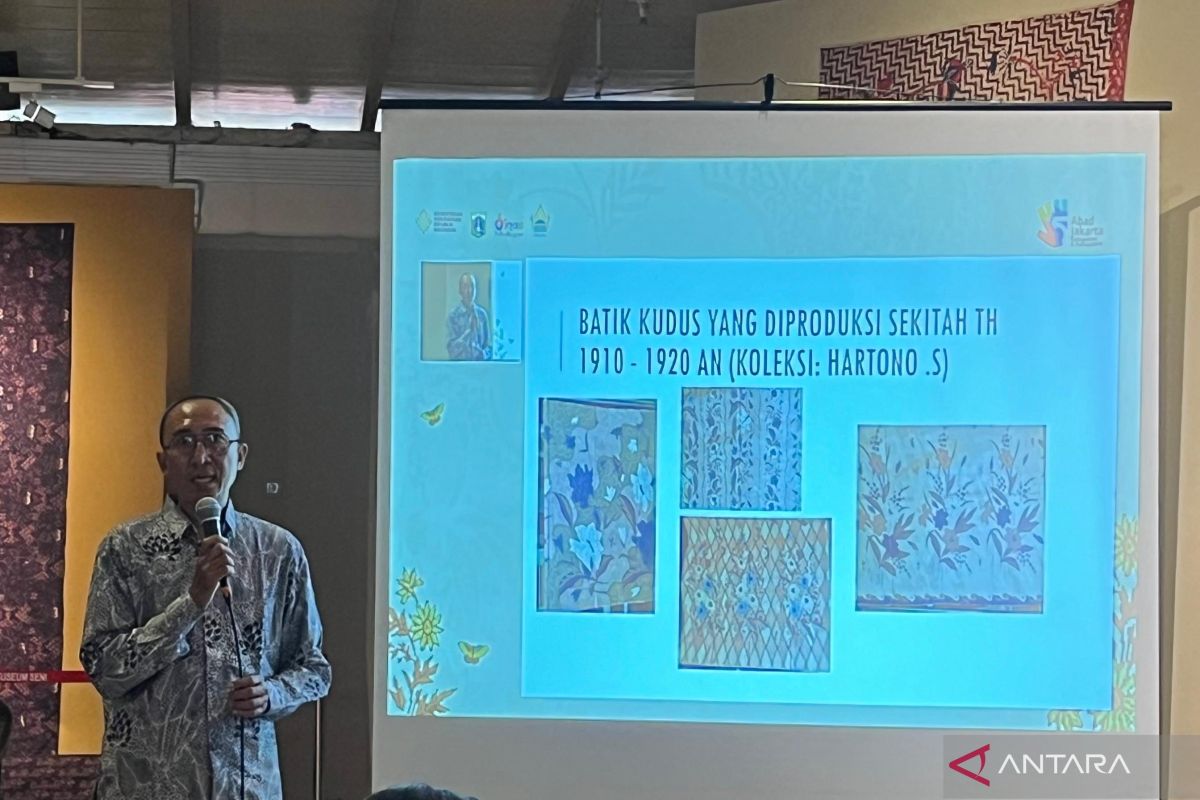
Jakarta (ANTARA) — Kudus batik artisan Muhammad Fadloli said the craft has a long history, although its presence was interrupted across several generations.
He said this did not mean batik-making had stopped altogether. Rather, the artisans who continued practising the craft received little public attention, partly because they were overshadowed by the clove-cigarette industry.
“Kudus batik was, so to speak, overshadowed by the clove-cigarette industry, which was highly dominant,” Fadloli said at the event “Batik Discussion: Reconnecting the Broken Chain” at the Textile Museum in Jakarta on Tuesday.
Fadloli explained that Kudus batik is characterised by a blend of coastal patterns and the soga colours associated with inland batik.
He said Kudus batik reached its heyday around the 1930s. The clove-cigarette industry subsequently expanded in Kudus, employing workers who had previously been batik artisans.
“Kudus itself had a batik-making tradition in the past. But during the clove-cigarette industrial era, entrepreneurs who wanted to produce very fine Kudus batik brought in artisans from Pekalongan, Batang and Lasem,” Fadloli said.
“So if there is very fine Peranakan Kudus batik, the workers were probably from Pekalongan and Batang. Local artisans, meanwhile, worked alongside the artisans from Lasem,” he added.
Fadloli said people in Kudus often used batik as sarongs and long cloths. The tradition of wearing batik remains visible at various events, where men wear batik sarongs.
This encouraged him to revive and preserve Kudus batik, despite having only a very small number of artisans.
“To maintain that tradition, even though we made only small quantities, I remember that at one point we could produce only four sarongs a month. To get more, we placed orders with our family in Solo. This continued until the early 2000s,” Fadloli said.
He said the tradition of wearing batik sarongs in Kudus had continued to grow, particularly among the local santri, nearly all of whom wear them in their daily lives.
However, he lamented that hand-drawn batik artisans have limited production capacity and cannot fulfil large orders.
“What concerns me is that, as hand-drawn batik artisans, we cannot make large quantities. The ones who benefit are printed-batik businesses, because they can meet the required volume,” he added.
Fadloli said preservation efforts must take account of the sources and heritage of antique batik, whose patterns and isen-isen, or filler ornaments, are highly intricate.
He said artisans capable of producing these details usually begin batik-making at the age of 15 and do not become proficient until they are around 40 or 50.
“So it cannot be done overnight. If I have artisans aged 20 to 30, they can make isen-isen, but not as finely as the artisans from Pekalongan. Bringing workers to Kudus, as earlier artisans did, now presents us with many challenges,” he said.
Source: jawawa.id (https://jawawa.id/newsitem/efforts-to-preserve-kudus-batik-face-the-challenge-of-artisan-succession-1793098539)
Originally published by Antara (Indonesian) (https://www.antaranews.com/berita/5814887/upaya-melestarikan-batik-kudus-hadapi-tantangan-regenerasi-perajin), translated from Indonesian