
Education to Increase Public Awareness of Sustainable Waste Management
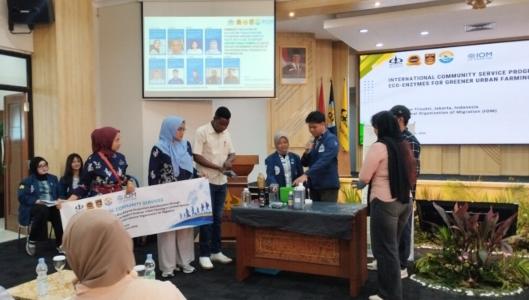
Domestic waste management remains a significant environmental challenge in densely populated urban areas. Consequently, simple yet applicable education is considered vital to increasing public awareness regarding sustainable waste management.
To address this, Universitas Trisakti has partnered with the International Organization for Migration (IOM) Indonesia for an International Community Service (PkM) project. The initiative focuses on processing household waste into environmentally friendly products through the production of eco-enzyme.
“Through this activity, we want to demonstrate that household organic waste still holds utility value. With proper processing, kitchen waste can be transformed into eco-enzyme, which is useful and reduces the environmental waste burden,” said Tazkiaturrizki, a lecturer in environmental engineering and the Chair of the International PkM project, in Jakarta on Tuesday.
According to Tazkiaturrizki, the eco-enzyme concept not only helps reduce the volume of organic waste but can also be utilised to support urban farming in areas with limited land. “Limited land does not mean one cannot farm. Through an urban farming approach, narrow spaces can still be utilised to produce food crops useful for daily needs,”
The activity, held at Universitas Trisakti, involved lecturers from the Faculty of Landscape Architecture and Environmental Technology (FALTL) under the auspices of the Institute for Research and Community Service (LPPM) of Universitas Trisakti. The programme, themed ‘Community Education on Eco-Enzyme Production and Utilization through Domestic Waste Recycling to Support Greener Urban Farming in Limited Spaces,’ was attended by 25 participants under the guidance of IOM Indonesia.
Participants received education and practical training on processing household organic waste, specifically kitchen scraps, into eco-enzyme for household and urban agricultural use. In addition to waste management education, participants were equipped with urban farming skills to optimise small open spaces within migrant residential areas. “We hope this programme can help create a greener environment and support independent food security,” added Tazkiaturrizki.
The programme was designed to address key challenges, including the diversification of waste products and the optimisation of sustainable solutions for communities facing land constraints.