
Education Ministry Prepares 'Lapak Luar Biasa', a Digital Platform for Special Needs Students' Creations
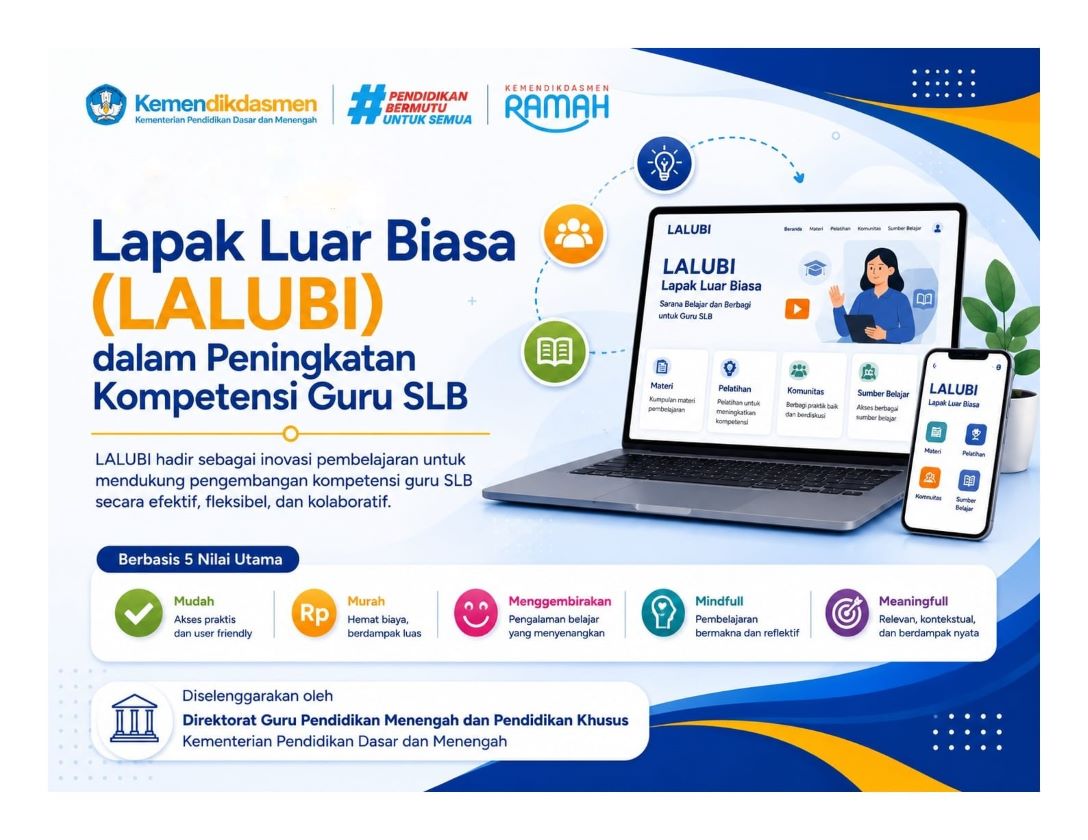
The Ministry of Primary and Secondary Education, through the Directorate of Secondary and Special Education Teachers, continues to drive educational transformations that impact students with special needs. One strategic step currently being prepared is the development of the ‘Lapak Luar Biasa’ (LALUBI) portal, a digital platform designed as a venue for the promotion, marketing, and development of works produced by students with special needs from across Indonesia.
The LALUBI portal serves as an effort to open wider market access for products generated by students in Special Needs Schools (SLB). To date, various works—such as agricultural products, culinary arts, cosmetology, handicrafts, graphic design, and other creative products—have generally been marketed on a limited basis through school exhibitions or local activities.
In reality, many works by students with special needs possess high quality and the potential to compete in a broader market if supported by an adequate marketing ecosystem. To ensure the developed system meets the needs of users in the field, the Directorate of Secondary and Special Education Teachers held a System Trial for the Lapak Luar Bias and Special Needs Portal (LALUBI) from 24 to 26 June 2026.
The activity was conducted in a hybrid format, involving representatives of teachers, school operators, and educational staff from various regions of Indonesia. Offline participants attended the activity at the Teacher and Education Personnel Centre (BGTK) of DKI Jakarta Province, while online participants joined from various regions including Aceh, Sumatra, Java, Kalimantan, Sulawesi, Maluku, and Papua.
Involving participants from all corners of Indonesia was intended to ensure that the built system can address the needs of special education units which possess different characteristics, geographical conditions, and levels of technological readiness.
During the three-day implementation, participants tested various key features of the portal, ranging from user registration, school account management, product uploading, catalogue management, and product searching, to digital promotion. Participants were also asked to provide feedback regarding ease of use, accessibility, data security, and various system development needs before national implementation.
Student Independence
The Director of Secondary and Special Education Teachers, Arif Jamali, stated that LALUBI is part of the government’s efforts to strengthen the independence of students with special needs through skills-based education and entrepreneurship that is relevant to modern developments.
According to Arif, the development of technology and the digital economy has opened new opportunities for persons with disabilities to participate more broadly in economic activities. Therefore, schools need to have facilities capable of connecting skills-based learning outcomes with real market demands.
“LALUBI is not only a digital showcase for students’ works, but also a space to build confidence, independence, and broader economic opportunities for children with special needs,” said Arif.
He explained that the development of the portal will not only target Special Needs Schools but will also be expanded to inclusive education units across Indonesia.
“Children with special needs do not only study in SLB. Many are currently enrolled in inclusive education units. Therefore, moving forward, LALUBI will be developed to serve as a shared platform for all students with special needs to display their work, develop entrepreneurial skills, and gain wider opportunities to participate in economic activities,” said Arif.
The Vital Role of LALUBI
According to him, the need for a platform like LALUBI is increasingly important amidst the development of the global digital economy. Various studies show that digital technology can expand access to employment and business opportunities for vulnerable groups, including persons with disabilities.
In Indonesia, strengthening vocational education and entrepreneurship is also a focus of human resource development. Therefore, the skills education provided to students with special needs needs to be supported by an ecosystem that allows their works to be recognised and valued by society.
Through LALUBI, the public will eventually be able to see various products created by students with special needs from various regions. These products are not merely results of school learning but also have the potential to become sources of income and a means of building economic independence.
Furthermore, Arif hopes that the presence of LALubi can serve as a bridge for collaboration between the government, schools, the community, the business world, and the industrial sector in supporting the empowerment of students with special needs.
He invited companies in Indonesia to take part through Corporate Social Responsibility (CSR) programmes.
Business Sector Support
He noted that support from the business sector does not always have to take the form of financial assistance. Companies can contribute through entrepreneurship mentoring, digital marketing training, product quality improvement, assistance with production equipment, internship programmes, and providing market access for the works of students with special needs.
“LALUBI opens a very wide space for collaboration. We hope that companies can utilise this platform as one of the means to implement CSR programmes that have a direct impact on children with special needs. When companies help improve product quality or open market access for them, they are essentially [contributing to their future].”