
Education Ministry Prepares Inclusive MPLS Guidelines for Special Needs Schools
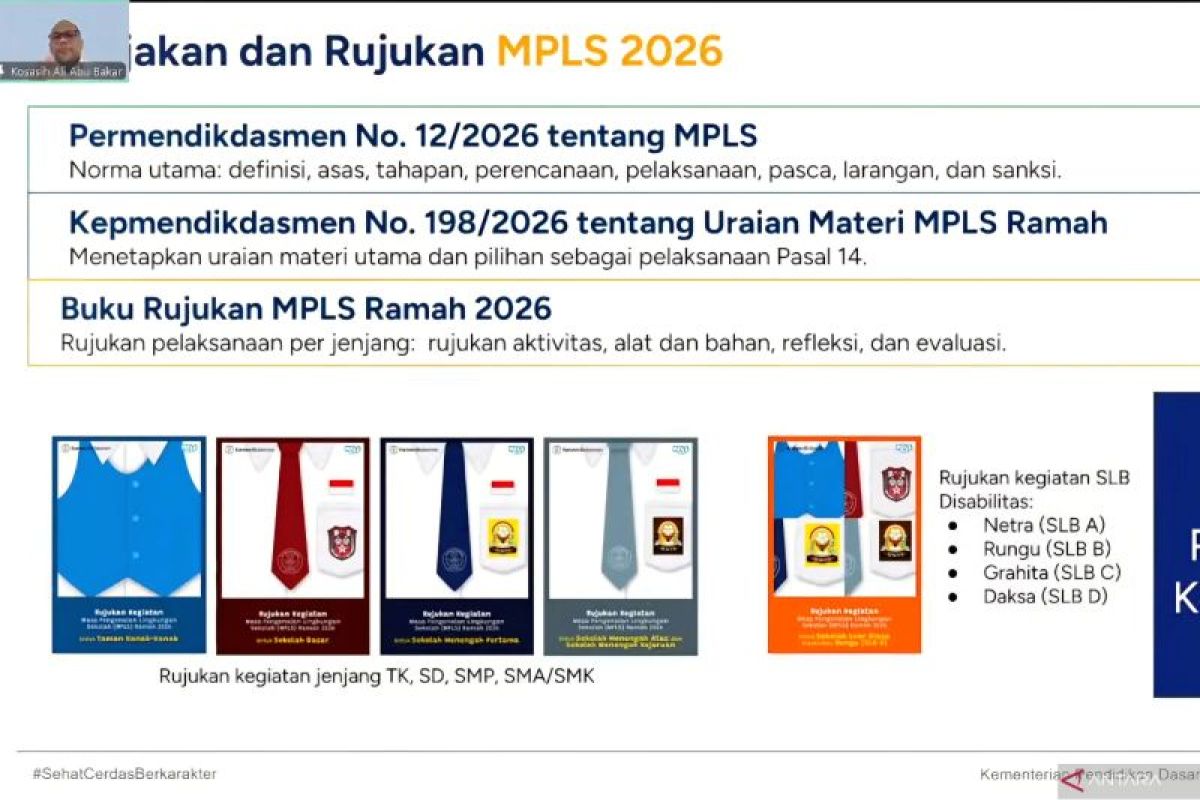
Jakarta (ANTARA) - The Ministry of Primary and Secondary Education (Kemendikdasmen) has prepared a set of reference activities for special needs schools (SLB) to implement during the Masa Pengenalan Lingkungan Sekolah (MPLS) Ramah, designed to accommodate the specific challenges faced by students with disabilities.
Kosasih Ali Abu Bakar, Head of the Character Strengthening Centre Team at Kemendikdasmen, stated that the Ramah MPLS must be an initial activity for new students that provides a conscious, meaningful, and joyful learning experience, including for children with special needs (ABK). ‘By respecting every child’s rights and honouring all members of the school community, the school becomes a safe and comfortable second home for all students,’ Kosasih said during a webinar on Tuesday.
For SLBs, the ministry has prepared four activity reference books tailored to different disabilities: visual impairment for SLB A, hearing impairment for SLB B, intellectual disability for SLB C, and physical disability for SLB D. For SLB B, for instance, the reference includes activities using video players, laptops, whiteboards, visual and photographic flashcards, simple sign language cards, and various physical activities. ‘So for SLB, we created the references based on the students’ disabilities. So far, there are four categories, and in each reference book, we have also arranged activities according to the educational level,’ Kosasih explained.
For regular schools, the ministry has also compiled activity references to help detect any special needs among students following the Ramah MPLS activities. ‘This screening is not a tool for medical diagnosis, psychological assessment, or determining a student’s disability status. The results serve as a basis for referring students to professional services, while also being used by teachers to prepare necessary support, such as assistive devices, mentoring, and learning adjustments,’ he said. The screening aims to provide an overview of potential obstacles or difficulties a student may experience, including visual, hearing, intellectual, physical motor, and mental (emotional and behavioural) impairments, as well as communication and interaction disorders (autism), attention deficit hyperactivity disorder (ADHD), specific learning difficulties, Down syndrome, slow learner intellectual barriers, and giftedness (CIBI).