
Education Ministry Highlights Interactive Panels as Key to Engaging Teaching Experience
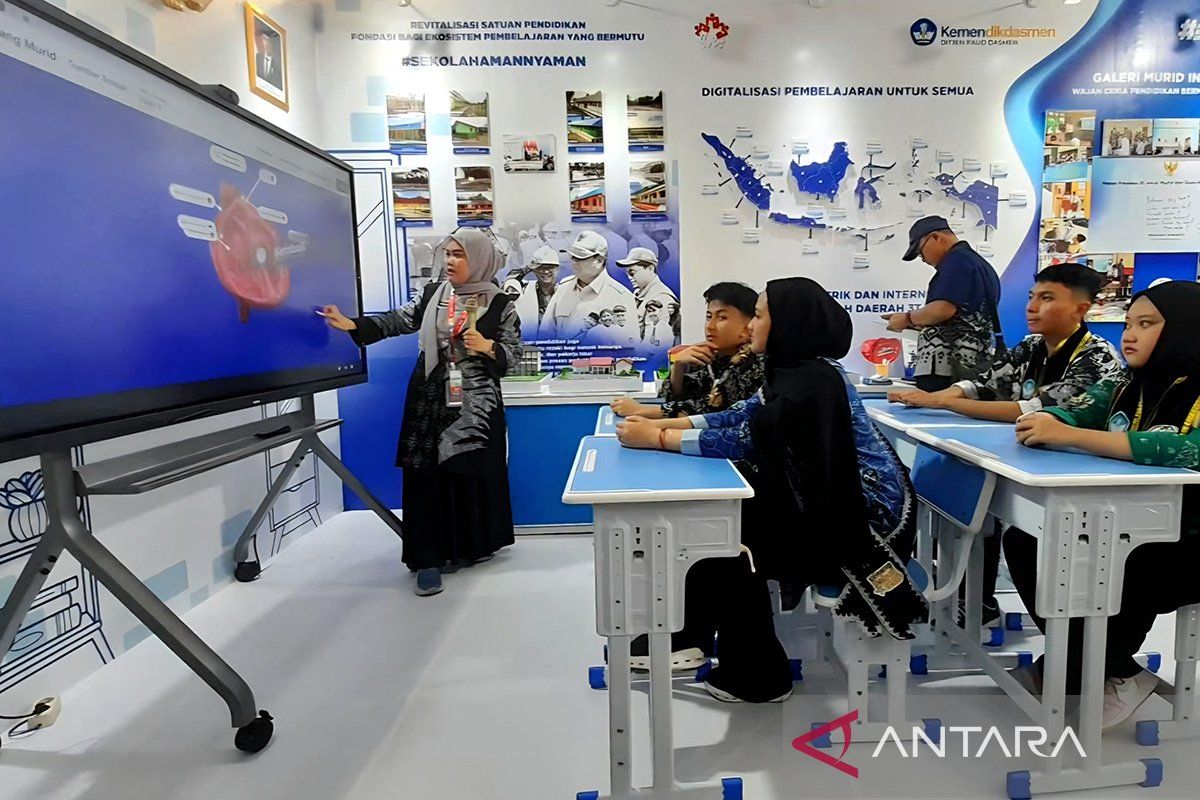
Jakarta (ANTARA) - The Ministry of Primary and Secondary Education (Kemendikdasmen) has stated that the use of Interactive Flat Panels (IFPs) is providing a memorable teaching experience by facilitating material delivery for a number of teachers in Purbalingga Regency, Central Java.
Director General of Vocational Education, Special Education, and Special Service Education at Kemendikdasmen, Tatang Muttaqin, said in a written statement in Jakarta on Monday that the digitalisation of learning through the distribution of IFPs is the ministry’s effort to ensure teaching and learning activities in every classroom are feasible, safe, and comfortable with the help of more adequate technological access.
On a separate occasion, Ahmad Fahrudin, a Physical Education, Sports, and Health (PJOK) teacher at SMPN 2 Kutasari Purbalingga, said the experience of teaching the ‘Senam Anak Indonesia Hebat’ (Great Indonesian Children’s Gymnastics) has changed since the arrival of the IFP. According to Ahmad, the features that help him the most are multimedia video playback, screen mirroring, and direct annotation on the screen. The annotation function on the IFP allows a person to make specific notes to explain or provide comments. This function, he said, is capable of sharpening students’ understanding and fostering critical thinking patterns while opening up opportunities for discussion.
A similar experience was felt by Patmiarsih Winarni, a science teacher from the same school who has been teaching for 25 years. According to her, the IFP presents a much more lively learning experience compared to conventional methods. “The IFP makes it easy to present videos, presentations, YouTube, and current news that is relevant to the material. The most memorable experience is when students are very enthusiastic about participating in interactive quizzes and educational games. Children who usually pay less attention immediately focus on the screen because the learning feels fun,” she said.
Patmiarsih added that the digital whiteboard, annotation, and screen mirroring features are her favourites. “I can access various references quickly, give notes directly on the screen, while also adapting learning to the students’ needs. Visual learners learn through videos and infographics, auditory learners through audio, while kinaesthetic learners can come forward to touch, write, or move objects on the screen,” she said. Thus, technology is not just a device in the classroom, but truly becomes a bridge that helps teachers deliver more effective, interactive, and relevant learning for the needs of today’s generation.