
Education Minister Regulates Distance Learning for Schools Affected by Forest Fire Haze
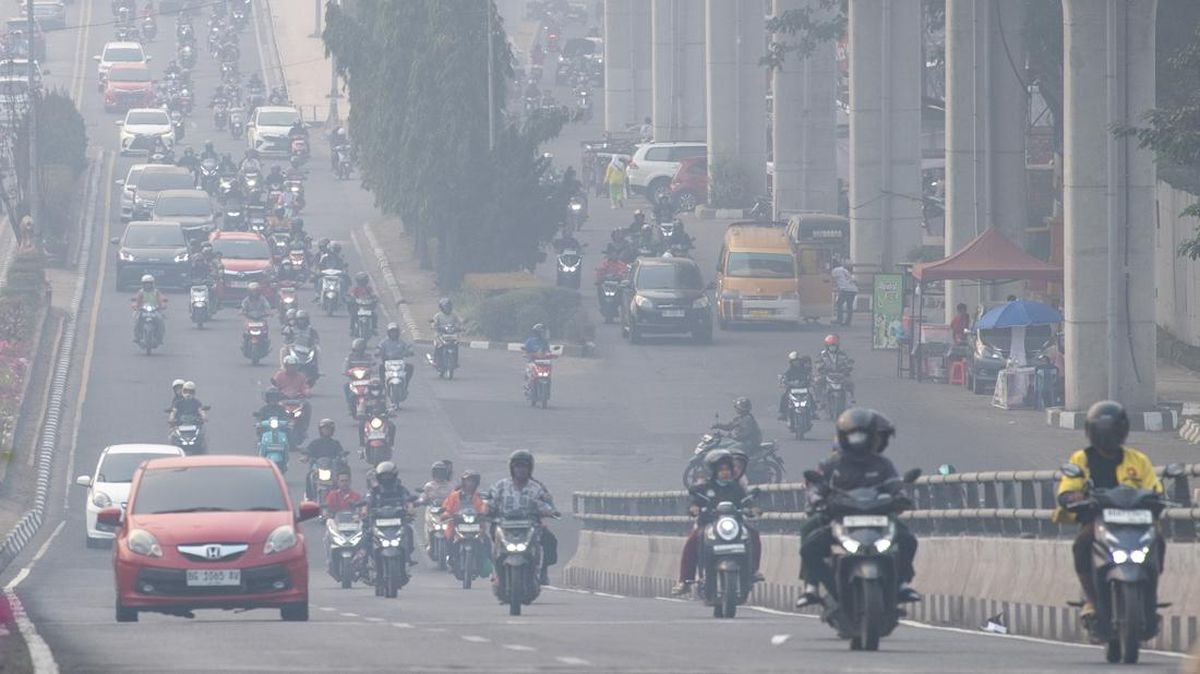
Minister of Primary and Secondary Education Abdul Mu’ti has regulated the implementation of distance learning for schools affected by haze from forest and land fires. The policy is applied based on the level of air pollution and health risks in each respective region.
The provision is set out in Circular Letter of the Minister of Primary and Secondary Education Number 20 of 2026 concerning the Provision of Education Services at Education Units in Areas Affected by Forest and Land Fire Haze, issued on Friday (28/8).
The circular was issued because forest fire haze is considered to have an impact on the health and safety of students, educators, and education personnel, as well as disrupting the learning process.
“The provision of education services at education units in areas affected by forest fire haze is carried out with due regard to air quality conditions, health risk levels, and the characteristics and needs of education units and students,” the circular states.
Local governments, through education offices, determine the learning mode by referring to the daily Air Pollutant Standard Index (ISPU). Air quality is monitored at least twice a day, namely before learning activities begin and in the middle of the day.
For ISPU 1-50, or the good category, learning continues to be carried out fully in person. At ISPU 51-100, or the moderate category, learning is still in person, but outdoor activities such as ceremonies, sports, and extracurricular activities are limited or moved indoors.
When the ISPU reaches 101-200, or the unhealthy category, in-person learning is carried out on a limited basis. Distance learning is applied for vulnerable groups, including early childhood education students, primary school grades 1 to 3, special school students, and students with comorbidities.
Meanwhile, at ISPU 201-300, or very unhealthy, schools are required to temporarily stop in-person learning and switch to distance learning. Distance learning can be carried out online or offline according to conditions.
“Distance learning,” the circular states in the learning mode provisions for the ISPU 201-300 category.
For ISPU above 300, or the hazardous category, all gathering activities at education units are stopped. Schools then prioritise evacuation and health protection and coordinate with the Regional Disaster Management Agency and health offices.
Changes in learning mode are determined by the regent/mayor through the education office for early childhood education, primary schools, and junior secondary schools. Meanwhile, for senior secondary schools, vocational schools, and special schools, the decision rests with the governor through the provincial education office.
However, if air quality suddenly deteriorates while a decision from the authorised official has not yet been issued, the head of the education unit may take precautionary measures first.
Such measures may include stopping outdoor activities, sending students home early, or switching learning to distance learning. The school principal is then required to report this to the education office no later than 1x24 hours.
The decision on changing the learning mode is valid for a maximum of three days and is evaluated daily based on ISPU developments. The circular also explicitly states that stopping in-person learning does not mean schools are closed.
“The temporary suspension of in-person learning is not to be interpreted as a holiday and does not reduce the right of students to receive learning services,” the circular states.
In its implementation, distance learning does not have to be carried out via the internet. The circular regulates that learning can be carried out online, offline, or a combination of both, taking into account the availability of electricity, internet networks, and student devices.
For schools that do not have access to electricity or the internet, learning can be carried out through printed modules, activity sheets, home-based assignments, visiting teacher assistance with due regard to safety, as well as local radio and television.
The learning load during the emergency period is also simplified with a focus on literacy, numeracy, and character strengthening. Schools are asked not to give assignments that burden students or parents.
On the other hand, affected schools are required to prepare at least one smoke-safe classroom as a temporary shelter. The room can be equipped with ventilation covers, damp cloth curtains, exhaust fans, and HEPA air purifiers if available.
The Ministry of Primary and Secondary Education also requests special attention for vulnerable groups, such as young children, primary school students, students with disabilities, and students with comorbidities.
Meanwhile, activities that require students to gather in large numbers or are carried out outdoors, such as assessments, student activities, and new student admissions, can be rescheduled or held online.
To monitor conditions in the field, the Ministry of Primary and Secondary Education will activate Forest Fire Emergency Education Posts in affected provinces. Schools are also asked to report learning conditions every day, including ISPU values, learning modes, the number of affected students, and health disruptions.
After air quality improves, schools are asked to conduct diagnostic assessments and recovery programmes for students who have fallen behind in their learning.