
Education Becomes an Important Legacy from Sorowako's Mining Area
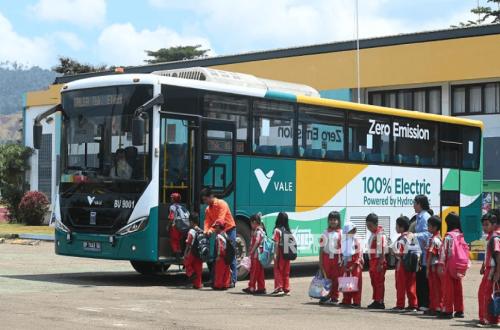
Hirwaty Aris still recalls that sense of pride. In the past, when her name was called to step onto the stage to receive a scholarship, her chest filled with excitement. Now, the same feeling returns, not for her, but as she watches her children stand on the same stage.
“Earlier I was proud when called to go on stage to receive a scholarship award. Now I feel that pride again when my children receive scholarships,” she said.
Hirwaty is one of the residents of Sorowako, Luwu Timur, a nickel mining area that not only stores wealth underground but is also beginning to build the future of the surrounding community. Behind the industrial activity, a new hope grows from children who come to school each morning with aspirations to become teachers, technicians, nurses, and engineers.
For many of them, their families are daily wage workers and local residents who have lived side by side with the industrial area for years. School is not merely a place to learn but a bridge to a better life.
That bridge was built by the Sorowako Education Foundation (YPS), which manages education from kindergarten to polytechnic with the support of PT Vale Indonesia Tbk, a member of the mining industry holding MIND ID. About 70 percent of the students nurtured by the foundation come from low-income families in the mining area. There is even a kindergarten specifically for local community children, not the company’s employees’ children.
Vale’s scholarship programme, which has run since the early 2000s, covers school fees, uniforms, books and study equipment. For families like Hirwaty, the assistance is not merely about education costs but also the belief that their children’s futures can change for the better.
“Hopefully local children can go to university and compete. I want my children to be more successful than me,” she said.
That hope now has more open pathways. At higher education level, Sorowako Polytechnic has emerged as a centre for developing industrial talent in Eastern Indonesia. About 70 percent of its students come from Luwu Timur.
What sets Sorowako Polytechnic apart from many other vocational institutes is the freedom of its graduates to determine their career futures. Sorowako Polytechnic graduates are not bound to work for the company that founded it. They are free to choose their own workplaces with diplomas and official competence certificates from the Professional Certification Institute (LSP).
“Usually if other companies establish a polytechnic, it’s for their talent pooling. But for us, after graduation they are free to seek work anywhere,” said YPS Chair Firman Fauzie.
As a result, a number of companies are now actively monitoring Sorowako Polytechnic graduates because they are considered job-ready without the need for retraining. The schools under the foundation have also adopted the Cambridge curriculum for science and mathematics subjects. That move gives children in Luwu Timur the opportunity to obtain an education standard on par with students in big cities.
In the midst of ambitions towards Indonesia Emas 2045, Sorowako’s story reminds us that wealth of natural resources will be more meaningful when the surrounding communities grow through education. From the classrooms in Luwu Timur, tomorrow’s generation is being built through dreams and opportunities that are continuously nurtured.