
EDS16 and CPOPC Call for Palm Oil Investment to Create Quality Jobs
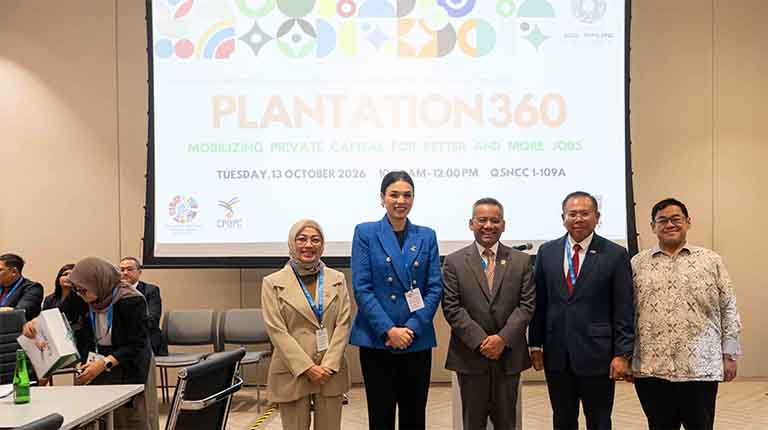
BANGKOK — Investment in the palm oil industry should not focus solely on increasing production. Private capital needs to be channelled into improving smallholder productivity, developing downstream industries and creating quality jobs so that the sector’s growth benefits rural communities more widely.
The issue was discussed at a seminar titled Plantation 360: Mobilizing Private Capital for More and Better Jobs, held by the Office of the Executive Director for the South-East Asia Voting Group (EDS16) of the World Bank Group and the Council of Palm Oil Producing Countries (CPOPC). The event took place on the sidelines of the 2026 Annual Meetings of the World Bank and the International Monetary Fund (IMF) in Bangkok, Thailand, on 13 October 2026.
The forum explored how investment opportunities across the palm oil value chain could be turned into viable business projects that also expand employment and strengthen rural economies. Topics included replanting, improved cultivation practices, processing, product traceability, digital services and the use of palm biomass.
CPOPC Secretary-General Izzana Salleh said investment in the palm oil sector should not be driven solely by production expansion. It should also promote value creation, widen opportunities for smallholders and micro, small and medium-sized enterprises (MSMEs), and improve job quality.
“Investment in the palm oil sector should not only expand production. It should help businesses create added value, give smallholders and MSMEs a fair opportunity to participate, and create jobs with better prospects for workers and rural communities,” Izzana said.
She said the palm oil value chain had significant potential to drive economic activity in producing countries. It encompasses not only cultivation on plantations, but also transport, processing, trade and various downstream industries.
More than seven million smallholders worldwide depend on palm oil for their livelihoods. Their numbers underline the direct impact that investment policies in the sector can have on people’s welfare, particularly in rural areas whose economies rely on plantations.
Indonesia’s Ambassador to Thailand, Hari Prabowo, opened the seminar. In the keynote address, Indonesian Finance Minister Suahasil Nazara discussed the role of development finance in driving investment and creating better jobs.
The forum also featured World Bank Group Vice-President for Planet Guangzhe Chen, who discussed the links between resilient rural transformation, job creation and private sector-led development.
From an investor’s perspective, Jeep Kline, a board member of Raisewell Ventures, highlighted opportunities for innovation in sustainable value chains, product traceability and smallholder engagement. Meanwhile, Malaysian Palm Oil Association chief executive Roslin Azmy Hassan discussed how sustainability efforts could go hand in hand with profitability and long-term industry growth.
The discussion stressed that sustainable investment requires a balance between commercial viability and economic benefits. Investors need policy certainty, reliable information, market access and risk-management mechanisms. Smallholders and MSMEs, meanwhile, need financing and technical assistance suited to their circumstances.
Plantation replanting was identified as one area requiring investment support. The programme is not only about replacing trees, but also about boosting productivity and sustaining smallholders’ incomes over the long term. As replanted trees take time to yield, financing arrangements need to account for farmers’ living costs during that period.
Maharani Hapsari of Gadjah Mada University offered perspectives on replanting and the adoption of good cultivation practices. The discussion emphasised that productivity gains need to be supported by smallholders’ technical capabilities so that invested capital leads to improved plantation performance.
Another challenge is expanding access to finance for smallholders and MSMEs. Naphongthawat Phothikit of the Bank of Thailand discussed the potential of digital payments and safe, practical financing solutions to meet the needs of these groups.
Digitalisation could improve transaction records, increase transparency and broaden access to financial services. Its implementation, however, requires adequate infrastructure, digital literacy, user protection and services tailored to the characteristics of plantation communities.
Beyond cultivation, downstream industry development and biomass use were also discussed. Dikki Akhmar of the Indonesian Palm Kernel Shell Entrepreneurs Association examined the potential of palm biomass to support new businesses and create jobs.
Using plantation and processing by-products could open up additional economic opportunities if supported by technology, infrastructure, reliable supply and adequate markets. These businesses could also increase local companies’ participation in the palm oil supply chain.
Reynaldi Hermansjah of PT Sarana Multi Infrastruktur discussed lessons from public-private partnerships in development financing. Amri Bukhairi Bakhtiar of the Indonesia-Malaysia-Thailand Growth Triangle highlighted opportunities for regional cooperation to link investment with stronger value chains.
Both speakers drew attention to the importance of collaboration in overcoming barriers to investment. Government and development finance institutions can help prepare projects, strengthen their commercial viability and reduce risks that deter private capital.
EDS16 Alternate Executive Director Nakhafi Hassan said transforming agricultural value chains required the active involvement of investors, financial institutions and industry. Public resources played an important catalytic role, he said, but could not replace the funding capacity that private capital could provide.
“There is no path to the transformation we aspire to without the active participation of investors, financial institutions and industry. Public resources are vital as a catalyst, but cannot replace the scale that private capital can bring,” Nakhafi said.
His remarks underscored the importance of dividing responsibilities between the government and the private sector. The government can strengthen regulation, infrastructure and development support, while investors bring capital, technology, innovation and business-development capacity.
Investment success, however, should not be measured solely by the amount of capital flowing in or by increased production capacity. It should also be assessed by its ability to expand employment, improve workers’ skills and enable smallholders and MSMEs to share in the industry’s added value.
EDS16 and CPOPC will consider the seminar’s findings in further discussions on viable investment opportunities, inclusive financing and partnerships to strengthen resilient agricultural value chains.
For palm oil-producing countries, the next challenge is to ensure that industry growth goes hand in hand with improved public welfare. With appropriate financing, downstream industry development and smallholder participation in the value chain, palm oil investment is expected not only to expand economic activity but also to provide more productive and sustainable jobs.
Source: jawawa.id (https://jawawa.id/newsitem/eds16-and-cpopc-call-for-palm-oil-investment-to-create-quality-jobs-1792162246)
Originally published by news.majalahhortus.com (https://news.majalahhortus.com/eds16-dan-cpopc-dorong-investasi-sawit-ciptakan-lapangan-kerja-berkualitas/), translated from Indonesian