
Editorial: Indonesia Enters the Era of Artificial Intelligence, But Must Not Only Become a Market
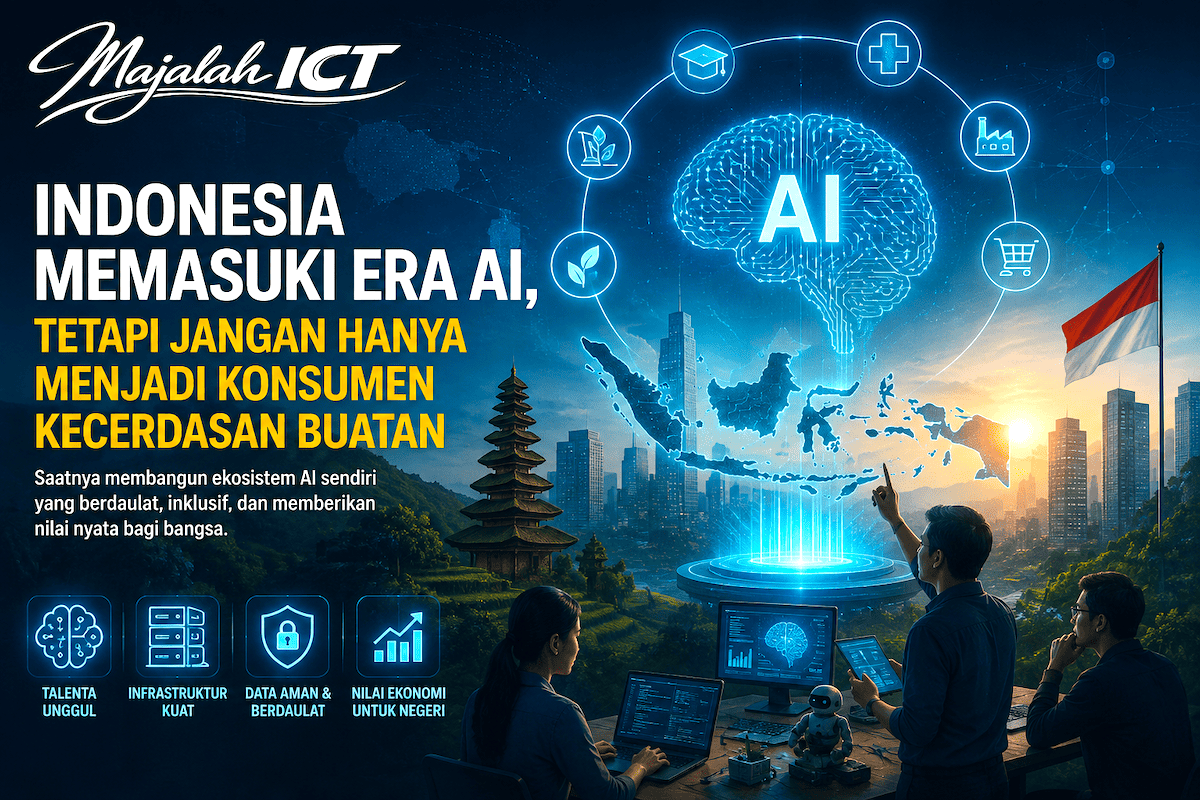
Indonesia is entering a new phase in its digital transformation journey. Artificial intelligence (AI) is no longer just a future technology discussed in conference rooms. AI is now present in education, health, industry, public services, finance, media, trade and everyday life.
Major investments in data centres, GPUs and AI factories are also beginning to arrive. Technology companies are racing to build computing infrastructure. The government is encouraging the development of AI talent and ecosystems. The public is becoming increasingly familiar with various generative AI services.
All of these developments certainly deserve appreciation.
But there is one question we must begin to ask seriously: Is Indonesia building its own AI strength, or is it merely preparing itself to become a large market for AI made by other countries?
This question is important because being an AI user is the first step, not the final goal.
Indonesia has a population of more than 280 million and a digital economy that continues to grow. For global technology companies, Indonesia is certainly a very attractive market. The more people use AI, the greater the economic value created from data, computing, digital services, applications and the various ecosystems behind them.
But if most AI models, GPUs, cloud platforms, algorithms and intellectual property remain abroad, then Indonesia risks becoming merely a consumer in the global AI value chain.
We buy services.
We use the applications.
We pay for the computing.
We generate data.
But the greatest value from that technology does not necessarily stay in Indonesia.
This is what must be avoided.
Indonesia does not need to close itself off from global AI technology. We actually need collaboration with the world’s technology companies. It would be unreasonable for Indonesia to build everything itself.
However, openness to global technology must go hand in hand with domestic capability to build our own technology.
We need more AI researchers, machine learning engineers, data scientists, application developers, AI security experts and talent capable of understanding both AI and the real problems in industrial sectors. We need universities that not only teach how to use AI, but are also able to conduct research and create AI innovations.
We also need AI models that understand Indonesia.
Indonesia is not just the Indonesian language. We have a diversity of regional languages, cultures, social characteristics and development needs that are very different from other countries. AI that truly understands Indonesia can become a strategic asset, not just a technology product.
Therefore, the ambition to build national AI should not be measured by the question of whether we can create an ‘Indonesian version of ChatGPT’.
The more important measure is whether we are able to build an Indonesian AI ecosystem.
That ecosystem requires computing, data, energy, networks, talent, models, applications, capital, research, industry and regulation that are interconnected.
The development of AI factories and large-scale data centres is an important step. But Indonesia must not merely provide land, electricity and GPUs to run global companies’ AI.
Every AI investment must generate value creation domestically.
There must be talent that grows.
There must be local companies that develop.
There must be research that emerges.
There must be new startups.
There must be applications that solve Indonesia’s problems.
And most importantly, there must be economic value that stays in Indonesia.
We must also be careful that AI transformation does not turn into merely a race to buy technology.
Buying thousands of GPUs does not mean having an AI industry.
Having an AI factory does not automatically mean becoming an AI hub.
Using ChatGPT, Gemini, Claude or various other AI models also does not automatically make our nation master AI.
Mastery of technology occurs when we are able to understand, develop, modify, create and generate value from that technology.
This is where the government has a major task.
Indonesia’s AI policy must be directed not only to accelerate adoption, but also to strengthen national capability. Investment incentives must be linked to talent creation, research, knowledge transfer, local industry development and domestic added value.
The government also needs to be an early adopter of AI in public services, but with good governance. Digitalisation and AI must not create new dependence on vendors.
We must learn from previous digital transformation experiences. Indonesia once experienced a phase when digital devices and technology grew very rapidly, but most core technology remained abroad.
The AI era must not repeat the same pattern.
We must not become a nation that uses AI the most, but owns AI the least.
We must be a market, but at the same time a producer.
We must be users, but also developers.
We must attract foreign investment, but at the same time ensure that investment gives birth to national capability.
And we must open ourselves to global technology, but still have technological choice and sovereignty for strategic sectors.
Indonesia is at a critical point.
AI can become a new productivity engine that improves economic competitiveness, accelerates public services, helps education and health, and opens new employment opportunities.
But AI can also widen inequality, create technological dependence and cause most economic value to flow abroad if we do not have the right strategy.
Therefore, Indonesia is entering the AI era not merely to become a consumer of artificial intelligence.
We must become creators, developers, users and at the same time owners of the value from that technology.
Technological independence in the AI era does not mean Indonesia must make everything itself.
Independence means we have the ability to choose, develop, control and utilise technology for the nation’s interests.
In the end, the biggest question is not:
‘How many Indonesians use AI?’
But:
‘How much is Indonesia able to create value from AI?’
If we can answer that question correctly, then AI will not only be a technology used by Indonesia.
AI can become one of the new engines for Indonesia to grow, be sovereign and determine its own future.