
Editorial: Ensuring the Digital Transformation Does Not Benefit Only Global Platforms
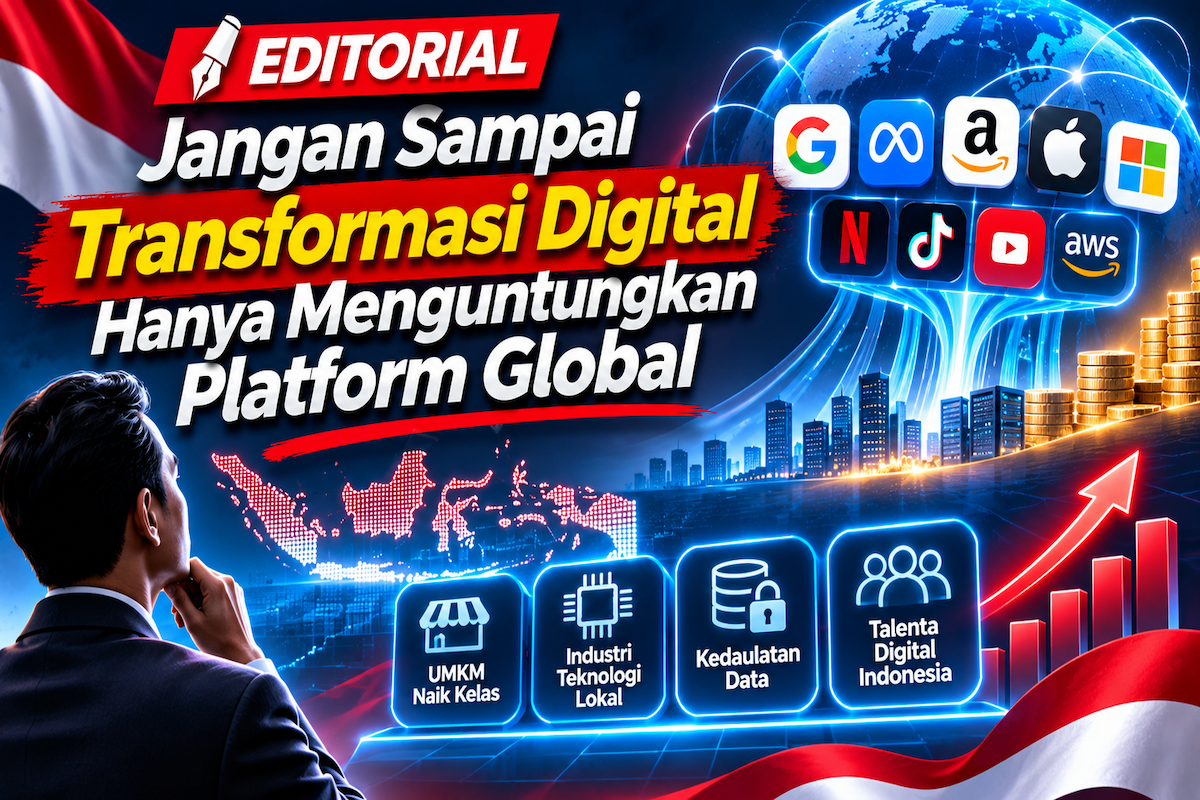
MAJALAH ICT – Jakarta. Indonesia is moving further into the digital economy. People shop on e-commerce platforms, book transport and food through apps, make digital payments, enjoy streaming services and use artificial intelligence to work and study. Digital activity has become part of everyday life.
On paper, this progress looks encouraging. The number of internet users is growing, digital transactions are increasing, infrastructure investment is rising and technology-based services are becoming easier to access. But there is a fundamental question we need to ask: who is benefiting most from the economic value of Indonesia’s digital transformation?
Indonesia must not become merely a large market while the biggest profits, control of technology, ownership of data and command of the ecosystem remain in the hands of global platforms.
This is an issue the government must not overlook.
The digital transformation should be a means of strengthening the national economy, boosting productivity, creating high-quality jobs and fostering domestic technology industries. It should not simply shift people’s economic activity to apps whose added value is enjoyed largely by companies based overseas.
We are not objecting to the presence of global companies. They bring investment, technology, innovation, market access and efficiencies that people need. Indonesia also needs to collaborate with international players to accelerate the development of its digital ecosystem.
But openness must not mean losing bargaining power. Competition must be fair, rules must apply equally and economic contributions should be commensurate with the benefits gained from the Indonesian market.
We must not become a country that is among the most active in using technology but among the weakest in capturing its economic value.
Where does the economic value of Indonesian data go?
One of the most strategic issues is control of data. Every day, hundreds of millions of people’s digital activities generate vast amounts of data. Transaction records, consumer behaviour, user preferences, mobility and social interactions all have significant economic value.
Data has become the fuel of the digital economy and artificial intelligence. Those able to collect, process, analyse and use it will have a competitive advantage.
The question is whether Indonesia is obtaining optimal added value from data generated by its own people.
Data sovereignty should not be understood solely as an obligation to store data domestically. More important is ensuring sound governance, protection, lawful access and productive use, as well as enabling national industries to develop data-based products and services.
Indonesian people’s data must not become a source of business advantage for others while domestic companies struggle to access the technology, financing, computing power and research capacity needed to compete.
MSMEs must not be merely platform users
The position of domestic businesses, particularly micro, small and medium-sized enterprises (MSMEs), is another concern.
Digitalisation is often promoted as a way for MSMEs to reach wider markets. That is true: digital platforms provide access that was previously difficult to obtain. But joining a platform does not automatically make an MSME stronger.
As businesses become more reliant on platforms, questions arise over service fees, commissions, search algorithms, access to consumers, customer data management and unilateral policy changes. Businesses may own their products, but their access to markets and relationships with customers increasingly depend on platform owners.
For this reason, the digitalisation of MSMEs must not stop at onboarding programmes or simply encouraging traders to open online shops.
The government must ensure that MSMEs can build brands, develop products, manage customer relationships, use data, master digital marketing and improve productivity. They must progress into competitive digital-economy businesses, rather than remain mere suppliers of goods to platform ecosystems.
Digital investment must build national capacity
The same principle applies to investment in data centres, cloud computing, artificial intelligence, telecommunications networks and other digital infrastructure.
Indonesia certainly needs global investment. But the success of an investment should not be measured only by the amount of capital brought in or the capacity of the infrastructure built.
We need to ask more: how many skilled local workers are employed? How much knowledge and technology is transferred? Do national companies have the opportunity to join the supply chain? Are domestic research and innovation growing? And how much added value genuinely stays in Indonesia?
Data centres, for example, must not be merely large facilities providing services to global companies. They should underpin the development of national cloud industries, AI, research, public services and the domestic digital economy.
Indonesia needs investment that generates wider economic benefits, not investment that simply deepens dependence.
The government must set the direction, not merely regulate
This is why Indonesia’s approach to digital policy needs to change.
The government cannot limit its role to that of a regulator issuing permits, setting obligations and monitoring technology companies’ compliance. It must also architect an ecosystem that ensures the digital transformation delivers more widely shared economic benefits.
First, the government must establish fair digital competition policies. Market dominance, business practices that harm enterprises and abuse of platform power need serious scrutiny.
Second, it should strengthen domestic technology industries through research incentives, talent development, access to finance, government procurement that encourages local innovation, and partnerships that deliver genuine capability transfer.
Third, it must ensure that MSMEs and start-ups have greater bargaining power in the digital ecosystem.
Fourth, it should strengthen data governance and personal data protection so that people do not become objects of exploitation in the digital economy.
Fifth, it must build national capacity in AI, cloud computing, cybersecurity, semiconductors and other strategic technologies. We do not have to produce every technology ourselves, but we must be able to develop, adapt and control technologies that are important to national interests.
Sixth, the success of the digital transformation should be measured using more substantive indicators. These should include not only the number of internet users, transaction values or investment, but also contributions to national productivity, the growth of local technology companies, job quality, ownership of intellectual property and the distribution of economic value added.
Do not become a giant market but a dwarf in technological control
Indonesia has considerable assets: a large population, a growing digital market, strong MSMEs, promising young talent and economic resources that offer the opportunity to become a global digital power.
But that opportunity will not automatically translate into economic strength if we rely solely on consuming technology.
A digitally strong country is not simply one whose people use the most apps. It is a country able to create technology, develop industries, manage data, foster innovation and ensure that the digital economy’s value benefits its people.
The digital transformation must strengthen economic independence, not create new forms of dependence.
We do not need to take an anti-global-platform stance. We need these companies, but they also need the Indonesian market. This relationship must be balanced, with legal certainty, fair competition and equitable contributions.
Indonesia must now move beyond being merely a digital-economy market and become a player that helps control the digital economy’s value chain.
The measure of success is not how many Indonesians use global platforms, but how much digital technology improves people’s welfare, strengthens national industries and creates added value for Indonesia.
We must not celebrate the growth of the digital economy while its greatest gains are enjoyed by others.
Indonesia must not merely use the digital future. It must become one of the owners and shapers of that future.
Source: jawawa.id (https://jawawa.id/newsitem/editorial-ensuring-the-digital-transformation-does-not-benefit-only-global-platforms-1794725442)
Originally published by majalahict.com (https://www.majalahict.com/editorial-jangan-sampai-transformasi-digital-hanya-menguntungkan-platform-global/), translated from Indonesian