
Economy Tightens, Indonesians Demand Jobs and Decent Wages
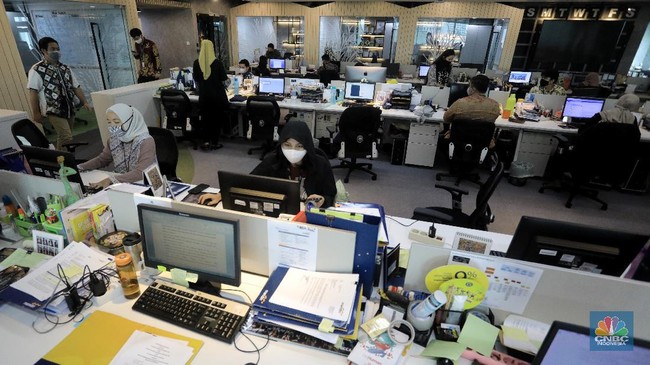
The Consumer Confidence Index (IKK) weakened in May 2026, falling to 120.9, its lowest level in seven months since September 2025 when it hit 115 during widespread demonstrations across the country. While the figure from Bank Indonesia’s Consumer Survey remains in the optimistic zone above 100, the persistent decline, particularly in its main components, signals that the Indonesian economy is under strain, ultimately worrying consumers.
“What is more concerning is not the headline number, but its composition,” said Yusuf Rendy Manilet, Strategic Research Manager at the Center of Reform on Economics (CORE) Indonesia.
Rendy explained that the largest component declines occurred in perceptions of job availability and current economic conditions, reflecting public assessment of income levels and durable goods purchases. The Job Availability Index fell to 105.0 in May 2026 from 108.8 in April, a drop of 3.8 points, while the Current Economic Conditions Index declined to 112.2 from 116.5.
“At the same time, the portion of household income used to pay instalments has increased, while the portion that can be saved has decreased. This indicates that the pressure is not merely due to price increases, but is beginning to affect the income side and labour market conditions,” Rendy stated.
Because the source of weakness appears to stem from income and employment, Rendy argued that government policy priorities should be directed towards protecting the purchasing power of low-income groups through well-targeted social assistance and increased spending in labour-intensive sectors capable of creating jobs and decent incomes. “In this way, policy not only drives short-term consumption but also repairs the foundation of people’s income,” he stressed.
A similar view was shared by Ronny P Sasmita, Senior Analyst at the Indonesia Strategic and Economics Action Institution. He considers the IKK decline a signal that households are beginning to curb spending due to real income pressure and future uncertainty. This situation, he said, requires the government to disburse assistance in the form of incentives to the public, especially vulnerable groups and the lower-middle class who are the main drivers of household consumption.
“The most effective incentive right now is one that directly increases the purchasing power of vulnerable groups and the lower-middle class, because they have a high marginal propensity to consume. This means almost every rupiah given is almost certainly spent immediately and moves the economy,” Ronny said. In the short term, he noted, incentives could take the form of more targeted, sustainable, and price-pressure-responsive direct cash assistance. Additionally, electricity tariff discounts for low-power customers, such as 450 VA and 900 VA, need to be rolled out again.
“I actually see stronger policy space in food price intervention and supply stabilisation. Because the reality on the ground is that the greatest pressure on purchasing power comes from food inflation. So market operations, strengthened distribution, and logistics cost subsidies could be far more effective in maintaining purchasing power than large but temporary cash transfers,” he explained.
Beyond demand-side assistance, Deni Friawan, Senior Researcher in the Economics Department at the Centre for Strategic and International Studies (CSIS), believes the government must also redesign incentives that can boost the supply side. Supply-side incentives, he said, relate to encouraging job creation, from cash-for-work labour-intensive programmes to apprenticeship schemes like last year’s national apprenticeship programme, which was fully funded by the government.
“That provides two benefits. They gain experience, and they also get money to help their purchasing power. So the demand side benefits, and the supply side also adds production capacity. That, in my view, is the approach if we really want to not just help from the demand side,” Deni asserted.
As is known, the Indonesian government is currently formulating incentives to support public purchasing power, especially to sustain the economic viability of the middle class, many of whom fell into lower categories last year. A Mandiri Institute report titled ‘Demographic Insights: Middle Class Dynamics in 2025’, released in February 2026, showed the middle-class population shrank by another 1.2 million people, from 47.9 million in 2024 to 46.7 million throughout last year.
Acting Director General of Economic and Fiscal Stability at the Ministry of Finance, Ferry Ardiyanto, said the government will continue efforts to ensure the middle-class group remains resilient against various economic challenges. He confirmed this will be done through optimising fiscal policy, focused not only on economic growth but also on maintaining the economic resilience of the public.
“We will do all this so that the middle class remains middle class or moves up a class, and does not fall into the aspiring middle class,” Ferry said during a working meeting with House of Representatives Commission XI at the parliament building in Senayan, Jakarta.
Commission XI Chairman Mukhamad Misbakhun also revealed that the government is currently formulating stimulus measures for the public, particularly following the increase in the price of Pertamina’s RON 92 fuel, Pertamax. “It is being formulated. We discussed it there,” Misbakhun said when asked about communication with the government to anticipate inflation resulting from the Pertamax price hike.