
Economy Pressured by Global Situation, INDEF Advises Government to Improve Domestic Policies
The Institute for Development of Economics and Finance (INDEF) has advised the government to immediately evaluate overlapping domestic policies amid the increasingly heavy pressure of the global economy on Indonesia. Fiscal flexibility and rupiah exchange rate stability are considered to be continuously eroded due to domestic policy responses that are less credible and lack technocratic synchronisation between ministries.
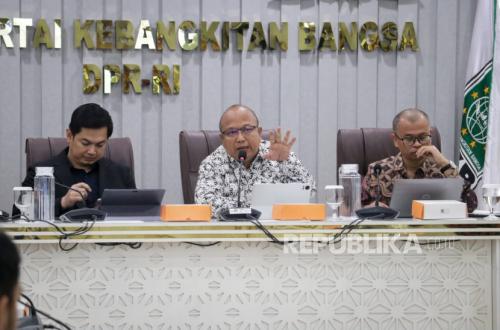
“The combination of a rising global uncertainty index and negative sentiment from the domestic market is now beginning to have a real impact on net foreign capital outflow from Government Securities (SBN) instruments and the stock market. This condition is feared to disrupt the foundation of the national manufacturing sector due to the ballooning cost of imported raw materials,” said INDEF Senior Researcher Tauhid Ahmad during a PKB Fraction Discussion titled ‘Weakening Rupiah Threatens Economic and Banking Stability: Assessing the Readiness of BI and LPS’, at the Parliament Building, Thursday (18/6/2026).
Tauhid revealed that the government can no longer merely use the geopolitical escalation in the Middle East and the tight monetary policy of the United States Central Bank (The Fed) as the sole reason for the weakening of macro indicators. According to him, uncertainty in domestic regulatory governance actually worsens the perception of investment risk in the eyes of international business players.
“External turmoil is a certainty, but the confusion of domestic policy is a matter of choice that can be fixed. Our governance score, which continues to be pressured, reflects the loss of regulatory consistency. When the world is uncertain, investors seek legal certainty and credible policy technocracy, not ever-changing regulatory experiments,” he said.
He noted the existence of contradictory policy anomalies. On one hand, Bank Indonesia (BI) aggressively raised the BI Rate to 5.5 percent and boosted the yield on Bank Indonesia Rupiah Securities (SRBI) to 6.9 percent in order to attract short-term capital. On the other hand, the yield on SBN is actually held at around 6.7 percent.
“This strategic imbalance is risky. Foreign liquidity ultimately only circulates in BI’s short-term instruments to seek quick profits, while our capital market and state bonds actually experience a drying up of capital because they are abandoned by investors. The real sector does not receive long-term productive fund flows,” he said.
In terms of budget resilience, the national fiscal position is also facing severe challenges due to the ballooning cost of energy subsidies and compensation, which reached Rp 203.7 trillion as of May 2026, equivalent to 45.6 percent of the state budget ceiling. The pressure is estimated to soar beyond Rp 500 trillion by the end of the year in order to prevent a rise in fuel prices for the public.
This runs in parallel with the widening of the budget deficit as of May 2026 to a level of 0.70 percent of GDP, due to early spending commitments for new programmes such as Free Nutritious Meals (MBG) and other programmes.
“The government must be disciplined in safeguarding the state budget. If all new programmes are forced to run aggressively at the start without considering tax revenue realisation, our fiscal deficit risks breaching the psychological limit of 2.5 percent, even the legal safe limit of 3 percent. New debt drawn to cover this deficit is very expensive amid the current high interest rate trend,” he said.