
Economists Say Rupiah Could Rebound Against Dollar, Here Are the 3 Conditions!
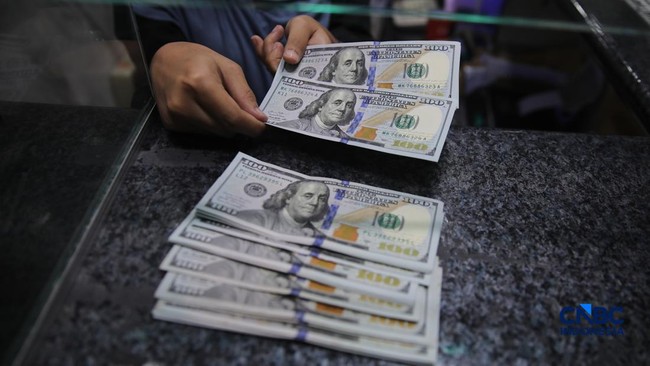
The Rupiah exchange rate continued to weaken during Wednesday’s trading, reaching Rp17,925/US$ by 11:00 WIB, according to Refinitiv data. This represents the worst level for the Rupiah against the greenback in history. After breaching the psychological level of Rp17,900/US, thecurrencyisnowapproachingthenextpsychologicalthresholdofRp18, 000/US.
Josua Pardede, Chief Economist at Permata Bank, acknowledged that the depreciation to around Rp17,900 reflects market pressures stemming from both global and domestic factors, rather than mere seasonal trends. “The most dominant global sentiment still stems from uncertainty regarding the US-Iran conflict, energy supply risks through the Strait of Hormuz, persistently high oil prices, and the demand for the US Dollar as a safe-haven asset,” Pardede explained on Wednesday.
On the domestic front, Pardede noted that the pressure on the Rupiah is exacerbated by a weakening trade surplus buffer. The trade surplus for April 2026 fell sharply to approximately US$ 90 million, down from US$ 3.32 billion in March. Consequently, the cumulative surplus for January–April 2026 dropped from US$ 11.07 billion to US$ 5.64 billion. This indicates that the supply of dollars from goods trade has significantly thinned. As imports grow—particularly for raw materials, energy, and capital goods—the demand for dollars increases, while export-driven dollar inflows are no longer sufficient to balance the market. “The Rupiah is weakening not because Indonesia is facing an immediate trade deficit, but because the quality of the surplus has weakened and is no longer strong enough to act as an exchange rate buffer,” he added.
Regarding the potential for appreciation, Pardede remains realistic, viewing it as a limited strengthening or gradual stabilisation. He stated that the Rupiah could return to the Rp17,600 to Rp17,750 range if three conditions are met: first, a clearer decline in oil prices due to progress in US-Iran peace negotiations; second, the return of foreign capital inflows into SBN (Government Bonds) and SRBI (Bank Indonesia Certificates); and third, the government providing convincing fiscal signals. However, if oil prices rise, peace talks stall, the US Dollar strengthens, and investors remain wary of fiscal and external balance risks, the Rupiah could remain stuck between Rp17,800 and Rp18,000.
Surya Wijaksana, Economist at UOB Kay Hian, added that the weakening is influenced by the thinning trade surplus, which could lead to a worsening current account deficit. While a recovery remains possible once seasonal pressures subside, he warned of risks from more hawkish global monetary policies, noting that both the ECB and the Fed are likely to maintain a hawkish stance.