
Economists Say Market Certainty Is Key to National Milk Self-Sufficiency
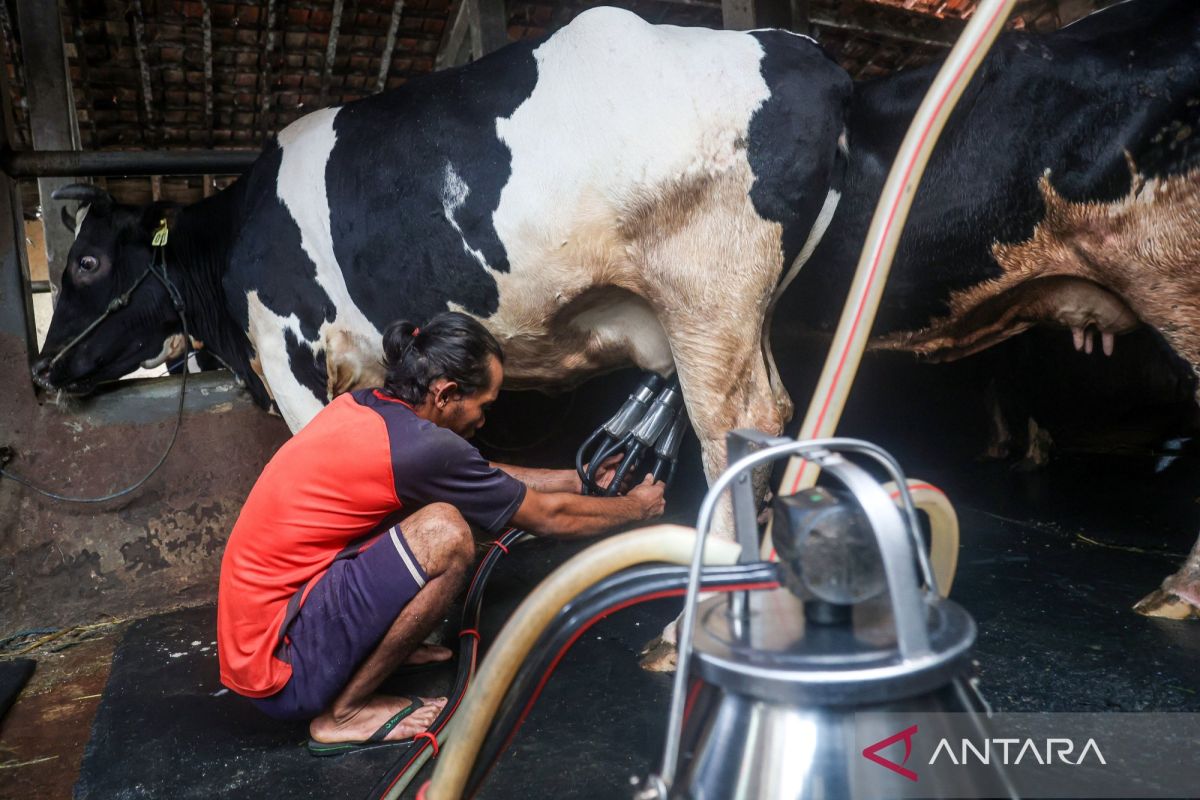
Economists have assessed that the government’s efforts to achieve milk self-sufficiency require strengthening market certainty so that fresh milk produced by farmers is absorbed by the milk processing industry.
“The most important thing here is that the government needs to guarantee absorption certainty, create a decent reference price, and also strengthen the distribution system for local dairy farmers’ milk, as well as encourage long-term contracts between the milk processing industry and local farmers,” said Isnawati Hidayah, a researcher at the Center of Economic and Law Studies (Celios), in Jakarta on Tuesday.
According to Isnawati, with such market certainty, farmers will be more courageous in increasing their dairy cow population and milk production because they have a guarantee that their output can be absorbed by the industry. “That way, at least when local farmers expand, for instance, they truly have a good supply system so that all the milk they produce can be absorbed, both in terms of quantity and quality,” she said.
Isnawati assessed that Indonesia’s dependence on milk imports is not only caused by production factors but also by the not yet optimal integration of the domestic dairy industry from upstream to downstream. She noted that local farmers still face various obstacles, ranging from small-scale businesses and low productivity to varying milk quality, limited access to financing, unstable feed quality, and outdated technology. Furthermore, the bargaining position of farmers is still considered weak against the milk processing industry, which has the flexibility to choose raw materials based on quality standards or to switch to imported raw materials when domestic supply cannot meet demand.
Meanwhile, Eliza Mardian, a researcher at the Center of Reform on Economics (CORE) Indonesia, said that farmers actually have the desire to increase production, but business expansion will be difficult without certainty that the processing industry will absorb their fresh milk. “It is not that local farmers do not want to expand their businesses, but even if they increase milk production, it will not be absorbed if the milk processing factories do not accept it,” Eliza stated.
Echoing Isnawati, she stressed that market certainty is a crucial factor in encouraging farmers to increase production, so that Indonesia’s dependence on milk imports can be gradually reduced. “If we want milk self-sufficiency, farmers must be given market certainty regarding who will absorb their fresh milk with all its standardisation requirements. Downstream, the milk processing industry must be obliged to absorb farmers’ fresh milk,” she said.
The Coordinating Ministry for Food is currently accelerating the preparation of an integrated national milk independence roadmap from upstream to downstream to reduce import dependence while strengthening food security based on animal protein. The government considers strengthening production, research, downstream processing, and cross-sector collaboration as essential parts of building the national dairy ecosystem. Coordinating Deputy Minister for Food Hanif Faisol Nurofiq previously stated that Indonesia currently only produces around 1 million tonnes of milk per year, while national demand reaches approximately 4 million tonnes per year, meaning almost 80 percent of the country’s needs are still met through imports.