
Economists Outline Major Tasks for Suahasil: From Fiscal Management to Public Purchasing Power
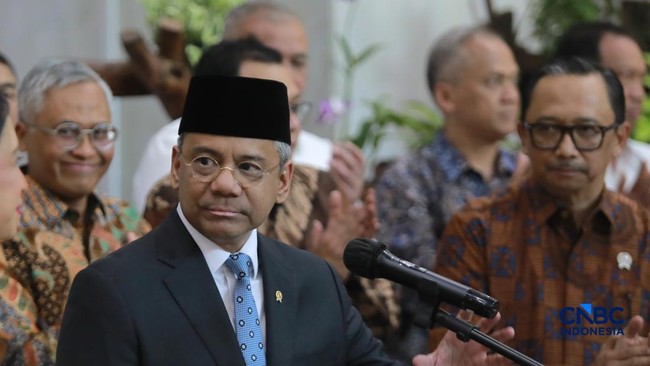
Jakarta, CNBC Indonesia - Suahasil Nazara has been officially inaugurated by President Prabowo Subasting at the State Palace on Monday (14/09/2026), replacing Purbaya Yudhi Sadewa as Finance Minister.
Economists view this sudden change as a signal of fiscal policy continuity, though the challenges facing Suahasil are significant due to the government’s increasingly limited fiscal space.
Irman Faiz, Lead Economist at PT Bank Danamon Indonesia Tbk, believes Suahasil’s extensive experience within the Ministry of Finance serves as vital capital for maintaining the credibility of State Budget (APBN) management. He noted that her technocratic background could minimise transition risks and ensure institutional continuity in fiscal management.
“Overall, we expect fiscal policy to continue supporting growth while maintaining the 3% fiscal rule as the primary anchor of credibility,” Faiz told CNBC Indonesia on Monday.
Similarly, UOB Kay Hian economist Surya Wijaksana stated that Suahasil’s credible track record will help maintain Indonesia’s fiscal policy stability. “I believe Indonesia’s fiscal policy will remain stable, generating positive sentiment in the financial markets,” he remarked.
Bank Permata economist Josua Pardede also noted that the appointment offers advantages in terms of policy continuity, as Suahasil possesses deep expertise in budget preparation, state revenue, expenditure, financing, and inter-agency fiscal coordination. “The main advantage is a relatively small transition period while the government is executing the 2026 Budget and preparing the 2027 Budget,” said Josua.
Despite the smooth transition, Josua believes Suahasil’s future challenge lies in balancing economic growth, funding priority programmes, increasing state revenue, and maintaining fiscal credibility. This is particularly critical given the limited fiscal space. “The 2027 Draft State Budget is designed with revenues of Rp3,426 trillion, expenditure of Rp4,097.2 trillion, and a deficit of 2.40% of GDP, leaving relatively little room for policy error,” Josua added.
He suggested that Suahasil must ensure fiscal policy supports the economy without sacrificing budgetary discipline. Meanwhile, Faiz noted the challenge of balancing ambitious growth agendas with tightening fiscal constraints. “We maintain a more conservative growth forecast of 5.1% and project a deficit of around 2.75% of GDP, which remains within the 3% statutory limit,” Faiz stated, adding that the government must be increasingly selective in its spending priorities.
Regarding Suahasil’s challenges, Surya added that they extend beyond fiscal management to domestic issues directly affecting public purchasing power, specifically regarding employment, inflation, and basic commodity prices.
Global economic uncertainty also presents a major hurdle. David Sumual, Chief Economist at Bank Central Asia (BCA), noted that high oil prices, inflation caused by prolonged El Niño, and rising global interest rate trends are significant challenges that must be anticipated.
Following her inauguration, Suahasil stated that her appointment reflects President Prabowo Subianto’s trust in her to serve as Finance Minister until the end of the Red and White Cabinet’s 2024-2029 term. She emphasised that her primary focus is to maintain the health and credibility of state finances, ensuring the State Budget remains robust enough to support the government’s priority programmes.
Source: jawawa.id (https://jawawa.id/newsitem/economists-outline-major-tasks-for-suahasil-from-fiscal-management-to-public-purchasing-power-1789387036)
Originally published by CNBC Indonesia (https://www.cnbcindonesia.com/news/20260914175048-4-767835/ekonom-beberkan-pr-besar-suahasil-dari-fiskal-hingga-daya-beli-warga), translated from Indonesian