
Economists Explain Why Pertamax Price Hike Is Unavoidable
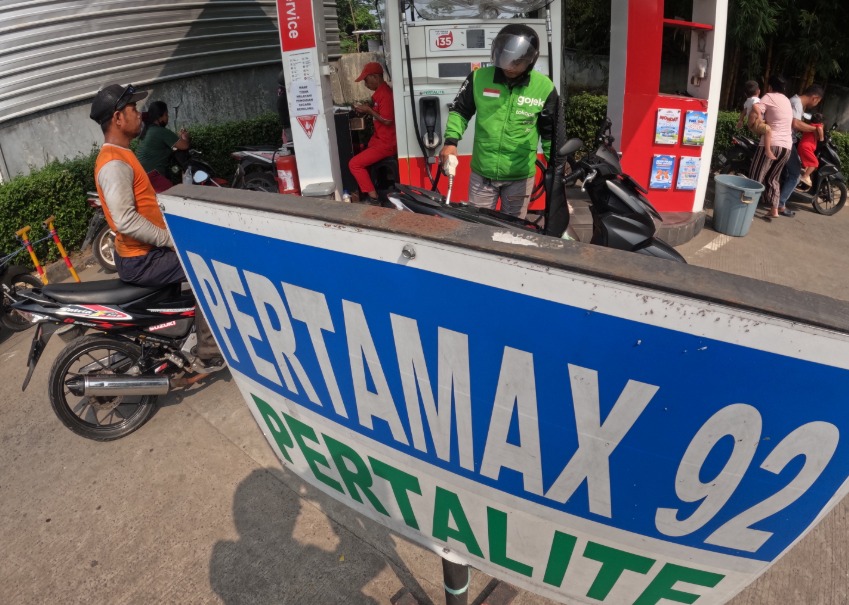
A number of economists believe the government’s decision to adjust the price of RON 92 fuel (Pertamax) to Rp16,250 per litre was unavoidable. Hendry Cahyono, an economist from Surabaya State University (Unesa), stated that for several months Pertamina had been holding the non-subsidised fuel price below its economic cost. “Eventually, after being held for some time, the non-subsidised fuel price could no longer be restrained and had to be released to follow the market mechanism. That is why the current increase is quite high. Pertamax had to go up,” Hendry said when contacted on Friday (12/6/2026).
Hendry explained that Pertamina had been using corporate bridging funds to keep Pertamax below its economic price. However, these bridging funds are essentially a temporary instrument to cushion price spikes so they are not immediately felt by the public. As the rupiah exchange rate and global oil prices continued to climb, the room to maintain this policy became increasingly narrow. “Pertamina’s bridging funds are also limited. Because Pertamax is a non-subsidised fuel. There is no state budget subsidy in it. So it purely follows the market price,” he clarified.
He added that if Pertamina continued to absorb the price difference without adjustment, it could erode the company’s profitability. The impact would not only affect dividend payments and the company’s contribution to the state, but also investor perception and the assessment of Pertamina’s financial performance by rating agencies. “Investors look at profit ratios and financial performance. If it keeps losing money, who would want to invest?” he said. In the short term, Hendry believes the price adjustment is a more realistic step than continuously expanding the bridging funds, as the burden borne by Pertamina will ultimately affect state finances and the health of the state-owned energy corporation.
Meanwhile, energy economist from Padjadjaran University (Unpad), Yayan Satyaki, said the weakening rupiah and rising global oil prices forced Pertamina to continuously cover the price gap through bridging funds. This condition caused the national energy supply cost to increase because the fuel pricing formula is heavily dependent on world oil prices and the rupiah exchange rate. “Because if we use the formula in the Minister of Energy and Mineral Resources Decree Number 19 of 2019, the price reference uses MOPS (Mean of Platts Singapore). That is very dependent on the rupiah exchange rate against the dollar,” he stated.
According to Yayan, for the past few months the public had been enjoying a relatively lower Pertamax price because Pertamina was holding back the increase through the bridging fund mechanism. However, this situation cannot continue indefinitely because the economic price of fuel keeps moving in line with global market developments. Based on his calculations using the formula referencing MOPS Singapore and the exchange rate, the economic price of Pertamax currently ranges from Rp14,150 to Rp16,650 per litre. Therefore, the new Pertamax price set by the government falls within that calculation range. “The government set it at around Rp16,250. So if you use the ESDM Ministerial formula, the price is indeed around there,” he said.
Yayan explained that the bridging funds used to hold down prices do not eliminate the cost burden, but merely postpone the payment. The price difference absorbed by Pertamina will eventually enter the compensation mechanism that must be accounted for by the government. “If now Pertamina has a claim that it will later receive compensation, that compensation will certainly be billed to the government,” Yayan said. Therefore, according to Yayan, maintaining the Pertamax price far below its economic price could potentially reduce state revenue from Pertamina. On the other hand, Pertamina’s ability to continuously absorb the price gap also has limits because the company must consider its financial health to maintain investor confidence. “If investors see Pertamina’s financial condition deteriorating, interest in investing in Indonesia’s oil and gas sector will also decline,” he stressed.