
Economists Applaud BI's Decision to Hold Interest Rate
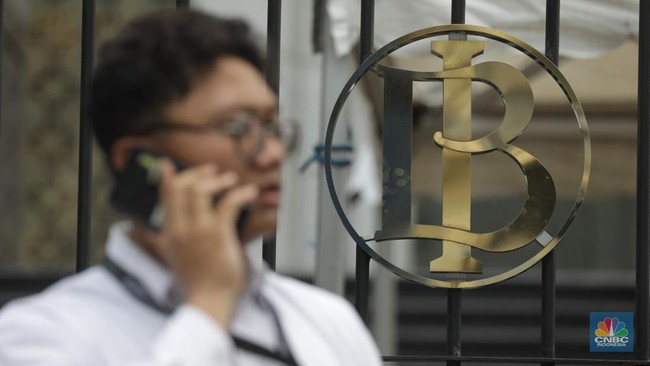
Jakarta, CNBC Indonesia – Bank Indonesia’s (BI) Board of Governors meeting has decided to maintain the BI-Rate at 5.75%, the Deposit Facility rate at 4.75% and the Lending Facility rate at 6.50%. Commenting on the move, Bank Permata Chief Economist Josua Pardede said the decision to hold the BI-Rate is a positive step to support rupiah stability while safeguarding economic growth momentum.
“In line with our forecast, BI maintained the BI-Rate at 5.75% at the July 2026 Board of Governors meeting, even though market expectations pointed to a 25 bps increase to 6.00%,” Josua told CNBC Indonesia, quoted on Friday (24/7/2026).
According to him, the central bank reaffirmed its commitment to monitor inflation pressures amid persistent external risks, while continuing to support domestic economic growth. BI also indicated that the cumulative 100 bps of policy rate increases carried out through May–June 2026 are, for now, considered sufficient to safeguard rupiah stability and anchor inflation expectations amid rising global uncertainty, particularly the escalating geopolitical tensions in the Middle East.
“The future direction of the BI-Rate will very much depend on developments in global and domestic uncertainty, which is likely to persist through the remainder of 2026. We believe BI’s policy rate decisions will remain highly dependent on both global and domestic conditions,” he asserted.
Meanwhile, on the external front, pressures are mounting as geopolitical tensions in the Middle East flare up again, pushing global oil prices back above US$90 per barrel and reviving concerns about global inflation pressures. Although the latest US inflation data for June 2026 came in lower than market expectations, prompting investors to scale back expectations of a faster and more aggressive Fed rate hike.
“We see this moderation as temporary. The softer inflation was mainly driven by falling energy prices, in line with the decline in global oil prices during June 2026. Given that oil prices have now rebounded sharply, inflation pressures could resurface in the coming months. Overall, we assess global risks in July 2026 to be higher than in June 2026. Moreover, the Fed retains a hawkish stance, with persistent inflation pressures remaining its primary concern,” Josua explained.
On the domestic front, several developments provide positive support. S&P’s decision to affirm Indonesia’s credit rating with a stable outlook has strengthened investor confidence and supported foreign capital inflows. Meanwhile, the government’s fiscal performance in the first half of 2026 indicates the fiscal deficit remains well under control, although the fiscal outlook ahead will still depend on developments in global oil prices and the rupiah exchange rate.
Nevertheless, the relatively prudent fiscal position has eased concerns about the risk of twin deficits, namely the fiscal deficit and the current account deficit. The rupiah strengthened to Rp17,885 per US dollar on 21 July 2026, after weakening since late June 2026 due to renewed conflict in the Middle East and stronger market expectations of a Fed rate hike.
“Our base case still projects BI to maintain the BI-Rate at 5.75% through the end of 2026. That said, we do not rule out additional monetary tightening should global or domestic conditions deteriorate further. In our negative scenario, the BI-Rate could rise to 6.50% if global conditions deteriorate significantly beyond the pressures seen in the first half of 2026,” he said.
In Josua’s assessment, the cumulative 100 bps of BI-Rate increases implemented through May–June 2026 already reflect BI’s anticipation of a potential 25 bps Fed rate hike at the end of this year, with a higher probability of occurring in the fourth quarter of 2026.
“In other words, BI has acted pre-emptively. If those expectations materialise without further deterioration in global conditions, the probability of an additional BI-Rate hike could decline,” he concluded.
Echoing Josua, Bank Tabungan Negara (Persero) macro economist Myrdal Gunarto said the BI-Rate was held at 5.75% in line with expectations. According to him, the decision is positive for the Indonesian economy, particularly in giving room for the real sector to accelerate once again.
So overall, BI’s policy remains accommodative to support the economy, both from the real sector and the financial and banking sectors, to continue growing.
Myrdal said this optimism is reflected in recent developments in several indicators, such as the consumer confidence index, the durable goods purchases index, the retail goods sales index, and the manufacturing PMI. Thus the trend of Indonesian economic growth accelerating more aggressively above 5.15% this year will continue.
“So, even though the BI-Rate is unchanged, we see Bank Indonesia’s monetary ammunition to safeguard rupiah stability and the prices of government bonds (SUN) and other instruments as highly robust. That can be seen from the recent heavy inflows from abroad via SRBI. Indonesia’s foreign exchange reserves also increased last month. So conditions are solid in terms of domestic monetary ammunition,” Myrdal explained.
Moreover, with Indonesia’s economic fundamentals proving resilient amid global shocks, plus the recognition of a BBB rating with a stable outlook, and the reality that government bond yields (in line with SRBI yields) remain above 7%, global fund inflows will continue to enter the Indonesian SUN market. If global pressures subside, Indonesian bond prices will return to a strengthening trend.
Meanwhile, if external pressures intensify, global investors will still adopt a ‘buy on weakness’ stance given the attractive yields, so the rise in yields will be limited, less than 5 bps as seen today (even as US Treasury yields rise). The Indonesian 10-year government bond yield remains capped with resistance at 7.31%, with the yield gap versus the 10-year US yield tending to remain attractive at more than 220 bps. Foreign ownership of SUN is also positive year to date.
“As for the exchange rate against the US dollar, we see the resistance level at Rp17,999 remains strong at present, because the July trade balance was better than June’s (in line with cheaper imported oil prices), and global fund flows have gradually returned to the Indonesian stock market (after the S&P decision, there was a net buy position of US$110.90 million during 16–21 July 2026), the peak of domestic forex demand has also passed (particularly for dividend transfers to foreign investors), plus there has been strong foreign inflows via SRBI this year,” he concluded.
For the record, BI maintained the BI-Rate at 5.75%, the Deposit Facility rate at 4.75% and the Lending Facility rate at 6.50%. Bank Indonesia has broadened its policy incentives and a number of other measures to boost inflows of foreign portfolio investment, strengthen rupiah exchange rate stability, accelerate the deepening of the money and foreign exchange markets (PUVA), and enhance liquidity and reduce liquidity segmentation in the money and banking markets.
The BI-Rate decision and these other policies form an integrated part of Bank Indonesia’s policy mix, which remains consistent in further strengthening rupiah exchange rate stability amid persistently high global uncertainty, as well as maintaining inflation in 2026 and 2027 within the 2.5±1% target range set by the Government (pro-stability).
Source: jawawa.id (https://jawawa.id/newsitem/economists-applaud-bis-decision-to-hold-interest-rate-1785289892)
Originally published by CNBC Indonesia (https://www.cnbcindonesia.com/market/20260728185807-17-754534/ekonom-apresiasi-langkah-bi-pertahankan-suku-bunga), translated from Indonesian